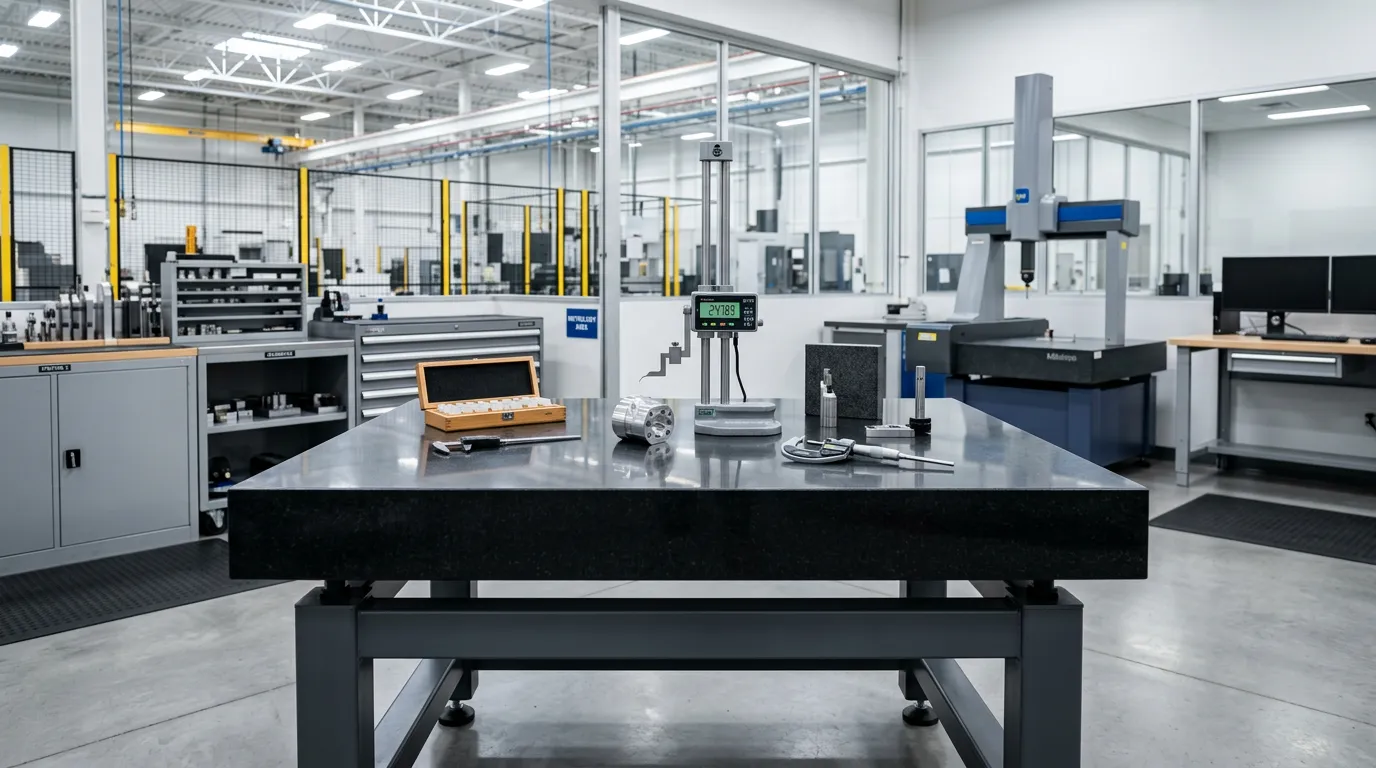
Expert Surface Plate Calibration, Addison
On-site [granite surface plate calibration services](/services/) are routinely conducted across Addison, [Illinois](/illinois-surface-plate-calibration/), ensuring local manufacturing facilities maintain metrological accuracy without requiring off-site shipment. This A2LA-accredited service adheres to stringent ISO/IEC 17025 standards, providing precise flatness verification directly within the operational environment.
Precision calibrations are performed utilizing Hilger-Watts autocollimators, with results traceable to NIST, and any necessary resurfacing employs the wet lap method to eliminate airborne silica dust. All required certification documentation is furnished before the calibration technician departs the facility on the same day.
The Village of Addison, nestled within DuPage County in Chicago’s western suburbs, represents a significant hub for diverse manufacturing and industrial operations across the broader [Chicagoland area](/chicago-surface-plate-calibration/). Its strategic location, with proximity to major transportation arteries like I-355, I-290, and I-390, facilitates a robust industrial presence. Within these facilities, which range from precision machining shops to general fabrication plants, the accuracy of dimensional measurements is paramount, often influencing product quality, compliance, and operational efficiency.
Central to many of these metrology processes are granite surface plates, serving as the stable reference plane for inspection and layout tasks. However, the continuous use of these foundational tools, involving repeated contact with components, fixtures, and measurement devices, inevitably leads to localized wear and degradation of their critical flatness. Such wear, particularly in high-traffic zones, compromises measurement integrity, potentially causing parts to be rejected incorrectly or, more critically, accepted when they are out of tolerance. Regular [flatness verification](/services/) is therefore an indispensable practice to maintain the reliability of quality control systems.
Precision [calibration of these granite surface plates](/services/), employing instruments like Hilger-Watts autocollimators and often following methodologies such as the Moody Method, restores confidence in measurement results. This service ensures adherence to stringent specifications like GGG-P-463C and ASME B89.3.7, with all measurements traceable to NIST. For plates found to be out of tolerance, a wet lap resurfacing process can be performed on-site, effectively restoring the plate’s designated Grade (AA, A, or B) without generating airborne silica dust, thereby maintaining a clean operational environment. On-site [service models](/about/) are particularly beneficial in dynamic manufacturing settings across Addison and DuPage County, eliminating the logistical challenges and downtime associated with shipping large, heavy metrology equipment.
Upon completion of the calibration or resurfacing, comprehensive documentation is supplied, including a detailed calibration certificate that affirms NIST traceability, a flatness map illustrating specific data point measurements, and a clear classification of the surface plate’s current grade. This documentation is crucial for facilities maintaining ISO/IEC 17025 or [A2LA accreditation](/about/), providing verifiable proof of metrological control. Such meticulous attention to the precision of surface plates supports the continued accuracy and quality output demanded by Addison’s diverse industrial landscape.
Improving Precision for Addison Industry
Statewide Service, Prompt Calibration
Rapid on-site granite surface plate calibration service is provided to facilities throughout Addison, Illinois, and the wider manufacturing hubs of the Chicago metropolitan area. Scheduling for these precision metrology services is frequently accommodated on an expedited basis, minimizing operational downtime.
A2LA Certified, NIST Traceable Calibration
Measurements for granite surface plates in the Addison industrial corridor are conducted to exacting standards, with full ISO/IEC 17025 accreditation, A2LA certification, and NIST traceability governing every flatness verification.
Silica-Free Wet Lap Resurfacing
The wet lap resurfacing method restores out-of-tolerance granite surface plates to their specified flatness without generating harmful silica dust. This specialized process ensures a cleaner working environment for Addison facilities, preventing airborne particulate common with traditional dry grinding.
Frequently Asked Questions
Why is consistent support crucial for a granite surface plate?
Consistent and proper support is crucial for a granite surface plate because improper support can induce deflection and distortion, negatively affecting its flatness. The supports should be placed at specific nodal points to minimize sag and maintain the plate’s intended geometry. This ensures the inherent stability of the granite is fully utilized.
How does ISO/IEC 17025 relate to A2LA accreditation for calibration?
A2LA accreditation is granted to laboratories that demonstrate competence to perform specific tests or calibrations in accordance with ISO/IEC 17025. This international standard outlines the general requirements for the competence, impartiality, and consistent operation of laboratories. Therefore, A2LA accreditation is a recognized demonstration of compliance with ISO/IEC 17025.
What is the significance of ‘repeat reading’ measurements during calibration?
Repeat reading measurements assess the localized flatness and stability of specific areas on the surface plate, particularly those prone to heavy use. They indicate the plate’s ability to consistently provide the same measurement result at a given point. This parameter is critical for identifying potential high spots or depressions that could affect gauge block or height gauge applications.
How does a resurfaced plate typically affect its subsequent calibration?
A resurfaced plate will typically show significantly improved flatness during its subsequent calibration, often restored to its original tolerance grade or better. The calibration after resurfacing verifies the success of the material removal process. This process re-establishes the plate’s metrological foundation.