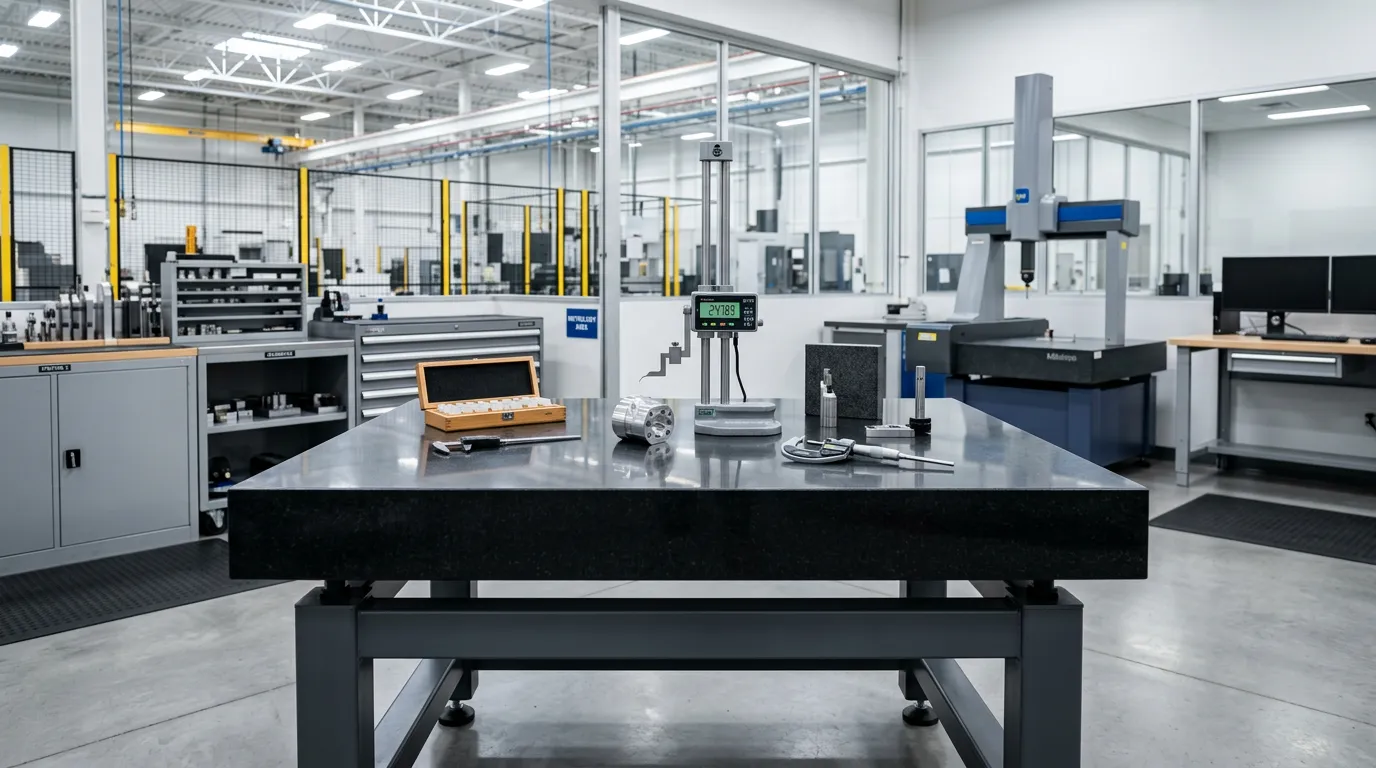
Precision Calibration for Granite Plates, Wheeling
For entities operating in Wheeling, Illinois, ISO/IEC 17025 accredited [granite surface plate calibration](/services/) is performed directly on-site. Precision flatness verification is conducted using advanced Hilger-Watts autocollimators, ensuring accurate measurements without requiring off-site transport from the facility.
This direct facility service encompasses [wet lap resurfacing](/services/) for plates requiring restoration, a method that minimizes airborne particulate during the process. Comprehensive, NIST-traceable documentation, including calibration certificates, is immediately furnished upon service completion, negating any delay or shipping logistics.
Within the dynamic industrial framework of the [Chicago metropolitan area](/chicago-surface-plate-calibration/), Wheeling, Illinois, and its surrounding communities in Cook County, host a diverse array of manufacturing and precision engineering operations. The region’s strategic location, with access to major transportation arteries and proximity to Chicago Executive Airport, supports a robust ecosystem of fabricators, machinists, and assembly plants. These facilities, spanning various scales and specialties, consistently rely on foundational metrology equipment to uphold the quality and dimensional integrity of their output. The ongoing demand for precision across these varied sectors underscores the critical importance of maintaining accurate measurement standards at every stage of production.
[Granite surface plates](/illinois-surface-plate-calibration/) serve as the fundamental reference plane for countless dimensional inspection and calibration tasks performed daily within these industrial settings. From verifying the accuracy of gages and instruments to ensuring the precise assembly of components, the integrity of these plates is paramount. Over time, constant use, abrasive contact with workpieces, and accidental impacts can degrade a surface plate’s flatness, causing it to deviate from its specified Grade AA, A, or B tolerances. Regular [flatness verification](/services/), conducted in accordance with standards such as GGG-P-463C or ASME B89.3.7, is indispensable for preventing costly measurement errors that could compromise product quality and lead to scrap or rework.
For Wheeling-area manufacturers, the challenges of transporting large, heavy surface plates for off-site calibration can disrupt workflow and incur significant logistical costs. The provision of [on-site calibration services](/services/), utilizing precision autocollimators to perform detailed flatness verification, eliminates these complexities. Measurements are performed directly within the facility, ensuring minimal downtime for critical inspection stations. Documentation, including an [A2LA accredited, ISO/IEC 17025 compliant certificate with NIST traceability](/about/) and a comprehensive flatness map detailing measured data points, is typically provided before the technician departs. Should a surface plate be found out of tolerance, on-site wet lap resurfacing is available to restore its precision, preventing the accumulation of silica dust and extending the operational life of the equipment.
Enhancing Quality for Wheeling Businesses
Servicing Your Area, Fast Turnaround
On-site granite surface plate calibration can be promptly arranged for industrial operations situated in Wheeling, Illinois, and across the broader Illinois manufacturing landscape, removing any need for equipment transport.
NIST Traceable Accuracy Assurance
In the Wheeling, Illinois area, granite surface plate calibration procedures operate under ISO/IEC 17025 accreditation. This framework mandates that all flatness verification measurements yield A2LA certified and NIST traceable results.
Precision Wet Lap Method Used
Precision wet lap resurfacing capabilities are available for out-of-tolerance granite surface plates in the Wheeling area, facilitating flatness restoration while entirely avoiding the airborne particulate associated with dry lapping methods. This process safely returns plates to required GGG-P-463C or ASME B89.3.7 specifications without creating hazardous silica dust.
Frequently Asked Questions
What aspects of surface plate geometry are assessed by ASME B89.3.7 beyond overall flatness?
ASME B89.3.7 specifies acceptable tolerances for parameters such as overall flatness, repeat reading, and local area flatness. These specifications ensure the plate’s suitability for precision measurement tasks across its entire surface. Compliance with these criteria confirms the plate’s conformance to its designated grade.
What are the fundamental differences in tolerance limits between Grade A and Grade B surface plates?
Grade A plates exhibit tighter overall flatness and repeat reading tolerances compared to Grade B plates. This distinction reflects Grade A’s suitability for higher precision inspection and layout work, whereas Grade B is adequate for general workshop applications. The allowable deviation from true flatness is significantly smaller for Grade A surfaces.
What factors might lead to a reduction in the recommended calibration interval for a surface plate?
A reduction in calibration frequency may be necessitated by factors such as high usage volume, exposure to abrasive materials, or significant changes in environmental conditions. Plates used for critical measurements or subject to heavy object placement would also require more frequent verification.
What steps are involved in preparing a granite surface plate for wet lap resurfacing?
Preparation for wet lap resurfacing typically involves thorough cleaning of the plate surface to remove all debris and contaminants. The plate must then be carefully inspected for deep gouges or damage that might require pre-grinding. Proper support and leveling are also critical to ensure a stable base for the resurfacing process.