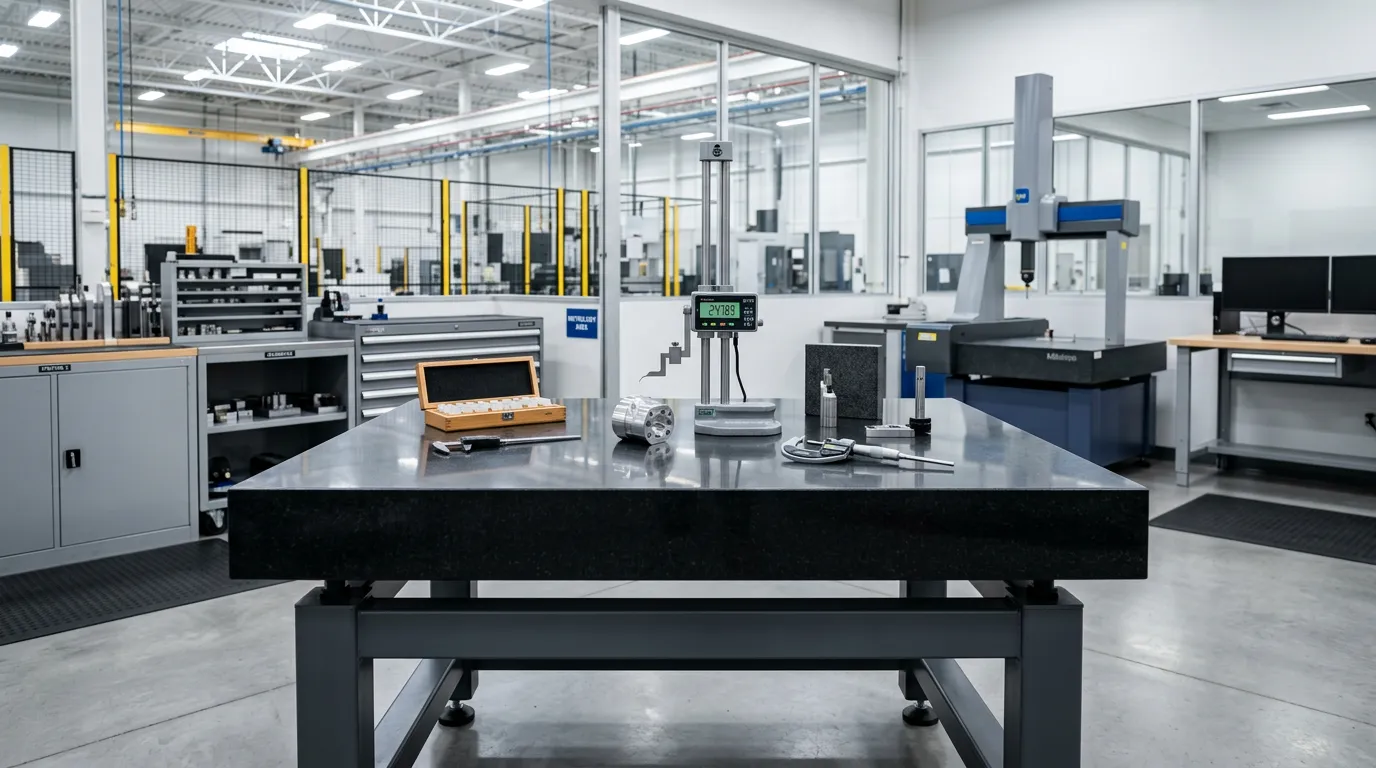
Ensuring Accuracy: Milwaukee Granite Calibration
Granite surface plate calibration, essential for precision manufacturing and quality control, is available on-site for facilities across Milwaukee, [Wisconsin](/wisconsin-surface-plate-calibration/). This critical [service](/services/) is delivered with ISO/IEC 17025 accreditation, guaranteeing metrological rigor and compliance. Flatness verification measurements are precisely executed utilizing advanced Hilger-Watts autocollimators.
All calibration and resurfacing operations are conducted directly at the client’s location, ensuring equipment remains within the production environment and eliminating any need for shipping. When plates fall outside specified tolerances, wet lap resurfacing is performed to restore accuracy, a process that removes material without generating airborne silica dust. Comprehensive, NIST-traceable documentation, including a flatness map and grade classification, is provided before the technician’s departure.
Milwaukee, a critical industrial hub in southeastern Wisconsin, supports a robust manufacturing sector extending across Milwaukee, [Waukesha](/waukesha-surface-plate-calibration/), and [Racine](/racine-surface-plate-calibration/) counties. This diverse economic landscape encompasses facilities specializing in heavy machinery, precision metal fabrication, advanced automation, and component manufacturing. Across these varied operations, the foundational accuracy of measurement equipment is indispensable. Maintaining the integrity of granite surface plates, which serve as the primary reference plane for quality control and inspection, is therefore paramount for ensuring product conformance and operational efficiency within the region’s demanding industrial environment.
The consistent use of granite surface plates within these manufacturing settings inevitably leads to gradual wear, localized impacts, and microscopic abrasions. Over time, these factors can cause significant deviations from a plate’s original flatness specifications, directly affecting the veracity of subsequent dimensional measurements. Regular flatness verification, conducted in accordance with standards such as ASME B89.3.7 and federal specification GGG-P-463C, is essential to confirm continued compliance. Without precise calibration, the accuracy of critical workpiece inspection becomes compromised, potentially leading to increased scrap rates, costly rework, and non-compliance with quality management systems like ISO/IEC 9001.
For operations throughout the Greater Milwaukee metropolitan area, maximizing uptime and streamlining workflow are key considerations. On-site [granite surface plate calibration](/services/) addresses these needs by eliminating the complexities and downtime associated with off-site shipping. Utilizing high-precision instruments like Hilger-Watts autocollimators and applying established methods such as the Moody Method, a detailed flatness map with comprehensive data point measurements is generated. A NIST-traceable calibration certificate, including the determined grade classification (AA, A, B, or Laboratory), is provided directly upon completion of the service. Should a surface plate be found out of tolerance, on-site wet lap [resurfacing](/services/) can effectively restore its flatness to the required Grade B, A, or AA, a process known for safely containing silica dust. This A2LA-accredited and ISO/IEC 17025 compliant service ensures that manufacturers in southeastern Wisconsin can uphold stringent metrology standards with minimal disruption to their production schedules.
Local Industry Relies on Our Calibration
Servicing Your Area, Fast Turnaround
On-site granite surface plate calibration services are dispatched directly to facilities throughout Milwaukee and surrounding Wisconsin industrial areas. This approach eliminates shipping logistics, with scheduling typically arranged promptly to minimize operational downtime.
NIST Traceable Accuracy Assurance
Calibration services delivered throughout the Milwaukee area are performed under strict ISO/IEC 17025 accreditation, providing A2LA certified results with comprehensive NIST traceability for all flatness verification measurements.
Precision Wet Lap Method Used
Granite surface plate flatness can be precisely restored through wet lap resurfacing, a method that inherently prevents the creation of silica dust. This ensures a cleaner operational environment for precision manufacturing and quality control facilities across the Milwaukee metropolitan area.
Frequently Asked Questions
How should surface plate accessories, such as angle plates or parallels, be managed prior to calibration?
Surface plate accessories should be removed from the plate prior to calibration to allow full access to the surface and prevent interference with measurements. Any accessories requiring their own calibration should be handled separately and not be left on the plate during its flatness verification.
What constitutes a valid calibration certificate according to metrology best practices?
A valid calibration certificate must include unambiguous identification of the calibrated item, the calibration date, the procedure used, the measured results, measurement uncertainty, and a statement of conformity to specified tolerances. It also requires identification of the calibration laboratory, technician, and evidence of NIST traceability.
How can the internal stresses within a granite surface plate impact its long-term stability and calibration?
Residual internal stresses in a granite surface plate, typically from its geological formation or manufacturing processes, can slowly release over time, leading to subtle changes in its geometry. While high-quality plates are stress-relieved, any remaining stresses can contribute to long-term drift, necessitating periodic re-calibration to verify flatness.
What specialized equipment might be required for the accurate calibration of extremely large granite surface plates?
Calibrating extremely large plates may require specialized equipment such as long-range laser interferometers, robotic positioning systems for data collection, or multiple synchronized autocollimators. Custom, rigid scaffolding or support structures might also be needed to access all measurement points safely and accurately.
How does uniform wear across a surface plate differ in its impact compared to localized wear patterns?
Uniform wear, though it reduces overall flatness, often maintains the plate’s local area accuracy to a greater extent, making compensatory measurements more feasible. Localized wear, conversely, creates steep depressions or high spots that severely compromise accuracy in specific areas, often necessitating resurfacing to restore utility.
When is resurfacing considered a more appropriate solution than simple calibration for an out-of-tolerance surface plate?
Resurfacing is appropriate when a surface plate’s flatness deviation exceeds its specified tolerance by a significant margin or when deep scratches, gouges, or severe localized wear patterns are present. Calibration only verifies existing conditions, while resurfacing physically restores the plate’s geometry to within tolerance.