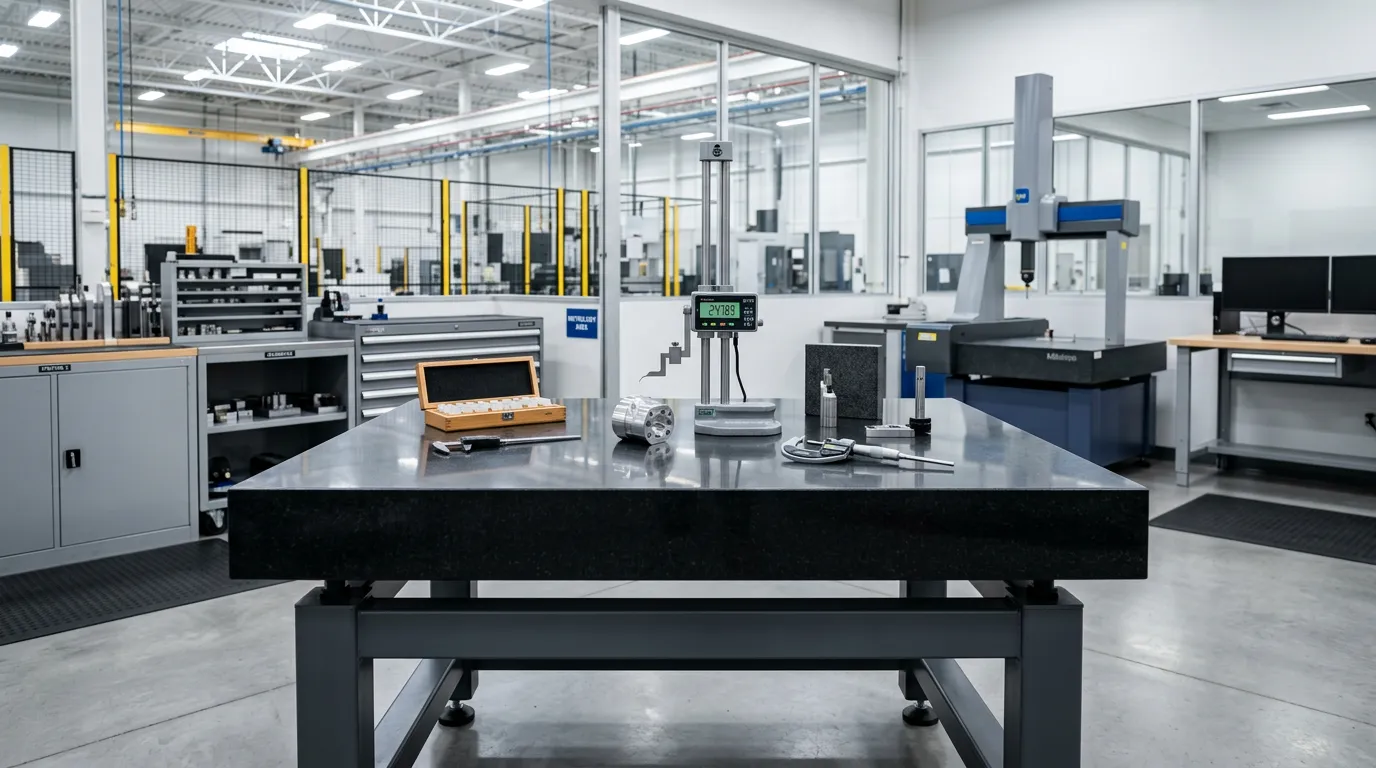
Granite Surface Plate Calibration in Kenosha
Throughout Kenosha, Wisconsin, ISO/IEC 17025 accredited [granite surface plate calibration](/services/) services are performed on-site. Flatness verification is executed using precise Hilger-Watts autocollimators, providing highly accurate metrological assessments for industrial operations across the region.
This on-site calibration strategy eliminates the logistics and expense of shipping large granite plates, with all necessary work completed directly at the facility. Same-day certification documentation, complete with NIST traceability, is always issued. Furthermore, out-of-tolerance plates are meticulously restored through a [wet lap resurfacing](/services/) process, effectively controlling airborne silica dust.
Kenosha, situated in southeastern [Wisconsin](/wisconsin-surface-plate-calibration/) along the Lake Michigan shoreline, maintains a robust industrial footprint. Its strategic location within the heavily trafficked corridor between the metropolitan areas of [Milwaukee](/milwaukee-surface-plate-calibration/) and Chicago makes it a critical hub for various manufacturing operations. Facilities throughout Kenosha County and the surrounding region frequently rely on exacting measurements and stringent quality control protocols to ensure the integrity of their products and processes. Precision metrology forms the bedrock of these operations, necessitating reliable and accurate measurement equipment.
Within these demanding industrial environments, granite surface plates serve as fundamental reference planes for dimensional inspection and layout tasks. Constant use, abrasive material contact, and environmental factors invariably contribute to the gradual wear and degradation of these critical metrology tools. Over time, the uniform flatness of a surface plate can diminish, leading to measurement inaccuracies that compromise product quality and operational efficiency. Regular [flatness verification](/services/) is therefore indispensable for maintaining the accuracy of subsequent measurements performed on these surfaces.
To mitigate disruptions to production schedules, on-site [plate calibration services](/services/) are paramount for facilities in Kenosha. Instead of shipping heavy, delicate surface plates off-site, comprehensive assessments are performed directly at the client’s location, ensuring minimal downtime. Calibration is executed using high-precision instruments, such as Hilger-Watts autocollimators, and often employs methodologies like the Moody Method to ascertain the precise flatness profile. If a plate is found to be out-of-tolerance, [resurfacing](/services/) is performed to restore its required grade, a process that inherently eliminates airborne silica dust, contributing to a cleaner work environment.
Upon completion of calibration and any necessary resurfacing, immediate, traceable documentation is provided. This includes a detailed calibration certificate demonstrating NIST traceability, a comprehensive flatness map illustrating data point measurements, and a clear grade classification (e.g., Grade AA, A, or B, or Laboratory Grade). Adherence to recognized national and international standards, such as GGG-P-463C and ASME B89.3.7, is confirmed, and the entire process is conducted under ISO/IEC 17025 accredited procedures, with A2LA certification guaranteeing the highest levels of technical competence and quality assurance.
Why Kenosha Businesses Prioritize Accuracy
Fast Scheduling Across Kenosha, Wisconsin
For facilities in Kenosha and throughout Wisconsin, on-site granite surface plate calibration is available, eliminating shipping requirements. Prompt scheduling for flatness verification and precision resurfacing procedures is maintained to support uninterrupted production schedules.
Certified to A2LA, Traceable to NIST
For manufacturing facilities throughout Kenosha, Wisconsin, surface plate calibrations are conducted with full A2LA certification and ISO/IEC 17025 accreditation. This ensures measurement results are meticulously traceable to NIST standards, maintaining integrity in metrology practices.
Wet Lap: Optimal Flatness Restoration
Restoration of out-of-tolerance granite surface plates in Kenosha is achieved through wet lap resurfacing, a technique that precisely re-establishes flatness specifications. This process inherently eliminates the production of fine silica dust, contributing to a healthier environment in manufacturing settings.
Frequently Asked Questions
What specific aspects of geometric accuracy, other than overall flatness, might be evaluated during a precision surface plate calibration?
Beyond overall flatness, a precision surface plate calibration might evaluate repeat reading accuracy, local area flatness, and the squareness of adjacent sides or T-slots. These additional parameters provide a more complete assessment of the plate’s suitability for high-accuracy metrology tasks.
How does the method of supporting a large granite surface plate differ from smaller plates during its calibration?
Larger granite surface plates generally require multi-point support systems (e.g., 5 or 6 points) to distribute the immense weight and minimize deflection, as opposed to the standard three-point support for smaller plates. The specific support points are often designated by the manufacturer based on finite element analysis.
What are the implications of continuing to use a surface plate that has been identified as out-of-tolerance?
Continuing to use an out-of-tolerance surface plate can lead to inaccurate measurements, rejection of conforming parts, or acceptance of non-conforming parts. This compromises product quality, increases scrap rates, and poses significant risks to manufacturing consistency and compliance with quality standards.
What information defines the ‘scope of accreditation’ for an ISO/IEC 17025 compliant laboratory performing surface plate calibration?
The ‘scope of accreditation’ explicitly defines the specific calibration activities a laboratory is accredited to perform, including the types of equipment, measurement parameters, ranges, and associated uncertainties. It assures clients of the laboratory’s demonstrated competence for precise surface plate flatness verification.
What is the fundamental principle by which an autocollimator measures angular deviations for flatness verification?
An autocollimator operates by projecting a collimated beam of light onto a highly reflective mirror placed on the surface plate. The reflected beam is then observed, and any angular deviation of the mirror is precisely measured by detecting the shift of the reflected image on a reticle or sensor. This optical method allows for highly sensitive detection of surface variations.
What is the primary objective when calibrating a granite surface plate that has recently undergone resurfacing?
The primary objective when calibrating a recently resurfaced plate is to verify that the resurfacing process has successfully restored the plate’s flatness and repeat reading accuracy to within its specified tolerance grade. This ensures the physical restoration has achieved the necessary metrological performance for critical measurements.