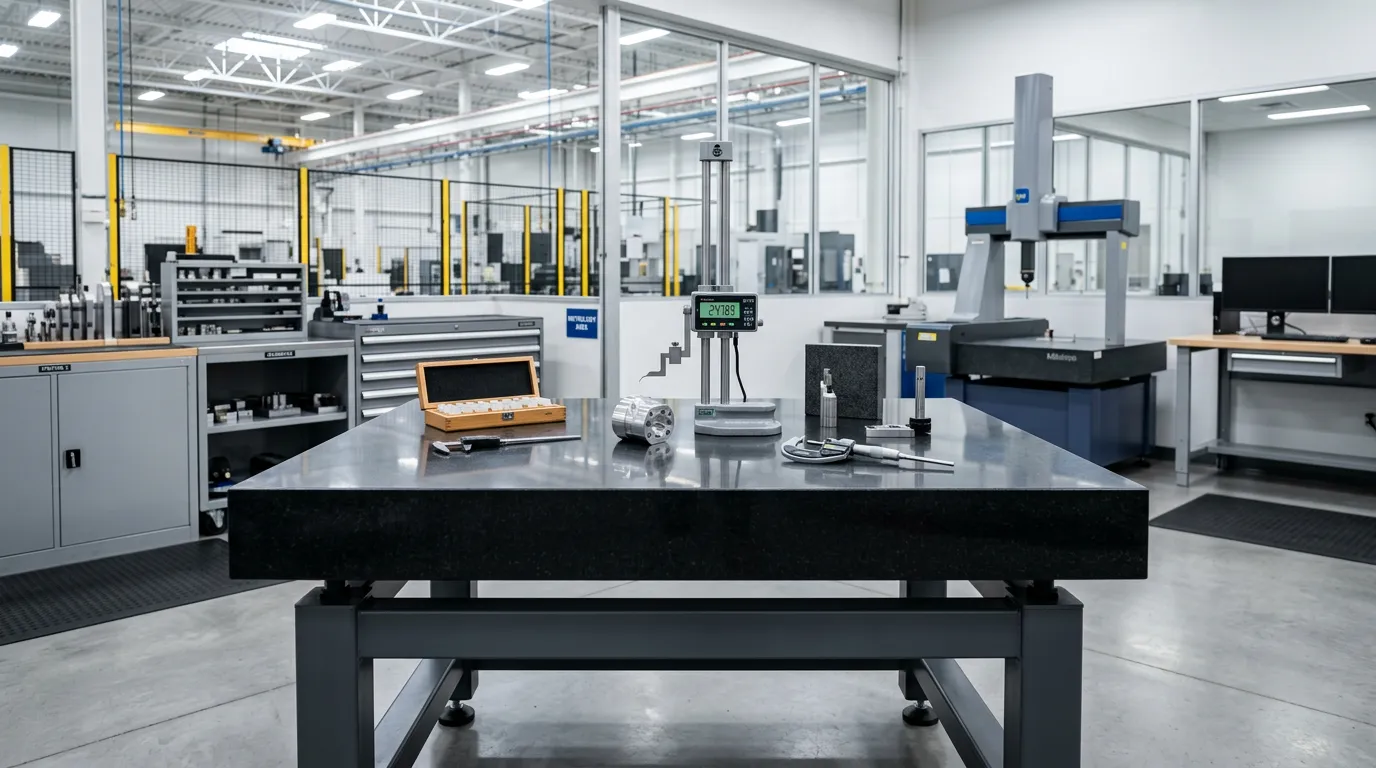
Expert Surface Plate Calibration, Green Bay
On-site [granite surface plate calibration](/services/) is provided throughout the Green Bay, [Wisconsin](/wisconsin-surface-plate-calibration/) area. This service maintains ISO/IEC 17025 accreditation, ensuring precise flatness verification. Measurements are conducted using advanced Hilger-Watts autocollimators, adhering to stringent metrological standards.
Eliminating the need for off-site transport, all calibration procedures and any necessary [wet lap resurfacing](/services/) are performed directly at the client’s facility. Same-day certification documentation, complete with NIST traceability, is issued before the technician’s departure, confirming adherence to specifications like GGG-P-463C or ASME B89.3.7.
The industrial landscape of Green Bay, situated within Brown County and serving as a vital economic hub in Northeastern Wisconsin, necessitates rigorous adherence to metrology standards. Manufacturing operations across the region, extending into the broader Fox Cities area, depend on foundational measurement instruments to ensure the precision and quality of their output. Within these varied facilities, [granite surface plates](/services/) are commonly employed as the basis for dimensional inspection and layout tasks. Their sustained accuracy is critical for a wide array of production and assembly processes, making regular [flatness verification](/services/) an essential component of operational integrity.
Despite their inherent durability, granite surface plates are subject to gradual wear from daily use, abrasive particles, and the repeated placement of components and gauges. This cumulative wear can lead to localized deviations in flatness, compromising the accuracy of subsequent measurements. To counteract this degradation and maintain the integrity of measurement systems, periodic flatness verification is indispensable. Such verification ensures that these critical tools remain within the specified Grade AA, A, or B tolerances, thereby upholding product specifications and preventing costly rework or material waste.
Precision [calibration services](/services/) are delivered on-site, directly within the operational environments of Green Bay’s manufacturing facilities. This eliminates the need for transporting bulky surface plates, minimizing workflow disruptions and equipment downtime. Calibrations are meticulously performed using high-precision instruments such as Hilger-Watts autocollimators, with measurements taken according to established procedures like the Moody Method. Comprehensive flatness maps are generated from a grid of data point measurements, clearly illustrating any deviations from the specified tolerance.
Adherence to federal specification GGG-P-463C and ASME B89.3.7 standards is maintained throughout the verification process. Every calibration includes the provision of a detailed certificate with NIST traceability, along with a clear grade classification. Should a surface plate be found out-of-tolerance, on-site wet lap resurfacing can be performed to restore its flatness. This method effectively eliminates the silica dust common with traditional dry lapping, ensuring a safer work environment, and is often completed with same-day documentation. Services are backed by [ISO/IEC 17025 accreditation](/about/), ensuring A2LA certified results that meet international standards for technical competence.
Why Green Bay Manufacturers Choose Our Service
Statewide Service, Prompt Calibration
On-site granite surface plate calibration is routinely provided to facilities throughout Green Bay and across Wisconsin, with scheduling structured for rapid deployment to maintain critical measurement workflows.
A2LA Certified, NIST Traceable Calibration
Verification services for granite surface plates in the Green Bay vicinity operate under rigorous ISO/IEC 17025 accreditation, providing A2LA certified results that maintain NIST traceability for all reported measurement values.
Silica-Free Wet Lap Resurfacing
When flatness verification reveals out-of-tolerance conditions for Green Bay manufacturers, precision wet lap resurfacing is performed. This process restores optimal plate geometry while completely mitigating the generation of airborne silica dust, a common concern with dry finishing methods.
Frequently Asked Questions
How does the selection of appropriate support points impact the flatness verification of a granite surface plate?
Correct selection of support points is essential to minimize deflection and ensure an accurate flatness verification. Standards like ASME B89.3.7 specify optimal support locations to maintain the plate’s inherent flatness. Improper support can induce significant errors, rendering calibration data unreliable.
What is the significance of the “repeat reading” measurement in determining a surface plate’s suitability for use?
Repeat reading measurement assesses the local flatness deviation over a small area, indicating localized wear or irregularities. This parameter is critical for determining the plate’s ability to provide consistent measurements when small components are moved across its surface. Exceeding specified repeat reading tolerances suggests compromised local accuracy, even if overall flatness is acceptable.
How does the calibration procedure differ for a portable granite surface plate compared to a stationary one?
While the fundamental measurement principles remain similar, portable plates require careful consideration of their temporary setup environment. Ensuring a stable, level, and vibration-free base is paramount, as their inherent stability might be less than permanently installed plates. Calibration is performed once the plate has fully settled and acclimatized to its temporary location.
What types of instruments are considered master references for establishing NIST traceability in surface plate calibration?
Master straightedges, often made of hardened steel or ceramic, are commonly used as primary references. These artifacts themselves undergo periodic calibration by accredited laboratories, with their flatness verified against higher-level standards. This establishes the measurement chain back to NIST or other national metrology institutes.
How does a calibration laboratory’s adherence to ISO/IEC 17025 benefit the end-user of surface plate calibration services?
Adherence to ISO/IEC 17025 ensures that a calibration laboratory operates under a rigorous quality management system and possesses demonstrated technical competence. This provides confidence that calibration results are reliable, impartial, and globally recognized. For the end-user, it signifies a commitment to accuracy, consistency, and professional integrity in measurement services.