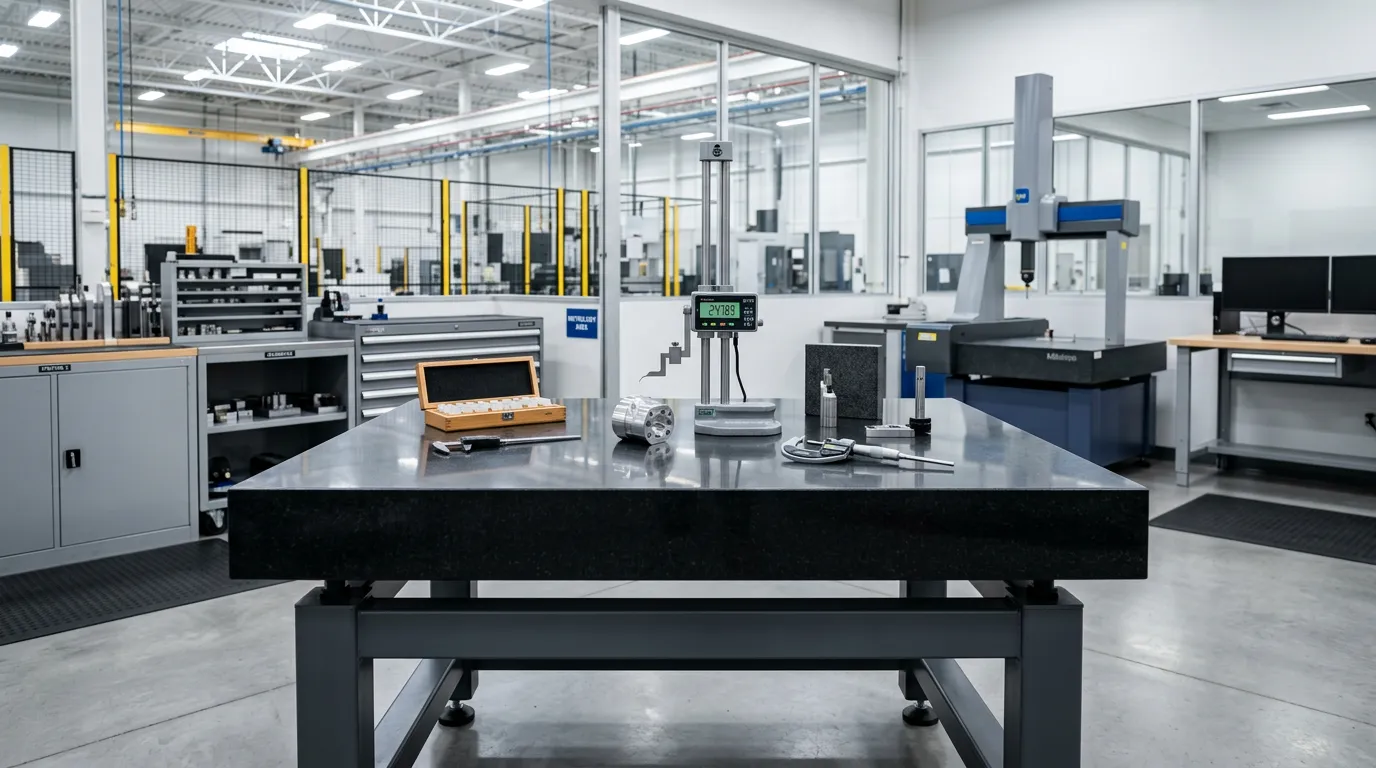
Expert Surface Plate Calibration, Indianapolis
ISO/IEC 17025 accredited granite surface plate calibration services are performed directly on-site throughout Indianapolis, [Indiana](/indiana-surface-plate-calibration/). Precision flatness verification is achieved using advanced Hilger-Watts autocollimators, ensuring accurate measurements crucial for quality control processes.
Through the use of wet lap resurfacing, out-of-tolerance plates can be [restored](/services/) without generating silica dust, all within the customer’s facility. This method bypasses shipping logistics entirely, with comprehensive calibration documentation provided on the same day the service is completed.
Indianapolis, a pivotal economic center in the Midwest, anchors a robust industrial landscape spanning Marion County and its surrounding metropolitan areas, including Hamilton, Hendricks, and Johnson Counties. This region is characterized by a significant presence of manufacturing facilities engaged in advanced machining, precision component fabrication, and complex assembly operations. The sustained economic vitality of these enterprises relies heavily on stringent quality control and the integrity of foundational [metrology equipment](/services/).
Central to the quality assurance processes within these industrial environments are granite surface plates, serving as critical reference planes for dimensional inspection. Continuous operational demands, typical of high-volume production in central Indiana, invariably subject these precision instruments to abrasive wear. Over time, this wear degrades the flatness integrity of the plates, leading to potential inaccuracies in measurement and inspection processes, thereby necessitating regular flatness verification and [granite surface plate calibration](/services/) to maintain adherence to specifications like GGG-P-463C and ASME B89.3.7.
To mitigate production disruptions, on-site calibration services are deployed directly within Indianapolis-area facilities. This approach eliminates the logistical complexities and downtime associated with shipping large, sensitive surface plates. Using Hilger-Watts autocollimators, flatness verification is performed with meticulous precision. Upon completion, comprehensive documentation is supplied immediately, including a calibration certificate detailing NIST traceability, a detailed flatness map with precise data point measurements, and a clear grade classification (AA, A, or B). For plates found to be out of tolerance, [wet lap resurfacing](/services/) capabilities are available, which effectively restores accuracy while significantly reducing airborne silica dust compared to dry methods, ensuring continued operational reliability in accordance with ISO/IEC 17025 and A2LA [accreditation standards](/about/).
Local Industry Relies on Our Calibration
Broad Coverage, Efficient Booking
On-site granite surface plate calibration services are regularly deployed across Indianapolis and surrounding industrial corridors throughout Indiana. Scheduling of these essential flatness verification procedures is typically arranged promptly, obviating the need for off-site equipment shipment.
Meeting ISO 17025, A2LA Standards
All calibration services for Indianapolis facilities are conducted under strict ISO/IEC 17025 accreditation, providing A2LA-certified results with full NIST traceability. This ensures reliable flatness verification crucial for precision manufacturing operations throughout the region.
Dust-Free Resurfacing for Accuracy
Out-of-tolerance granite surface plates in Indianapolis are brought back to specified flatness tolerances through wet lap resurfacing. This specialized technique completely avoids the creation of harmful silica dust, protecting the workspace.
Frequently Asked Questions
What role do intermediate measurements play in the comprehensive assessment of flatness using the Moody Method?
The Moody Method employs a systematic grid pattern of measurements, with intermediate points serving to refine the flatness profile across the entire surface. These measurements contribute to a detailed topographical map of the plate, allowing for the precise calculation of overall flatness and localized deviations. The cumulative data from intermediate points ensures a thorough and accurate assessment.
What are the inherent characteristics of granite that contribute to its dimensional stability over long periods?
Granite possesses a low coefficient of thermal expansion and high rigidity, which are critical for maintaining dimensional stability. Its natural resistance to corrosion and non-magnetic properties also contribute to its suitability in metrology environments. These combined characteristics ensure that a properly manufactured and maintained plate retains its flatness with minimal deviation over extended periods.
What specific considerations are given to the design and rigidity of the autocollimator stand during surface plate calibration?
The autocollimator stand must be exceptionally rigid and stable to prevent any movement or deflection that could introduce measurement errors. It is often constructed from heavy, vibration-dampening materials and designed to minimize thermal expansion. Any instability in the stand would directly compromise the accuracy and repeatability of angular deviation readings.
How does GGG-P-463C influence the choice of granite material for a new surface plate purchase?
GGG-P-463C specifies performance requirements for granite surface plates, implicitly guiding the choice of materials that can meet these standards. While not explicitly dictating a particular granite type, it mandates characteristics such as hardness, density, and modulus of elasticity. These requirements ensure that only granite types capable of achieving the specified flatness and stability are utilized in manufacturing.