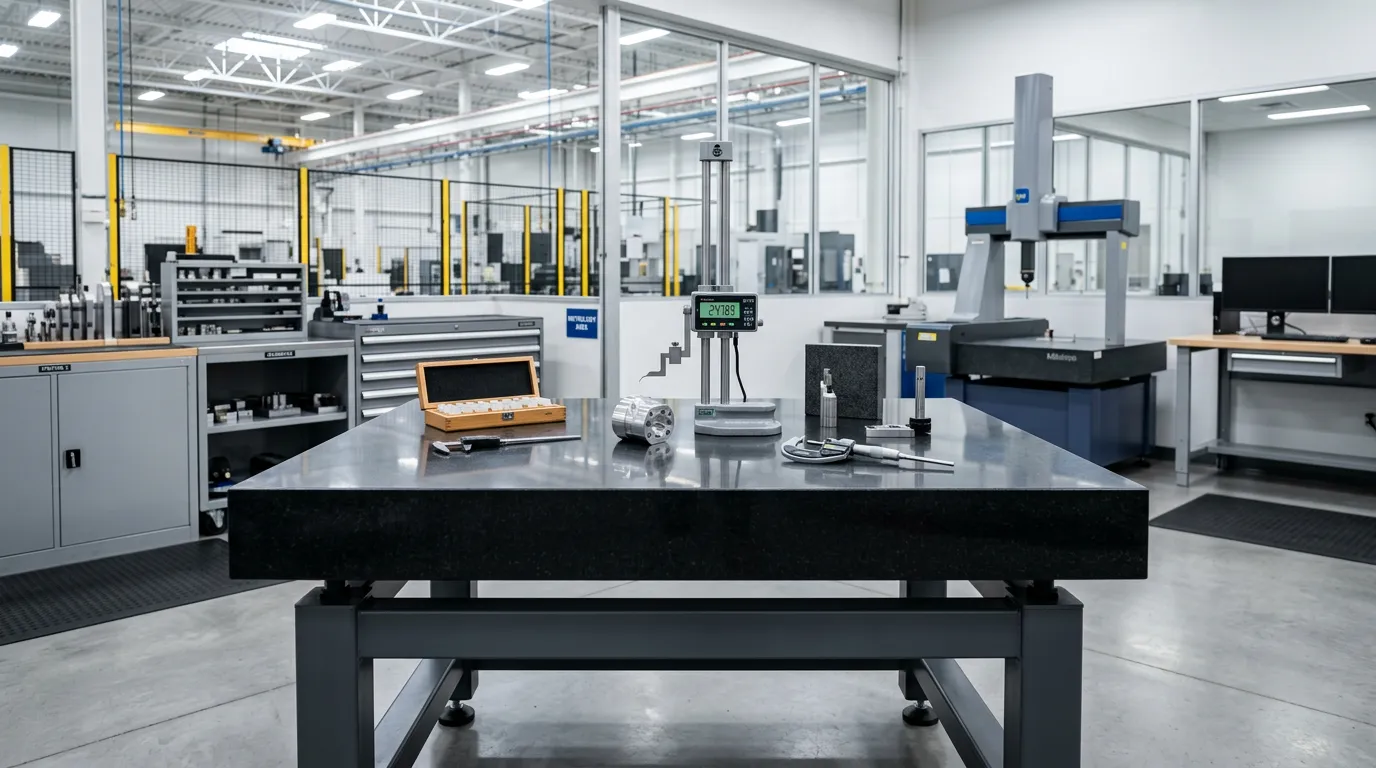
Maintain Flatness: Elkhart Calibration
In Elkhart, Indiana, precision [granite surface plate calibration](/services/) services are delivered directly at industrial facilities. This on-site approach ensures GGG-P-463C federal specifications are met without moving critical metrology equipment. Services are performed under [ISO/IEC 17025 accreditation](/about/), utilizing advanced Hilger-Watts autocollimators for flatness verification.
There is no requirement for heavy surface plates to be transported off-site, with all work conducted within the Elkhart facility. When plates exhibit out-of-tolerance conditions per ASME B89.3.7, [wet lap resurfacing](/services/) is employed to restore optimal flatness, avoiding the creation of airborne silica dust. Following service completion, NIST-traceable certification documentation is provided immediately.
The industrial landscape of Elkhart, Indiana, situated within the dynamic Michiana region, is characterized by a robust manufacturing presence that spans various sectors. Across Elkhart County and neighboring cities like Goshen and [South Bend](/south-bend-surface-plate-calibration/), facilities engaged in precision fabrication, assembly, and component production frequently utilize granite surface plates as foundational reference planes for dimensional metrology. The sustained operational integrity of these manufacturing processes is directly linked to the accuracy of such critical inspection tools, making regular [flatness verification](/services/) an indispensable practice within the region’s industrial corridors.
Granite surface plates, essential for quality control and part inspection, are continuously subjected to abrasive wear and impact from daily use. Over time, this cumulative exposure inevitably leads to deviations from specified flatness tolerances, which can compromise measurement accuracy and product quality. To mitigate this, periodic [calibration using highly sensitive instruments](/services/), such as Hilger-Watts autocollimators, is performed. This process ensures the plates adhere to stringent federal specifications like GGG-P-463C or industry standards like ASME B89.3.7, confirming their suitability for precision work and maintaining alignment with metrology best practices.
For the busy manufacturing operations prevalent in [northern Indiana](/indiana-surface-plate-calibration/), on-site surface plate calibration offers significant logistical advantages. Instead of requiring the costly and time-consuming shipment of large, heavy plates, calibration services are delivered directly to the facility. This approach minimizes production downtime by keeping critical inspection equipment in active service for as long as possible. If flatness measurements reveal an out-of-tolerance condition, resurfacing of the granite material can be immediately executed using the Moody Method and a wet lap technique, which effectively eliminates airborne silica dust, ensuring a safer and cleaner working environment within the industrial facility.
Upon completion of the calibration and any necessary resurfacing, comprehensive documentation is provided on the same day. This includes an NIST-traceable calibration certificate, ensuring all measurements are verifiable through an unbroken chain of comparisons to national standards. Additionally, a detailed flatness map is supplied, visually representing data point measurements across the plate’s surface. Each plate also receives an updated grade classification (e.g., Grade AA, A, or B), confirming its compliance with relevant metrology standards and its readiness to support the precision manufacturing demands of Elkhart’s diverse industrial base. Services are backed by [A2LA accreditation to ISO/IEC 17025](/about/), underscoring a commitment to rigorous quality systems and technical competence.
Enhancing Quality for Elkhart Businesses
Extensive Coverage, Rapid Scheduling
On-site surface plate calibration services are readily available in Elkhart, Indiana, and across the state, with scheduling typically managed for expedited deployment.
A2LA Certification for Precision
For industrial operations across Elkhart, Indiana, surface plate calibrations are performed within an ISO/IEC 17025 accredited framework. All measurements maintain NIST traceability, affirmed by A2LA certification, ensuring metrological integrity.
Enhanced Flatness, No Silica Dust
For surface plates requiring flatness restoration in Elkhart, Indiana, the wet lap resurfacing process is utilized. This method precisely reestablishes original tolerances while effectively eliminating the hazardous silica dust typically generated by dry abrasive techniques.
Frequently Asked Questions
What is the average lifespan of a well-maintained granite surface plate before it may require resurfacing or replacement?
The average lifespan of a well-maintained granite surface plate can extend for decades, often 20-50 years or more. Factors such as usage intensity, adherence to proper cleaning and care routines, and environmental stability significantly influence this duration. Regular calibration and timely resurfacing when needed can greatly prolong its serviceable life.
How do laboratories ensure the calibration equipment itself, such as autocollimators, maintains its own NIST traceability?
Calibration equipment, including autocollimators and master straightedges, is routinely sent to higher-level accredited laboratories for calibration. These instruments are verified against national or international standards, and their calibration certificates provide an unbroken chain of traceability to NIST or other recognized national metrology institutes. This ensures that the primary measurement tools used for surface plate calibration are themselves accurate and reliable.
What distinguishes the process of correcting minor flatness deviations through calibration from correcting major ones via resurfacing?
Calibration identifies and quantifies flatness deviations, ensuring the plate’s accuracy is known, but it does not alter the physical surface. It provides a report of current condition. Resurfacing, conversely, physically removes material from the granite surface to restore it to its original or a specified flatness tolerance, effectively correcting major deviations.
What are the essential safety considerations that should be observed during an on-site granite surface plate calibration?
Safety protocols are paramount during on-site calibration to protect personnel and equipment. This includes ensuring adequate lighting, clear access to the work area, and the safe handling of heavy precision instruments. Proper electrical connections for calibration equipment and awareness of any client-specific safety regulations are also critical.
How does the precision of the wet lap resurfacing process impact the ultimate achievable flatness tolerance?
Wet lap resurfacing, by utilizing fine abrasive slurries and highly controlled, low-pressure grinding, allows for extremely precise material removal. This meticulous process ensures that the granite surface is brought to the tightest possible flatness specifications. The precision of this method directly determines the lowest achievable overall flatness and local area flatness tolerances.
In what specific scenarios does the local area flatness of a granite surface plate become particularly important for measurement accuracy?
Local area flatness is critical when measuring small components or when using instruments with small bases that do not span a large area of the plate. Deviations in local areas, even if overall flatness is good, can introduce significant errors in these applications. This measurement ensures consistent accuracy across all working regions of the surface plate.