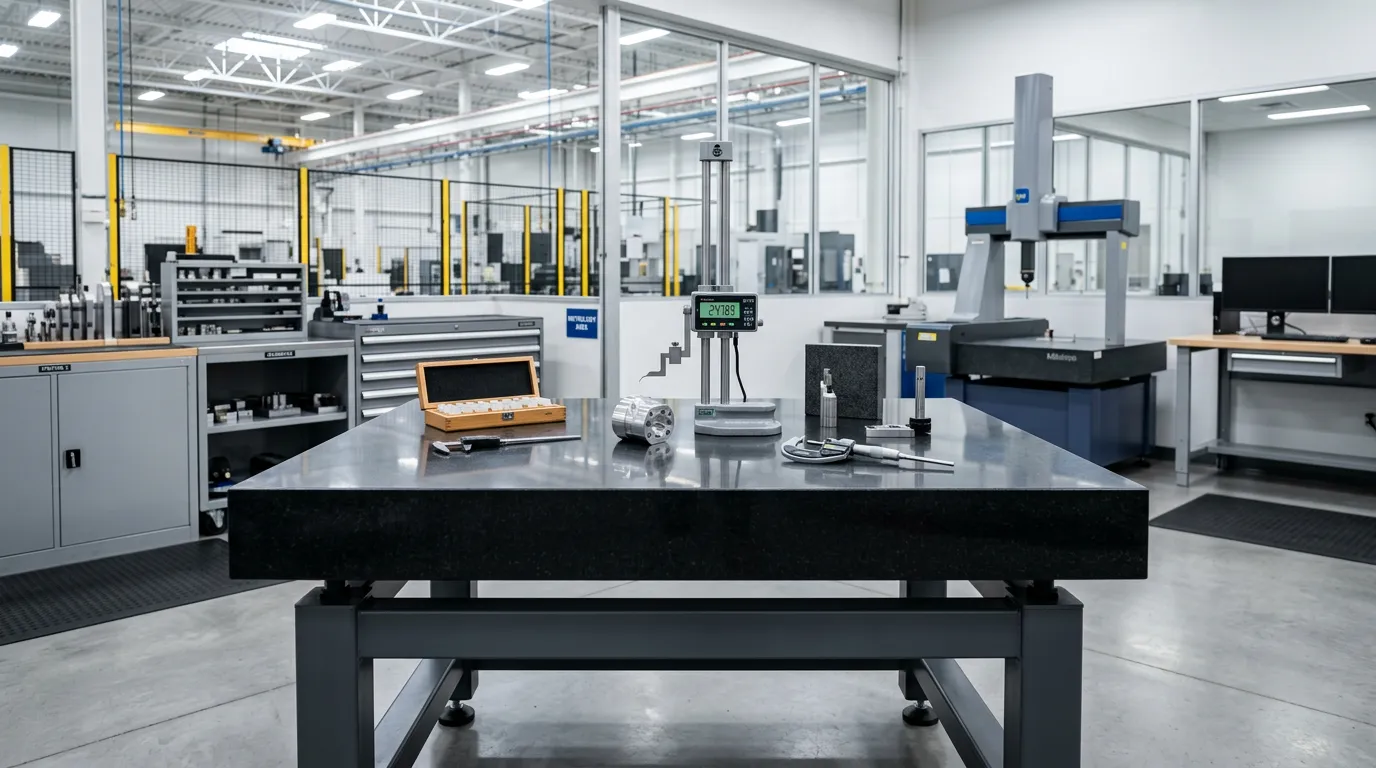
Expert Surface Plate Calibration, Fort Wayne
For manufacturing operations across Fort Wayne, Indiana, ISO/IEC 17025 accredited [granite surface plate calibration](/services/) is performed directly at the client’s facility. Precision flatness verification relies on Hilger-Watts autocollimators to ensure meticulous measurements, with [A2LA accreditation](/about/) affirming the quality management system. This on-site service eliminates logistical complexities and downtime associated with off-site shipments.
Any necessary resurfacing to restore out-of-tolerance plates utilizes a wet lap resurfacing process, preventing airborne silica dust. All calibration efforts culminate in NIST-traceable documentation, which is provided to the facility before the technician departs, affirming immediate compliance.
Fort Wayne, a significant industrial center in [Northeast Indiana](/indiana-surface-plate-calibration/) and the heart of Allen County, maintains a robust manufacturing heritage. The city and its surrounding areas contribute substantially to the region’s economic output, hosting numerous facilities engaged in various forms of production. This concentration of industrial activity necessitates a consistent commitment to accuracy and quality control across diverse operational scales. The ongoing output from these manufacturing enterprises relies heavily on foundational metrology principles and equipment.
Within these bustling industrial landscapes, granite surface plates serve as critical reference planes for dimensional inspection and precision assembly. Over time, constant use, abrasive contact, and environmental factors introduce wear to these surfaces, compromising their original flatness. Such degradation directly impacts the accuracy of measurements performed, potentially leading to errors in product specifications. Periodic [flatness verification](/services/) is therefore indispensable for maintaining the integrity of manufacturing processes and ensuring consistent product quality throughout the Fort Wayne metro area.
For busy facilities in Fort Wayne, on-site surface plate calibration offers a practical solution, eliminating the need for equipment shipping and minimizing operational downtime. Precision measurements are conducted utilizing advanced instruments such as Hilger-Watts autocollimators, applying methods like the Moody Method to gather comprehensive data. This meticulous process results in a detailed flatness map with data point measurements, a [calibration certificate](/services/) featuring NIST traceability, and an assigned grade classification (AA, A, B, or Laboratory). Crucially, essential documentation is provided before the technician departs the facility, allowing for immediate integration into quality systems.
Maintaining adherence to stringent industry specifications, including GGG-P-463C and ASME B89.3.7, is a cornerstone of operations in Fort Wayne’s manufacturing sector. When surface plates are found to be out-of-tolerance, on-site [wet lap resurfacing](/services/) capabilities are available, restoring flatness without generating airborne silica dust. This comprehensive approach ensures that foundational measurement tools remain compliant and accurate, supporting the high-precision requirements of industries located throughout Allen County and wider Northeast Indiana. A2LA accreditation under ISO/IEC 17025 further assures the competence and impartiality of these vital calibration services.
Why Fort Wayne Businesses Prioritize Accuracy
Wide Service Area, Expedited Appointments
On-site granite surface plate calibration is regularly performed for facilities throughout Fort Wayne and across Indiana, with scheduling optimized to support operational continuity. Precision flatness verification and required adjustments are conducted at the client’s location, eliminating the need for equipment shipping.
Compliant with ISO/IEC 17025 & NIST
Granite surface plate calibration for Fort Wayne facilities is performed under ISO/IEC 17025 accreditation. This ensures all measurement data is A2LA certified and fully NIST traceable, supporting stringent quality assurance requirements.
Safe Resurfacing: Wet Lapping Process
Flatness restoration for granite surface plates in Fort Wayne is accomplished through wet lap resurfacing. This technique inherently prevents the production of airborne silica dust, contributing to a cleaner industrial workspace during the calibration process.
Frequently Asked Questions
What specific quality metric is the main focus of a surface plate calibration?
The main focus of a surface plate calibration is the precise verification of its overall flatness and local area flatness. These metrics ensure the plate functions as an accurate reference plane for high-precision dimensional measurements. Deviations from specified flatness tolerances are systematically identified.
How does the “overall flatness” parameter relate to surface plate functionality?
Overall flatness represents the deviation of the entire working surface from a theoretical perfect plane. This parameter is critical as it directly impacts the accuracy of measurements taken across any two points on the plate. Maintaining overall flatness within specified ASME B89.3.7 or GGG-P-463C tolerances is essential for reliable metrology.
What is the importance of a surface plate’s supporting structure during calibration?
The supporting structure profoundly impacts a surface plate’s inherent flatness and stability. Calibrations require the plate to be supported precisely as it would be during normal use to ensure accurate assessment of its true working condition. Improper support can induce localized deflections or overall crowning/dishing, leading to inaccurate readings.
What is the rationale behind the stringent tolerance limits specified for Grade AA surface plates?
The stringent tolerance limits for Grade AA surface plates are predicated on the requirement for ultimate precision in metrology applications. These plates are intended to serve as primary reference standards where even minute deviations can significantly impact measurement accuracy. The tight specifications minimize measurement uncertainty in critical inspection processes.