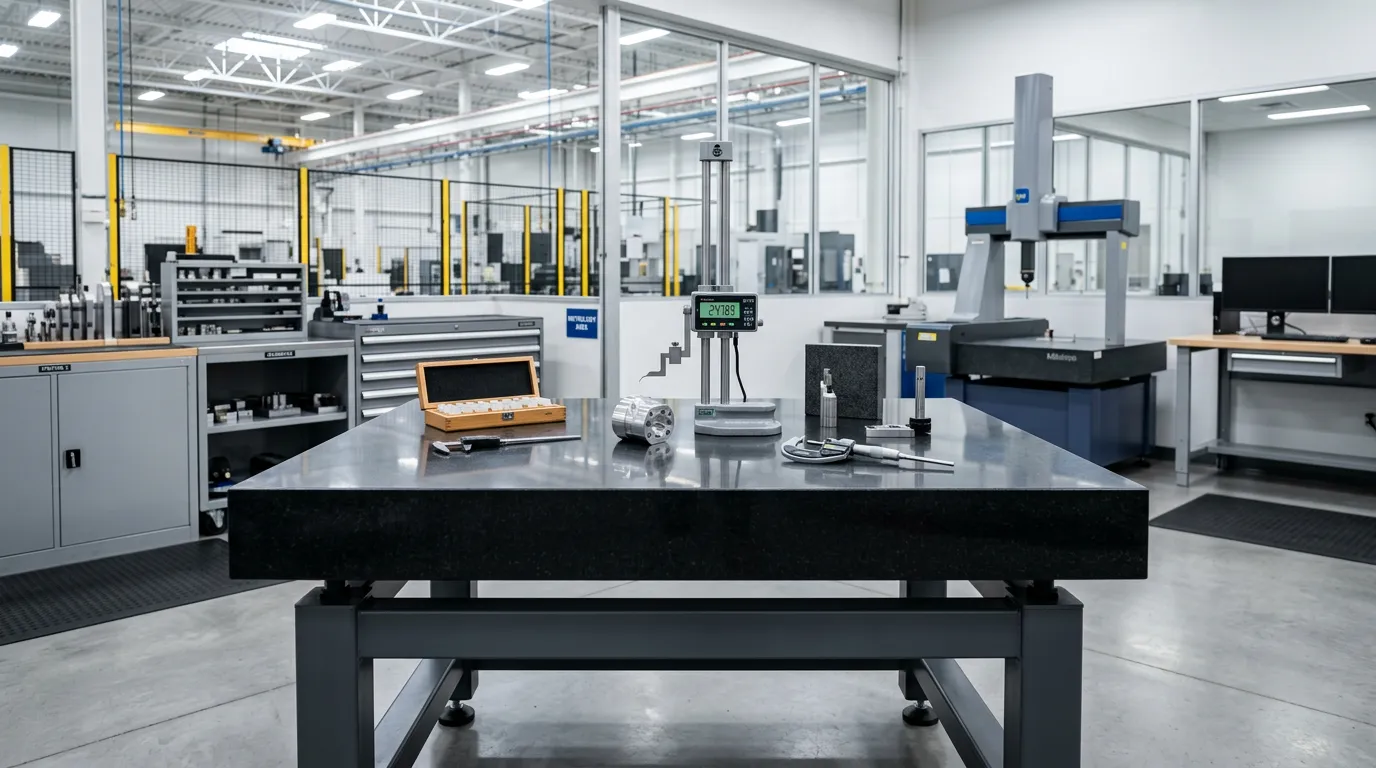
Warsaw Granite Surface Plate Services
Granite surface plate calibration, critical for maintaining dimensional accuracy in manufacturing, is available on-site across Warsaw, Indiana. This specialized metrology service employs precision Hilger-Watts autocollimators for comprehensive flatness verification, ensuring adherence to standards such as GGG-P-463C and ASME B89.3.7. An ISO/IEC 17025 accredited process removes the need for equipment shipping, as all calibration procedures are conducted directly within the client’s facility.
When plates are found to be outside Grade AA, A, or B tolerances, wet lap resurfacing is performed to restore precision without generating harmful silica dust. This technique improves measurement integrity and extends the service life of critical inspection tools. Following the completion of services, NIST-traceable certification documentation is immediately provided, detailing flatness maps and comprehensive data point measurements.
The industrial landscape of Warsaw, Indiana, nestled within Kosciusko County in northern Indiana, is characterized by a significant concentration of advanced manufacturing and precision-driven industrial operations. This region, often recognized for its highly specialized production, relies heavily on stringent quality control and accurate measurement processes. For facilities operating here, maintaining the integrity of foundational metrology equipment is paramount. Surface plates, serving as critical reference planes for dimensional inspection and layout work, are subject to continuous wear from daily use, making their periodic verification an essential aspect of maintaining product quality and operational efficiency.
Precision calibration of granite surface plates is a critical service for the numerous manufacturing entities distributed across Warsaw and its surrounding communities, including those near Fort Wayne and South Bend. Flatness verification is typically performed using highly sensitive instruments such as Hilger-Watts autocollimators, employing methods like the Moody Method to meticulously map the surface topography. This meticulous process ensures that measurement uncertainty is minimized, directly impacting the quality and reliability of products manufactured in the area. On-site service for these calibrations is often preferred, as it dramatically reduces downtime and eliminates the logistical challenges and risks associated with shipping large, heavy granite components.
The comprehensive service approach addresses several key operational needs for local industry. Calibration certificates, demonstrating NIST traceability, are provided promptly, often on the same day the service is completed, ensuring uninterrupted compliance with quality systems. Each certificate includes a detailed flatness map with precise data point measurements and a clear grade classification according to GGG-P-463C or ASME B89.3.7 specifications (Grade AA, A, B, or Laboratory). Furthermore, for plates found to be out of tolerance, wet lap resurfacing is performed to restore the plate’s accuracy without generating airborne silica dust, thereby maintaining a clean and safe working environment within the facility.
The Value for Warsaw Production Facilities
Fast Scheduling Across Warsaw, Indiana
For precision operations in Warsaw, Indiana, and surrounding industrial corridors, granite surface plate calibration is performed on-site, facilitating rapid scheduling to maintain measurement integrity with minimal operational downtime.
Certified to A2LA, Traceable to NIST
Surface plate calibrations conducted in Warsaw, Indiana facilities are fully ISO/IEC 17025 accredited and A2LA certified. This provides assurance that all flatness verification data and grade classifications are established through NIST-traceable measurement processes.
Wet Lap: Optimal Flatness Restoration
Wet lap resurfacing is utilized to correct flatness discrepancies identified during calibration within Warsaw’s industrial settings. This technique precisely restores surface plates to their required grade without the release of airborne silica dust, ensuring a cleaner operational environment.
Frequently Asked Questions
What is the typical timeframe for a granite surface plate to settle thermally before calibration?
A granite surface plate typically requires 24 to 72 hours to achieve complete thermal stability within its calibration environment. This acclimatization period allows the granite to reach a uniform temperature throughout its mass, minimizing thermal expansion or contraction effects. Ensuring the plate is at a stable ambient temperature is critical for accurate flatness verification.
What mathematical principle underpins flatness calculations derived from autocollimator measurements using the Moody Method?
The mathematical principle underpinning flatness calculations using the Moody Method involves the use of least squares approximation to define a best-fit reference plane. Angular deviation readings from the autocollimator are translated into elevation changes, which are then analyzed to determine deviations from this theoretical plane. This method allows for a comprehensive assessment of overall and local flatness across the surface.
What is the purpose of conducting a “repeat reading” measurement during surface plate calibration?
The repeat reading measurement assesses the local flatness and bearing surface quality within a small area, typically 25 square inches. It determines the maximum variation in height when moving an indicator over a specific section of the plate. This provides insight into the plate’s ability to support instruments without rocking, which is critical for precision gauge setup.
Why is thermal stability critical for the calibration environment of a granite surface plate?
Thermal stability is critical because granite is susceptible to thermal expansion and contraction, which can alter its flatness. Fluctuations in ambient temperature during calibration can cause temporary distortions in the plate, leading to inaccurate measurement results. A consistent temperature ensures the plate’s true geometry is being assessed, not a thermally induced deformation.
How is the uncertainty of measurement calculated and reported in a surface plate calibration?
Measurement uncertainty is determined by considering all identifiable error sources, such as environmental factors, equipment limitations, and operator variability. These contributions are combined according to ISO/IEC 17025 guidelines to yield an expanded uncertainty value. This value is reported on the calibration certificate, providing confidence limits for the stated measurement results.