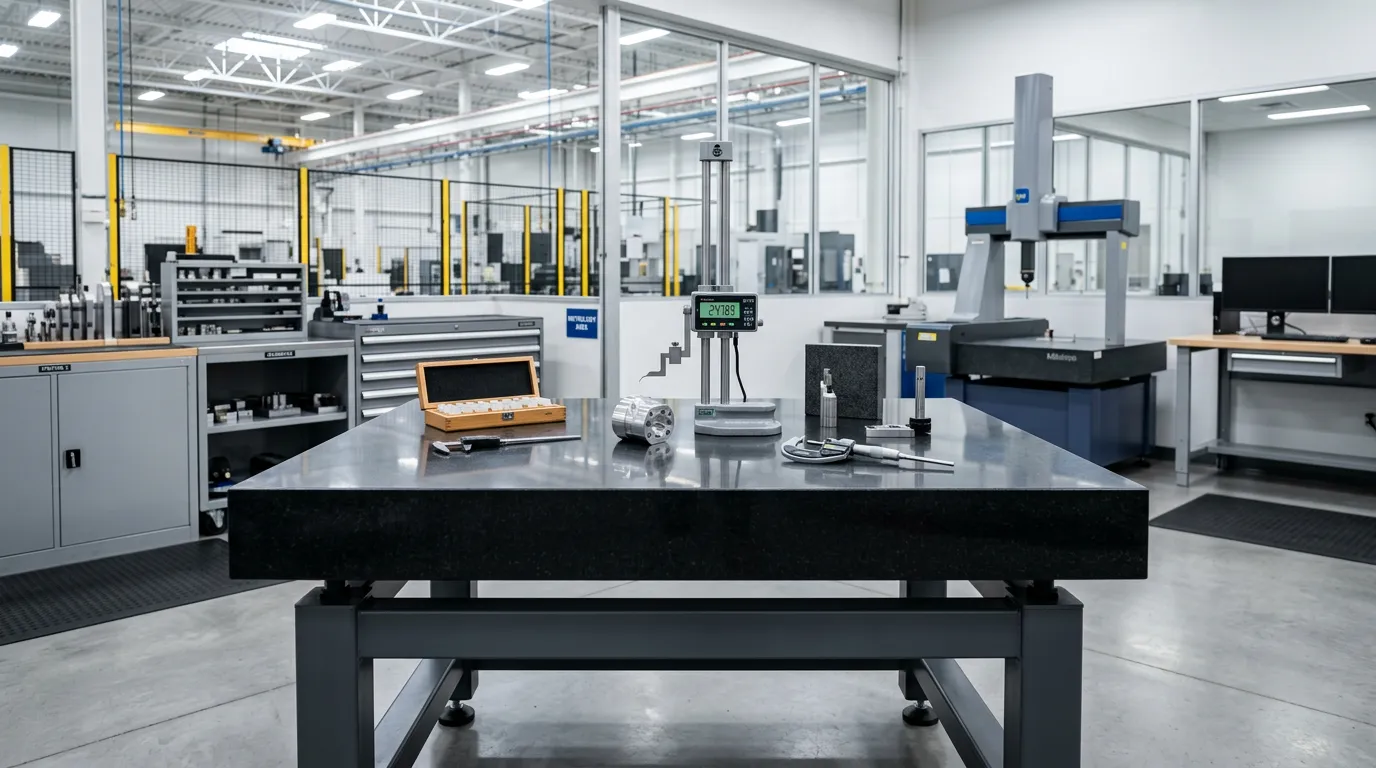
Metrology Services for Granite Plates, Lafayette
[Granite surface plate calibration](/services/), maintaining ISO/IEC 17025 accreditation through A2LA, is provided on-site for facilities across [Lafayette, Indiana](/indiana-surface-plate-calibration/). Flatness verification is executed with Hilger-Watts autocollimators, ensuring measurements align with GGG-P-463C and ASME B89.3.7 standards. This methodology supports critical manufacturing operations throughout the region.
The entire calibration process, including any necessary [wet lap resurfacing](/services/), is completed at the client’s location, circumventing any requirement for equipment shipment. This on-site approach allows for the immediate issuance of NIST-traceable certification documentation upon service conclusion, directly at the facility.
Lafayette, Indiana, positioned centrally within Tippecanoe County, functions as a significant industrial anchor in the Midwest, strategically linking major metropolitan areas such as [Indianapolis](/indianapolis-surface-plate-calibration/) and Chicago. The region supports a robust manufacturing landscape, encompassing diverse operations from automotive components to advanced machinery and general industrial equipment. Within these varied facilities, the foundational accuracy of measurement tools is paramount, with granite surface plates serving as critical references for quality assurance and dimensional inspection processes. The economic vitality of this industrial corridor relies heavily on the consistent production of precision-engineered components, making the integrity of metrology instrumentation a continuous concern.
Granite surface plates, despite their inherent durability, undergo gradual wear and tear through regular use, leading to deviations from their original specified flatness. This degradation necessitates periodic [flatness verification and calibration](/services/) to maintain manufacturing precision and adherence to quality standards like GGG-P-463C and ASME B89.3.7. On-site calibration services are particularly advantageous for facilities in the Lafayette area, allowing for critical metrology equipment to be verified without the logistical complexities and downtime associated with off-site shipping. Calibrations are performed directly within client facilities, ensuring minimal disruption to ongoing production schedules.
During an on-site calibration event, precision measurements are executed using advanced instruments such as Hilger-Watts autocollimators, often employing methodologies like the [Moody Method](/about/), to accurately assess surface plate flatness. A comprehensive calibration certificate is provided, detailing NIST traceability, along with a thorough flatness map that illustrates specific data point measurements across the plate’s working surface. This process culminates in a clear grade classification (AA, A, B, or Laboratory), confirming compliance with industry standards. Should a surface plate fall outside its specified tolerances, wet lap resurfacing can be performed to restore its original precision, effectively eliminating airborne silica dust during the restoration process while extending the operational lifespan of the plate. Adherence to ISO/IEC 17025 accreditation principles further assures the reliability and accuracy of all flatness verification services.
Why Lafayette Businesses Prioritize Accuracy
Areawide Coverage with Fast Scheduling
Calibration and resurfacing of granite surface plates are performed on-site for industrial operations across Lafayette, Indiana, and its adjacent manufacturing corridor, with expedited scheduling options available to minimize operational downtime.
ISO/IEC 17025 Accredited & NIST Traceable
Precision metrology services for surface plates within the Lafayette, Indiana region are conducted under rigorous ISO/IEC 17025 accreditation. This ensures A2LA certified results, with all flatness verification measurements directly traceable to NIST primary standards.
Wet Lap Resurfacing for Flatness
The wet lap resurfacing technique restores out-of-tolerance granite surface plates to GGG-P-463C and ASME B89.3.7 specifications. This method inherently eliminates the generation of airborne silica dust, maintaining a cleaner environment for precision operations within Lafayette’s industrial sector.
Frequently Asked Questions
What specific types of damage or wear patterns on a granite surface plate indicate a need for resurfacing?
Specific indicators for resurfacing include significant dishing or crowning across the plate, deep scratches, impact damage, or heavy localized wear areas. These conditions compromise the plate’s flatness beyond the scope of adjustment, making it unsuitable for precision measurements. Resurfacing restores the critical geometry necessary for accurate metrology.
How does the quality management system of an A2LA accredited laboratory benefit calibration clients?
An A2LA accredited laboratory operates under a rigorous quality management system conforming to ISO/IEC 17025, which ensures consistent, high-quality service delivery. This system encompasses strict control over personnel competency, equipment calibration, documentation, and traceability of measurements. Clients benefit from reliable, repeatable, and globally recognized calibration results.
What is the primary benefit of calibrating a new granite surface plate shortly after installation?
Calibrating a new granite surface plate shortly after installation establishes a baseline flatness measurement for its initial condition. This initial calibration helps identify any potential shipping damage or installation-related flatness deviations. It also serves as a crucial reference point for monitoring long-term stability and wear over time.
What is the significance of the “local area flatness” specification in surface plate metrology?
Local area flatness refers to the maximum permissible deviation within a small, defined area on the surface plate. This specification ensures that even small objects placed on the plate will rest on a sufficiently flat reference plane. It is crucial for maintaining accuracy when using precision instruments like height gauges or comparators that only interact with a limited surface area.
How does the selection of a calibration laboratory’s support equipment impact calibration accuracy?
The quality and stability of a calibration laboratory’s support equipment, such as the autocollimator stand and measuring straightedges, directly influence the accuracy of flatness verification. Unstable or improperly calibrated support equipment can introduce errors into the angular measurements. Ensuring all ancillary equipment meets stringent metrological standards is paramount for reliable results.
What inherent material properties of granite make it suitable for precision surface plates?
Granite possesses inherent properties such as excellent dimensional stability, low thermal expansion, and high rigidity, making it ideal for precision surface plates. Its non-magnetic nature and resistance to corrosion are also advantageous in metrology environments. These characteristics enable the creation of a stable and accurate reference plane.