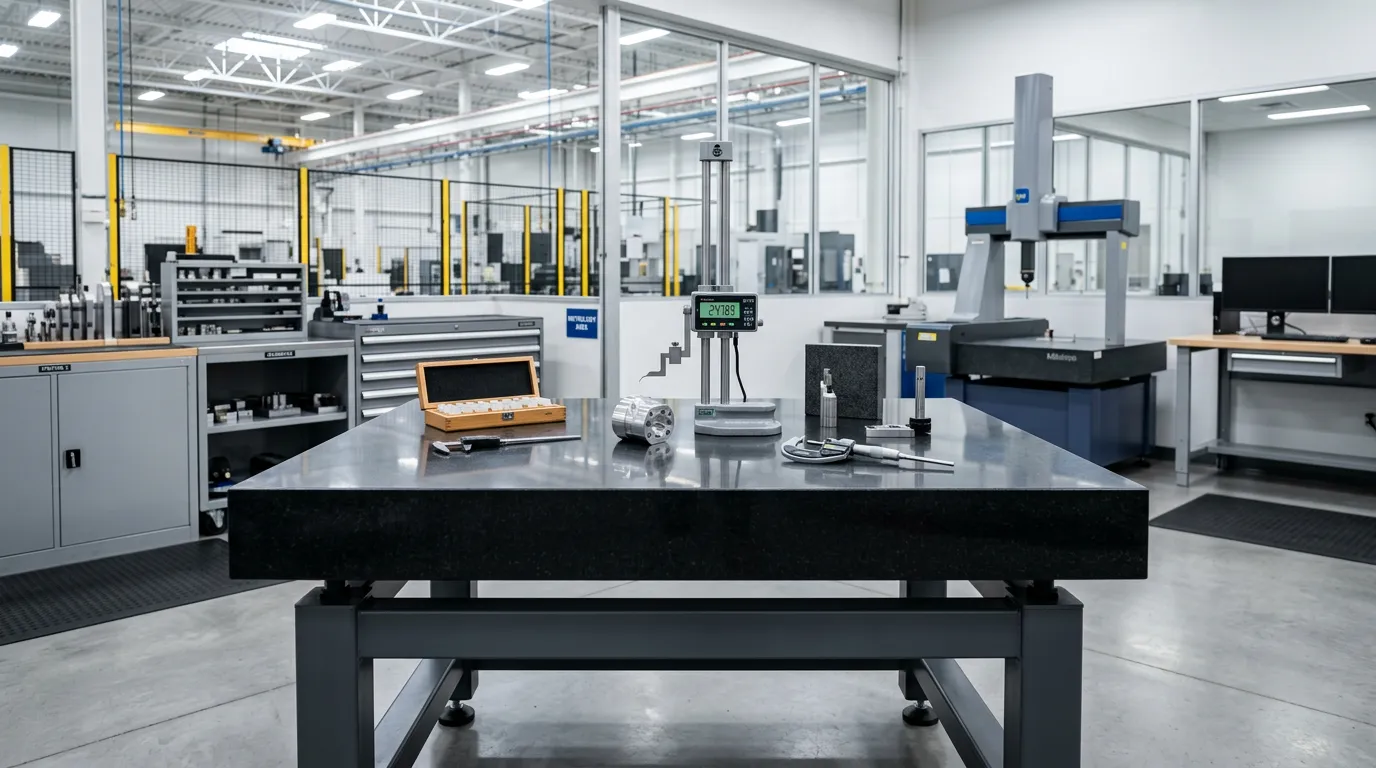
Granite Surface Plate Calibration in Des Moines
For industrial operations throughout Des Moines, Iowa, [granite surface plate calibration](/services/) services are performed directly on-site, eliminating the logistical demands of shipping precision equipment. This ISO/IEC 17025 accredited service employs state-of-the-art Hilger-Watts autocollimators to ensure meticulous flatness verification, providing A2LA certified measurements aligned with ASME B89.3.7 and GGG-P-463C specifications.
The comprehensive service includes wet lap resurfacing for out-of-tolerance plates, a method specifically designed to prevent silica dust generation within the facility environment. Following calibration and any necessary restoration, a detailed certification package, complete with a flatness map and NIST traceability, is issued before the technician’s departure, ensuring immediate compliance and operational continuity.
The Des Moines metropolitan area, encompassing Polk County and surrounding regions, serves as a significant economic engine and industrial hub within Central [Iowa](/iowa-surface-plate-calibration/). A diverse array of manufacturing facilities operates across its industrial corridors, contributing to sectors requiring stringent quality control and dimensional accuracy. In such an environment, the foundational integrity of metrology equipment is paramount, and precision calibration services become indispensable. Maintaining the accuracy of measurement tools directly underpins the quality and consistency of manufactured goods, making routine verification a critical component of operational excellence for these regional enterprises.
Granite surface plates are the bedrock of precision measurement in many Des Moines-area workshops and quality laboratories, providing a stable, highly accurate reference plane for inspection. However, continuous use, even with careful handling, inevitably introduces wear points that can compromise the plate’s flatness. This gradual erosion necessitates periodic [flatness verification and calibration](/services/) to ensure measurements remain within specified tolerances, such as those defined by Grade AA, A, or B classifications. Without regular assessment using instruments like Hilger-Watts autocollimators and methods such as the [Moody Method](/about/), even minor deviations in flatness can lead to significant errors in subsequent product inspection and manufacturing processes.
To support the uninterrupted workflows of these busy Des Moines facilities, on-site surface plate calibration is a highly efficient solution, eliminating the logistical complexities and downtime associated with shipping large, sensitive equipment. During these on-location services, comprehensive calibration is performed, and crucial documentation, including a detailed calibration certificate, is often provided before the technician departs the facility. Should a surface plate be found outside its specified GGG-P-463C or ASME B89.3.7 tolerances, on-site [wet lap resurfacing](/services/) is employed. This advanced technique effectively restores flatness while crucially preventing the generation of airborne silica dust, maintaining a clean and safe work environment.
The integrity of all calibration efforts is upheld through meticulous adherence to industry standards and accreditations. Measurements provided are rigorously NIST-traceable, ensuring a direct link to national measurement standards. A detailed flatness map, including specific data point measurements, accompanies the calibration certificate, clearly documenting the plate’s condition. Furthermore, the grade classification is assigned, providing transparent insight into the plate’s conformance. These services are delivered under the stringent quality management system associated with [ISO/IEC 17025 accreditation](/about/), affirming the technical competence and impartiality of the calibration process for all manufacturing operations in the Des Moines region.
Why Des Moines Businesses Prioritize Accuracy
Extensive Coverage, Rapid Scheduling
On-site granite surface plate calibration is readily available for facilities in Des Moines and across Iowa, with scheduling frequently optimized to minimize operational disruption and avoid equipment shipping requirements.
A2LA Certification for Precision
Accreditation to ISO/IEC 17025, confirmed by A2LA certification, underpins all granite surface plate flatness verifications conducted in the Des Moines area, ensuring NIST traceability for all measurement data.
Enhanced Flatness, No Silica Dust
For manufacturing facilities and metrology labs across Des Moines, wet lap resurfacing processes precisely restore granite surface plate flatness, eliminating the airborne silica dust typically associated with conventional resurfacing techniques.
Frequently Asked Questions
What visual indications might suggest a surface plate requires on-site calibration?
Visible signs of wear, such as dull spots, scratches, or uneven texture in frequently used areas, can indicate a need for calibration. Additionally, if measurement results become inconsistent or challenging to repeat, the plate’s flatness may have degraded.
What type of data is collected using an autocollimator and the Moody Method for flatness verification?
Angular deviation data is collected at various points across the surface plate, typically in a grid pattern. This raw data is then mathematically processed to compute the relative elevation differences and overall flatness profile of the plate.
How does the natural aging of granite contribute to its dimensional stability for metrology?
Granite undergoes a natural stress-relieving process over geological timescales, resulting in a material with minimal internal residual stresses. This inherent stability contributes to its exceptional long-term dimensional integrity, which is crucial for precision metrology.
How do sudden temperature fluctuations affect a granite surface plate’s flatness?
Granite, though having a low coefficient of thermal expansion, can exhibit temporary deformations when exposed to rapid temperature changes. This thermal gradient across the plate can cause transient bowing or cupping, momentarily compromising its flatness.
What is the primary purpose of receiving a comprehensive calibration certificate?
A comprehensive calibration certificate provides verifiable proof of a surface plate’s current accuracy status, essential for quality assurance and audit purposes. It documents traceability to national standards, assuring confidence in subsequent measurements performed on the plate.