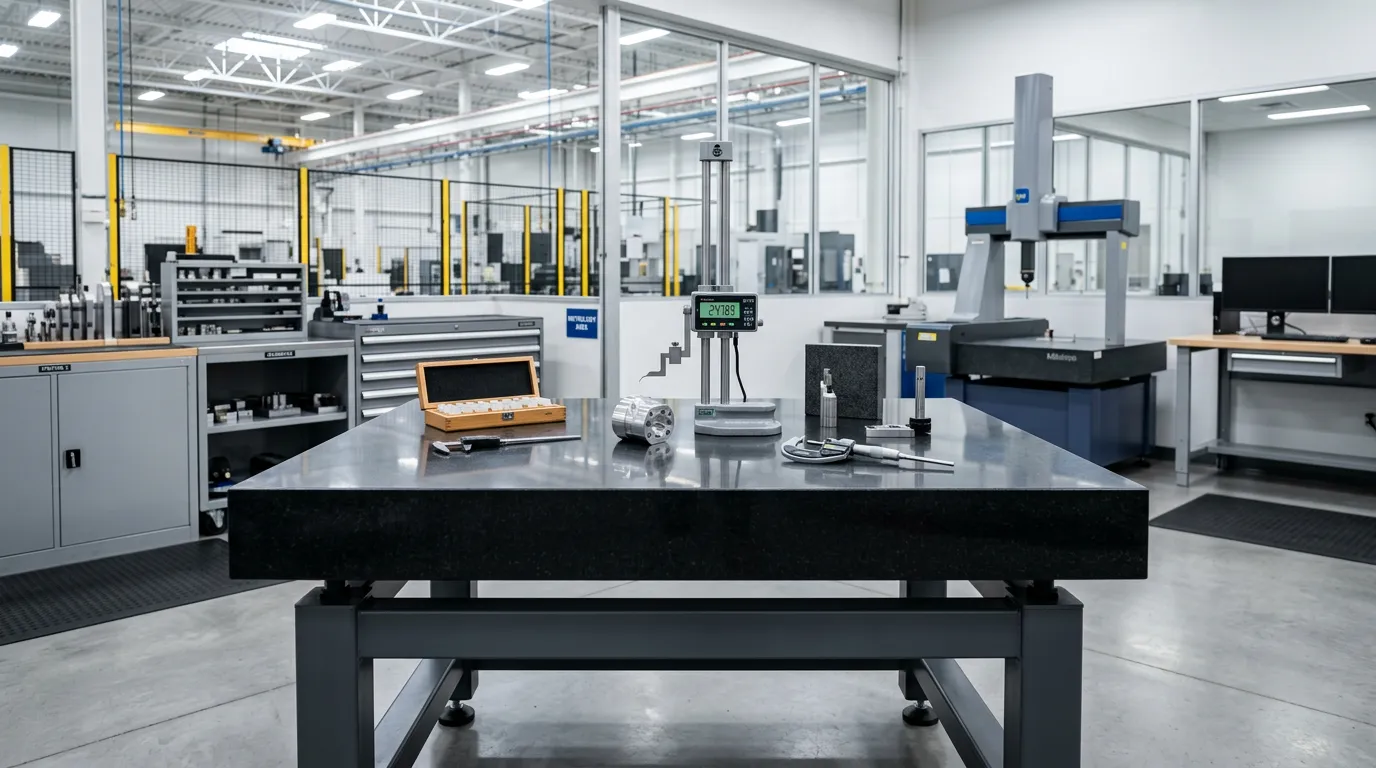
Granite Surface Plate Calibration in Minneapolis
[Precision granite surface plate calibration](/services/) is performed directly on-site for manufacturers throughout Minneapolis and the wider [Minnesota region](/minnesota-surface-plate-calibration/). This essential metrology service carries ISO/IEC 17025 accreditation, ensuring rigorous adherence to international quality standards for flatness verification. Measurements are executed with Hilger-Watts autocollimators, delivering highly accurate data points for GGG-P-463C and ASME B89.3.7 compliance.
Eliminating the need for surface plate shipping, all work is completed within the client’s facility. Out-of-tolerance plates can undergo wet lap resurfacing, a dust-free process that restores accuracy and extends plate lifespan. A comprehensive calibration certificate, detailing NIST traceability and the final Grade AA, A, or B classification, is issued before the technician departs.
As a vital component of the broader Twin Cities metropolitan area, Minneapolis, situated prominently within Hennepin County, supports a significant and varied manufacturing and industrial landscape. Facilities engaged in precision machining, medical device production, advanced electronics, and aerospace component fabrication are found throughout the region, particularly in established industrial corridors such as those near I-94 and I-35W. In environments where micron-level accuracy is paramount, granite surface plates serve as indispensable metrology tools, providing the stable, flat reference plane required for critical inspection, layout, and assembly operations. However, the continuous demands of production, including repetitive contact and abrasive conditions, subject these precision instruments to gradual wear, which can compromise their critical flatness and, consequently, the integrity of all measurements performed upon them.
The maintenance of dimensional accuracy in these demanding manufacturing settings necessitates the periodic calibration and verification of all granite surface plates. Verification processes typically employ high-precision optical instruments, such as Hilger-Watts autocollimators, to precisely map the surface flatness according to established methodologies like the Moody Method. Compliance with federal specifications such as GGG-P-463C and industry standards including ASME B89.3.7 is rigorously assessed. On-site [calibration services](/services/) are particularly valuable to organizations across Minneapolis, [St. Paul](/st-paul-surface-plate-calibration/), and surrounding municipalities like Brooklyn Park or Bloomington, as they eliminate the considerable logistical challenges and production downtime associated with shipping heavy, fragile granite plates to an off-site laboratory. This approach ensures that critical metrology equipment remains available for use with minimal disruption to ongoing operations.
Upon completion of an on-site calibration, comprehensive documentation is provided, often available before the technician departs the facility. This includes an official calibration certificate that establishes NIST traceability for all measurements, a detailed flatness map illustrating specific data point deviations, and a clear classification of the plate’s grade (AA, A, B, or Laboratory). If a plate is found to be outside its specified tolerance, resurfacing can be performed on-site utilizing a [wet lap process](/services/). This method not only restores the plate to its required flatness but also eliminates the generation of airborne silica dust, ensuring a cleaner work environment. Such [accredited services](/about/), grounded in ISO/IEC 17025 standards, are crucial for Minneapolis-area manufacturers to uphold stringent quality control measures and maintain confidence in their measurement processes.
Benefits for Minneapolis Manufacturing Facilities
Areawide Coverage with Fast Scheduling
On-site granite surface plate flatness verification service is performed throughout Minnesota, with scheduling for facilities within the Minneapolis-St. Paul metropolitan area often accommodated swiftly to minimize operational disruption. This direct approach eliminates the need for shipping sensitive metrology equipment.
ISO/IEC 17025 Accredited & NIST Traceable
Throughout the Minneapolis industrial landscape, surface plate calibrations are executed with a commitment to metrological integrity, substantiated by ISO/IEC 17025 accreditation, A2LA certification, and NIST traceability.
Wet Lap Resurfacing for Flatness
When granite surface plates in Minneapolis exhibit wear, wet lap resurfacing is employed to achieve renewed flatness specifications. This advanced technique completely avoids the creation of airborne silica particles, ensuring a clean and safe operational space.
Frequently Asked Questions
What precautions should be taken regarding air currents during surface plate calibration?
Air currents can introduce temperature gradients across the surface plate, leading to localized thermal expansion or contraction that compromises measurement accuracy. Calibration should ideally be conducted in a draught-free environment or with air conditioning systems carefully controlled to minimize airflow. Such stability ensures the plate’s thermal equilibrium is maintained.
What defines the ‘scope of accreditation’ for an ISO/IEC 17025 compliant laboratory performing surface plate calibration?
The scope of accreditation precisely details the specific types of calibrations, measurement ranges, and uncertainties that a laboratory is officially recognized as competent to perform. For surface plate calibration, this would specify the maximum plate size, tolerance grades, and the smallest uncertainty achievable. It confirms the laboratory’s technical capabilities within defined parameters.
Why are larger surface plates more susceptible to deflection errors during calibration than smaller ones?
Larger surface plates, due to their increased mass and surface area, are more prone to gravitational deflection if not adequately supported. These deflections can significantly distort the measured flatness profile, leading to inaccurate calibration results. Proper support placement and leveling are therefore critically important to counteract these forces.
How does repeated heavy loading contribute to a surface plate going out of tolerance?
Repeated heavy loading, especially in concentrated areas, can cause localized compression and wear on the granite surface. This mechanical stress progressively alters the plate’s original flatness, creating depressions over time. The accumulation of such wear eventually pushes the plate’s surface deviations beyond its specified tolerance limits.
What is the primary objective when calibrating a surface plate that has recently undergone resurfacing?
The primary objective when calibrating a resurfaced plate is to verify that the resurfacing process has successfully restored the plate to its specified flatness tolerance. This calibration confirms that the surface now meets the required grade standards, ensuring its renewed suitability for precision measurement. It essentially validates the quality of the resurfacing work.