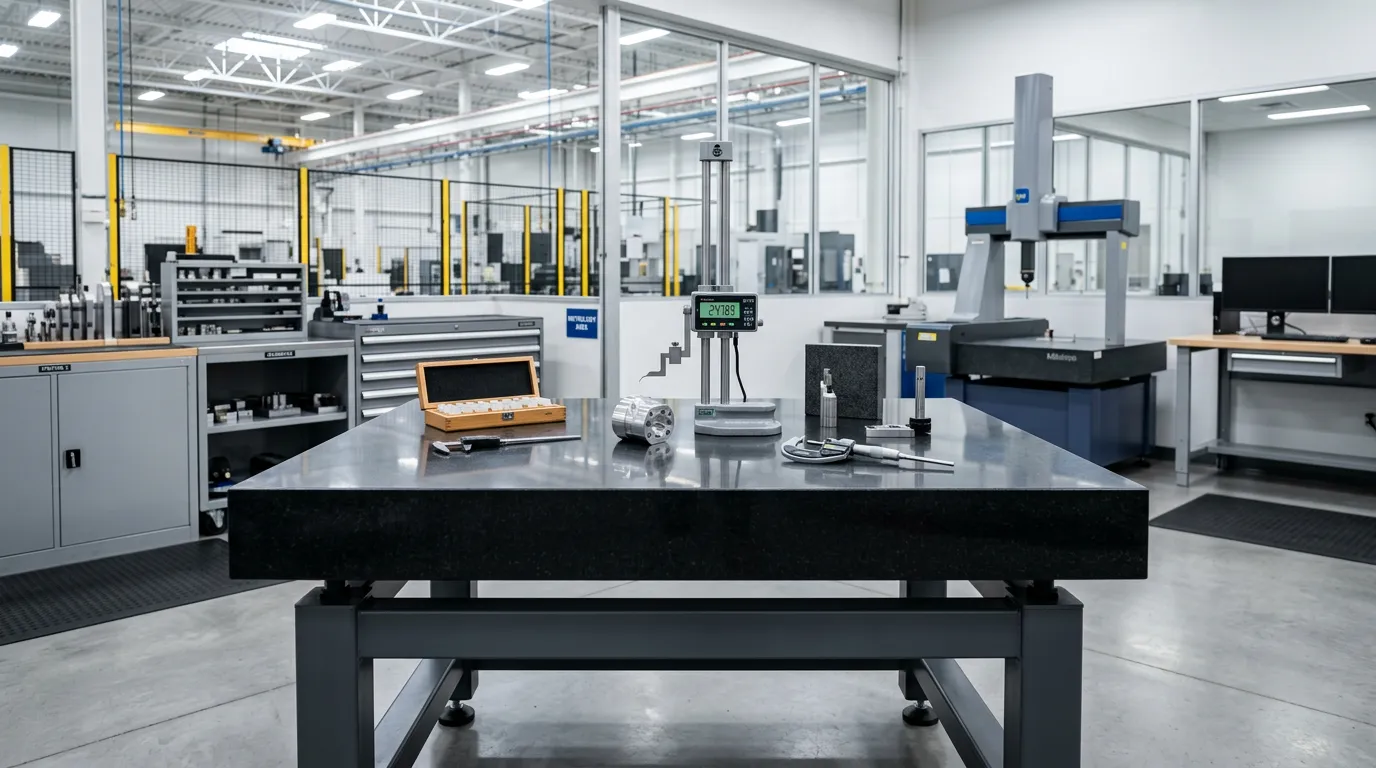
Wisconsin Granite Surface Plate Services
Granite surface plate calibration and resurfacing services are performed directly at client facilities throughout Wisconsin. This on-site approach ensures equipment remains in place, eliminating logistical concerns related to shipping and handling. An ISO/IEC 17025 accredited service, with A2LA accreditation, guarantees adherence to the highest precision metrology standards for all flatness verification procedures.
Rigorous measurements are conducted using Hilger-Watts autocollimators, providing highly accurate data for flatness mapping. Any surface plate found outside tolerance can be restored with wet lap resurfacing, a technique that prevents the generation of airborne silica dust. Immediately upon the service’s conclusion, comprehensive documentation, including NIST traceability, is provided before the technician’s departure.
Wisconsin’s diverse manufacturing landscape, stretching from the bustling industrial corridors of southeastern Wisconsin around Milwaukee and Waukesha to the specialized machinery producers in the Fox Valley and advanced fabrication plants near Madison, consistently demands high standards of precision. In these varied environments, the foundational accuracy of metrology equipment is paramount. Facilities engaged in precision machining, tooling, and quality assurance processes across counties like Dane, Milwaukee, and Outagamie depend on granite surface plates as critical reference planes for dimensional inspection, making their verifiable accuracy an essential component of operational integrity.
Constant use subjects granite surface plates to gradual wear and tear, leading to localized indentations and overall degradation of their flatness over time. This continuous exposure to component movement and measurement tools necessitates periodic flatness verification to ensure continued compliance with specifications such as GGG-P-463C and ASME B89.3.7. Maintaining a plate’s specified Grade AA, A, or B tolerances through regular calibration helps prevent measurement errors that could lead to costly rework, material waste, or quality control failures, impacting production across Wisconsin’s industrial base.
The logistical challenges and potential downtime associated with shipping large, heavy surface plates for off-site calibration are circumvented through on-site service delivery, a significant advantage for busy operations across Wisconsin. Precision flatness verification is performed directly within the facility, utilizing specialized equipment such as Hilger-Watts autocollimators and the Moody Method. Upon completion, a comprehensive calibration certificate, including NIST traceability and a precise flatness map detailing data point measurements, is issued immediately. This streamlined approach minimizes disruption to production schedules while ensuring that vital metrology equipment remains accurately calibrated.
Should a plate be found out of tolerance, resurfacing can restore its accuracy, effectively extending its service life. This process, when required, employs a wet lap resurfacing technique, which prevents the generation of airborne silica dust commonly produced by traditional dry grinding methods, thereby maintaining indoor air quality and facility cleanliness. All measurements and resurfacing activities are performed under an A2LA-accredited ISO/IEC 17025 quality system, guaranteeing the integrity and NIST traceability of every reported result and supporting the stringent quality control requirements of Wisconsin’s manufacturing sector.
The Value for Wisconsin Production Facilities
Broad Coverage, Efficient Booking
On-site calibration services for granite surface plates are consistently deployed across Wisconsin, covering manufacturing hubs from Milwaukee to the Fox River Valley. This enables swift scheduling and eliminates the logistical complexities associated with off-site measurement requirements.
Meeting ISO 17025, A2LA Standards
Surface plate calibration within Wisconsin is performed to the highest metrological integrity, with processes that are ISO/IEC 17025 accredited, yielding A2LA certified and NIST traceable results.
Dust-Free Resurfacing for Accuracy
Wet lap resurfacing is utilized to restore out-of-tolerance granite surface plates to their specified flatness, a technique particularly beneficial for Wisconsin’s diverse industrial operations as it inherently avoids the airborne silica dust created by dry grinding methods.
Frequently Asked Questions
How does the initial calibration interval for a new granite surface plate typically compare to subsequent intervals?
The initial calibration interval for a new surface plate is often recommended to be shorter, such as six months, to establish a baseline and assess its stability in the operational environment. Subsequent intervals can then be adjusted based on the plate’s observed stability, usage patterns, and wear rate.
What are the considerations for calibrating a surface plate located in a production environment with heavy machinery?
Calibration in a production environment requires careful scheduling to minimize interference from nearby machinery, which can induce vibrations or thermal fluctuations. Isolating the plate from these influences, often by performing the calibration during off-hours or employing temporary environmental controls, is crucial. This ensures stable measurement conditions.
How does a laser interferometer differ from an autocollimator for surface plate flatness verification?
A laser interferometer offers highly precise, non-contact measurement of flatness by using the interference patterns of laser beams. While both instruments measure angular deviation, the interferometer can often cover larger areas with higher resolution and may reduce manual data collection compared to a traditional autocollimator.
Why is granite generally preferred over other materials for precision surface plates, especially regarding thermal expansion?
Granite is preferred due to its low coefficient of thermal expansion, which means it undergoes minimal dimensional change with temperature fluctuations compared to metals. This inherent thermal stability is critical for maintaining measurement accuracy in varying environmental conditions. Its vibration damping properties are also beneficial.
What practical steps can be taken to mitigate the effects of localized air currents during a surface plate calibration?
Mitigating localized air currents involves using temporary barriers, curtains, or shields around the surface plate during calibration. Ensuring the HVAC system is stable or temporarily disengaged during measurement can also reduce air movement. These measures help prevent uneven heat transfer and maintain atmospheric stability over the plate.