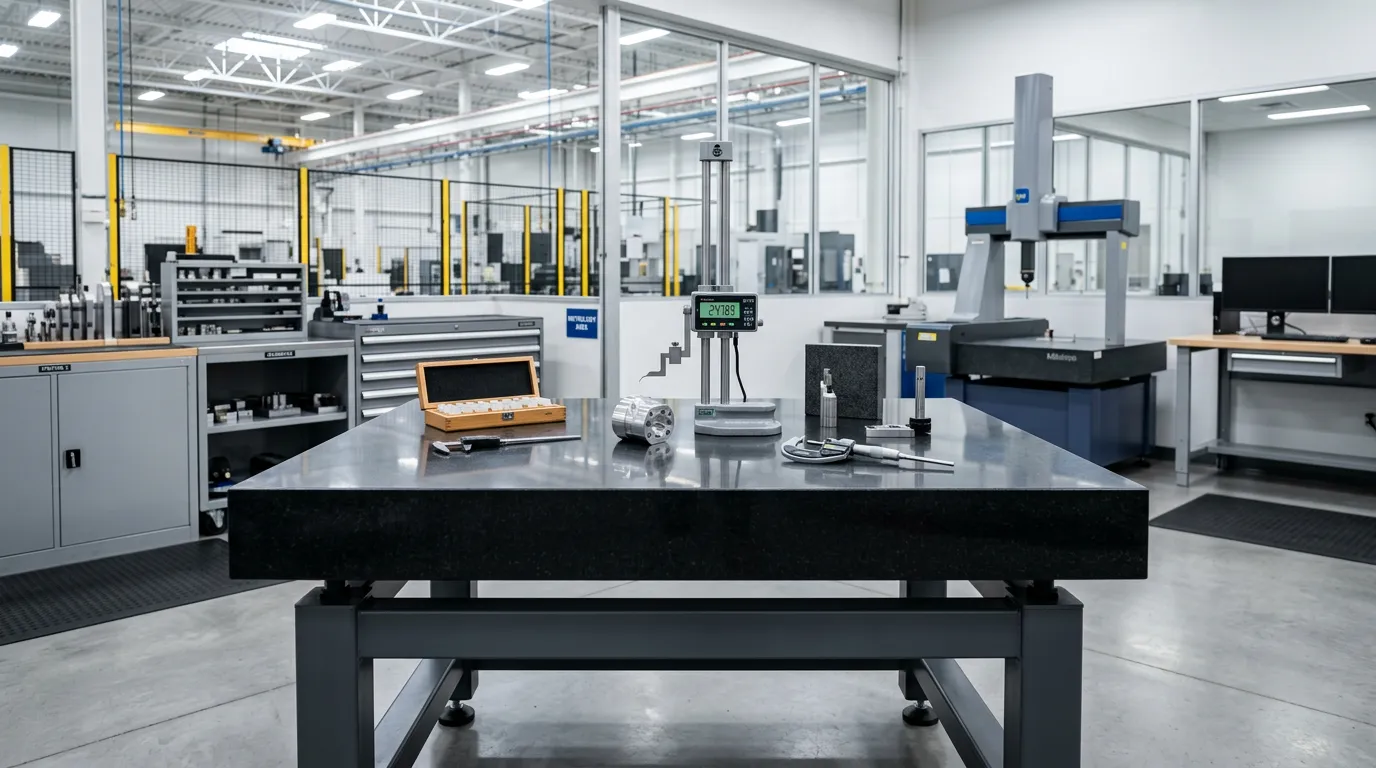
Cedar Rapids Calibration for Granite Inspection Plates
Granite surface plate calibration, critical for maintaining metrological integrity, is delivered on-site throughout Cedar Rapids, [Iowa](/iowa-surface-plate-calibration/). This service operates under ISO/IEC 17025 accreditation, ensuring robust quality management systems are in place. Flatness verification procedures are executed with precision, utilizing Hilger-Watts autocollimators to achieve accurate measurements of Grade AA, A, or B tolerances as specified by ASME B89.3.7 and GGG-P-463C.
The entire [calibration process](/services/) is performed at the client’s facility, eliminating the logistical overhead and potential damage associated with shipping. Should flatness verification reveal out-of-tolerance conditions, [wet lap resurfacing](/services/) is conducted on-site, a dust-free method designed to restore plate accuracy. Comprehensive certification documentation, including NIST traceability, is furnished immediately upon service completion.
Cedar Rapids, a significant economic hub within Linn County, Iowa, hosts a diverse array of manufacturing and industrial operations. The region’s robust production sector, extending along the I-380 corridor towards Iowa City, necessitates stringent quality control and precise metrology across various processes. For facilities engaged in high-precision machining, fabrication, or assembly, the foundational accuracy of measurement tools is paramount. Granite surface plates serve as the critical reference plane for dimensional inspection, making their calibrated condition directly impactful on product quality and operational efficiency throughout [eastern Iowa](/iowa-surface-plate-calibration/).
Over time, the consistent use of granite surface plates leads to cumulative wear, particularly in high-traffic areas, degrading their inherent flatness and overall integrity. This degradation can compromise the accuracy of subsequent measurements, potentially leading to costly production errors or non-conforming parts. Adherence to federal specification GGG-P-463C and industry standard ASME B89.3.7 mandates periodic [flatness verification and calibration](/services/) for these crucial inspection tools. On-site calibration services are designed to integrate seamlessly into busy facility workflows across the Cedar Rapids metropolitan area, eliminating the logistical challenges and downtime associated with shipping large, heavy surface plates to an off-site laboratory.
During on-site calibration, sophisticated equipment, such as Hilger-Watts autocollimators, is utilized to perform precise flatness verification across the entire surface plate, often employing methods like the Moody Method. Measurements are meticulously taken to assess deviations from an ideal plane, followed by a detailed analysis. Where out-of-tolerance conditions are identified, [resurfacing procedures](/services/), including wet lap resurfacing, are conducted to restore the plate’s flatness to within specified Grade AA, A, B, or Laboratory tolerances, crucially eliminating airborne silica dust. All calibration activities are performed under an [ISO/IEC 17025 accredited quality system](/about/), ensuring the highest standards of accuracy and reliability.
Upon completion of the service, comprehensive documentation is provided, including a calibration certificate detailing NIST traceability for all measurements. This critical documentation includes a full flatness map, illustrating data point measurements across the surface, along with the plate’s determined grade classification. This immediate provision of verifiable results allows local manufacturing and industrial operations in Cedar Rapids to promptly resume their inspection processes with confidence in their metrological foundation, supporting continued operational excellence and compliance.
Improving Precision for Cedar Rapids Industry
Servicing Your Area, Fast Turnaround
Precision flatness verification of granite surface plates is conducted on-site for manufacturers throughout Cedar Rapids and across Iowa. Scheduling is managed to ensure prompt service, eliminating the need for equipment shipment and minimizing operational disruption.
NIST Traceable Accuracy Assurance
Surface plate calibrations for facilities in Cedar Rapids are conducted under ISO/IEC 17025 accreditation, further validated by A2LA certification, ensuring all reported flatness measurements maintain strict NIST traceability. This comprehensive approach provides verifiable accuracy for critical industrial metrology.
Precision Wet Lap Method Used
To restore out-of-tolerance surface plates to GGG-P-463C or ASME B89.3.7 specifications for facilities in Cedar Rapids, wet lap resurfacing techniques are utilized, thereby preventing the generation of hazardous airborne silica dust.
Frequently Asked Questions
What is the main objective of standardizing granite surface plate calibration procedures?
Standardization through documents like ASME B89.3.7 and GGG-P-463C ensures consistency and comparability of measurements across different facilities and calibrations. This provides a uniform basis for verifying the dimensional stability and flatness of precision granite surfaces.
How does selecting an inappropriate tolerance grade affect measurement precision?
Using a surface plate with a tolerance grade lower than required for an application introduces avoidable measurement uncertainty. This can lead to inaccurate part inspections or improper tool setup, compromising product quality. The specified tolerance grade should always match or exceed the precision needs of the measurements performed.
Whose responsibility is it to determine the appropriate calibration interval for a surface plate?
The end-user or facility’s quality management system is responsible for establishing the calibration interval. This decision is informed by factors such as usage frequency, environmental stability, criticality of measurements, and historical calibration data for the specific plate.
What is the primary benefit of resurfacing a granite surface plate that has developed wear?
Resurfacing restores the original flatness and overall geometric accuracy of the plate, extending its serviceable life. This process ensures the plate can continue to provide a reliable, precise reference plane for metrological applications.