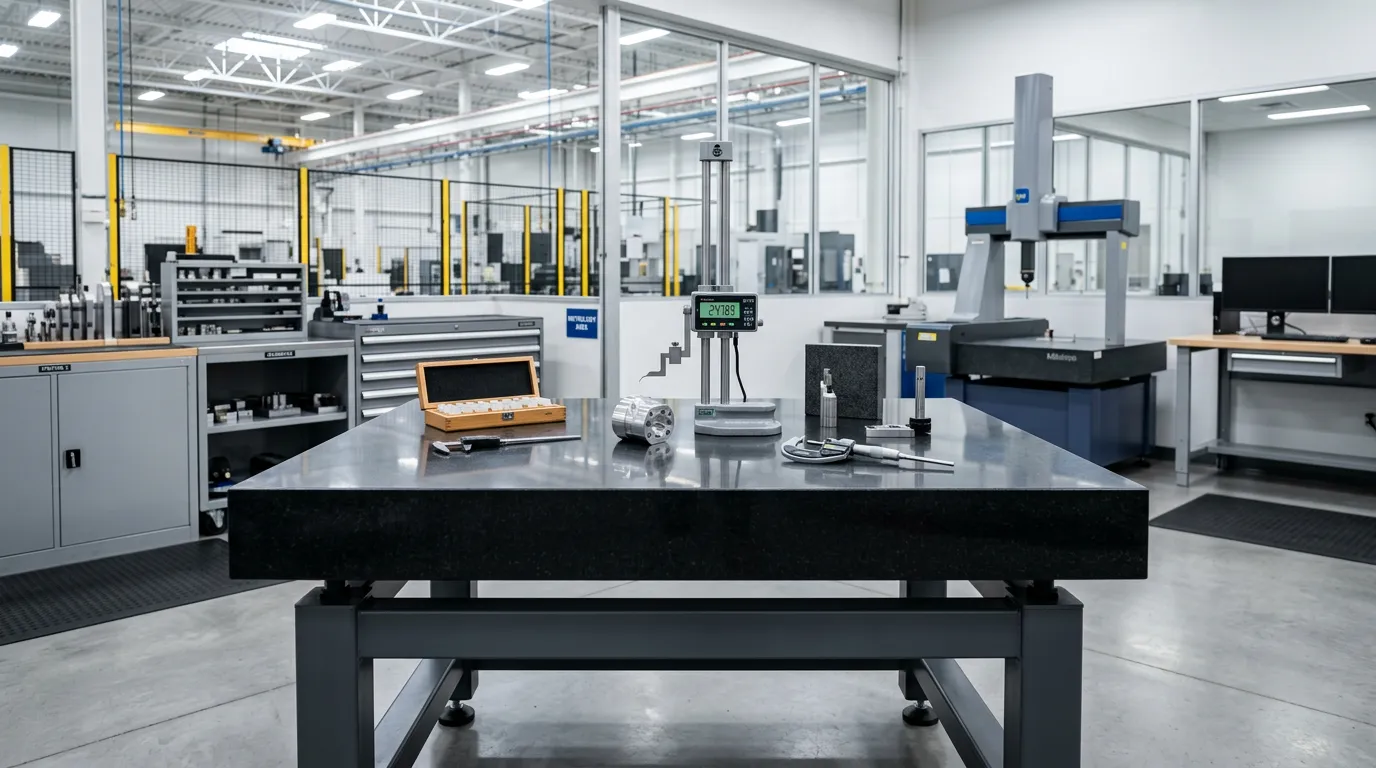
Expert Surface Plate Calibration, Chicago
Precision [granite surface plate calibration services](/services/) are provided directly at facilities across the Chicago, Illinois, region, eliminating logistics challenges associated with shipping large, sensitive metrology equipment. This on-site approach ensures minimal disruption to operations, with all work performed and ISO/IEC 17025 accredited documentation, complete with NIST traceability, issued before the technician’s departure. Flatness verification is executed using advanced Hilger-Watts autocollimators, ensuring adherence to specifications like GGG-P-463C and ASME B89.3.7 for industrial facilities from O’Hare to the South Side.
When surface plates require reconditioning to meet strict metrology standards, [wet lap resurfacing techniques](/services/) are employed. This process efficiently restores out-of-tolerance plates to their specified Grade AA, A, or B flatness, without generating hazardous airborne silica dust. The Moody Method of flatness mapping provides a detailed data point measurement grid, ensuring comprehensive analysis and precision in every calibration performed.
The vast industrial footprint of Chicago and its surrounding metropolitan area, extending across Cook County into the collar counties of DuPage, Will, and Lake, hosts an immense concentration of manufacturing and fabrication facilities. This critical hub for American industry, strategically positioned along major transportation arteries like I-55, I-80, and the I-90/94 corridors, relies heavily on the foundational principles of precision and quality control. Within these diverse production environments, ranging from heavy machinery fabrication to intricate component manufacturing, the integrity of measurement standards is paramount for ensuring consistent output and adherence to specifications.
Granite surface plates serve as the fundamental reference plane for dimensional inspection and metrology operations in countless Chicago-area facilities. Constant use, the movement of components across their surfaces, and environmental factors gradually contribute to wear, compromising the flatness of these critical instruments. Regular [flatness verification](/services/) is therefore essential to maintain the accuracy required for compliance with standards such as GGG-P-463C and ASME B89.3.7. Uncalibrated or out-of-tolerance surface plates can lead to measurement errors, impacting product quality, increasing scrap rates, and potentially causing significant production delays. Periodic [calibration, performed using high-precision autocollimators](/illinois-surface-plate-calibration/) and established methods like the Moody Method, ensures that these workhorses of the shop floor retain their specified Grade AA, A, or B tolerances.
For the busy manufacturing operations throughout the greater Chicago region, minimizing downtime during [calibration procedures](/services/) is a critical consideration. On-site service eliminates the logistical challenges and risks associated with shipping large, heavy surface plates off-site, allowing for the uninterrupted flow of production schedules. During these on-site interventions, wet lap resurfacing techniques are employed when plates are found to be out of tolerance, effectively restoring flatness without generating harmful silica dust. This comprehensive approach includes the provision of same-day certification documentation, affirming NIST traceability and upholding [A2LA accreditation under ISO/IEC 17025](/about/).
Each [calibration service](/services/) performed yields a detailed calibration certificate that establishes NIST traceability, accompanied by a comprehensive flatness map illustrating data point measurements across the plate’s surface. A precise grade classification is assigned—whether Grade AA, A, B, or Laboratory—reflecting the plate’s current accuracy. Should resurfacing be necessary to bring an out-of-tolerance plate back into specification, this process is meticulously executed to ensure the continued reliability of a facility’s most essential metrology asset.
Local Industry Relies on Our Calibration
Statewide Service, Prompt Calibration
Timely on-site calibration of granite surface plates is provided throughout the Chicago metropolitan area and broader Illinois manufacturing corridors. This approach eliminates shipping logistics and rapidly integrates metrology equipment back into operational workflows.
A2LA Certified, NIST Traceable Calibration
Precision metrology services in Chicago, Illinois, provide granite surface plate calibrations fully compliant with ISO/IEC 17025 accreditation and A2LA certification. Each verification is meticulously performed, with all measurement results directly traceable to NIST primary standards.
Silica-Free Wet Lap Resurfacing
The restoration of surface plate flatness for facilities throughout the Chicago metropolitan area is achieved through wet lap resurfacing. This advanced method effectively eliminates the generation of airborne silica dust, a common byproduct of conventional dry resurfacing processes.
Frequently Asked Questions
Which tolerance grade is suitable for inspection and toolroom use?
Grade A is generally suitable for inspection applications, providing a high level of accuracy for critical measurements. Grade B is typically recommended for toolroom use, offering sufficient precision for layout work and general shop processes. The choice depends on the required measurement uncertainty.
What applications typically require Grade AA surface plates?
Grade AA surface plates are designed for master calibration and high-precision laboratory environments. They offer the tightest flatness tolerances, essential for calibrating other measuring instruments or for research applications demanding extreme accuracy. These plates are typically maintained under stringent environmental controls.
What is the recommended calibration frequency for granite surface plates?
A general recommendation for granite surface plate calibration is annually. However, the optimal frequency can vary depending on factors such as usage intensity, environmental conditions, and the criticality of measurements performed on the plate. Heavily used plates or those in demanding environments may require more frequent assessment.
How do factors like usage affect calibration intervals?
High-frequency or heavy-duty use of a surface plate can accelerate wear, necessitating shorter calibration intervals. Plates used for frequent setup work with abrasive materials will likely degrade faster than those used for light inspection tasks. Environmental stability also plays a critical role in maintaining accuracy over time.
Is annual calibration always necessary for all surface plates?
While annual calibration is a common recommendation, it is not universally mandatory for all surface plates. The necessity of annual calibration depends on the plate’s grade, frequency of use, environmental stability, and the organization’s quality management system requirements. A risk-based assessment can help determine appropriate intervals for less critical applications.