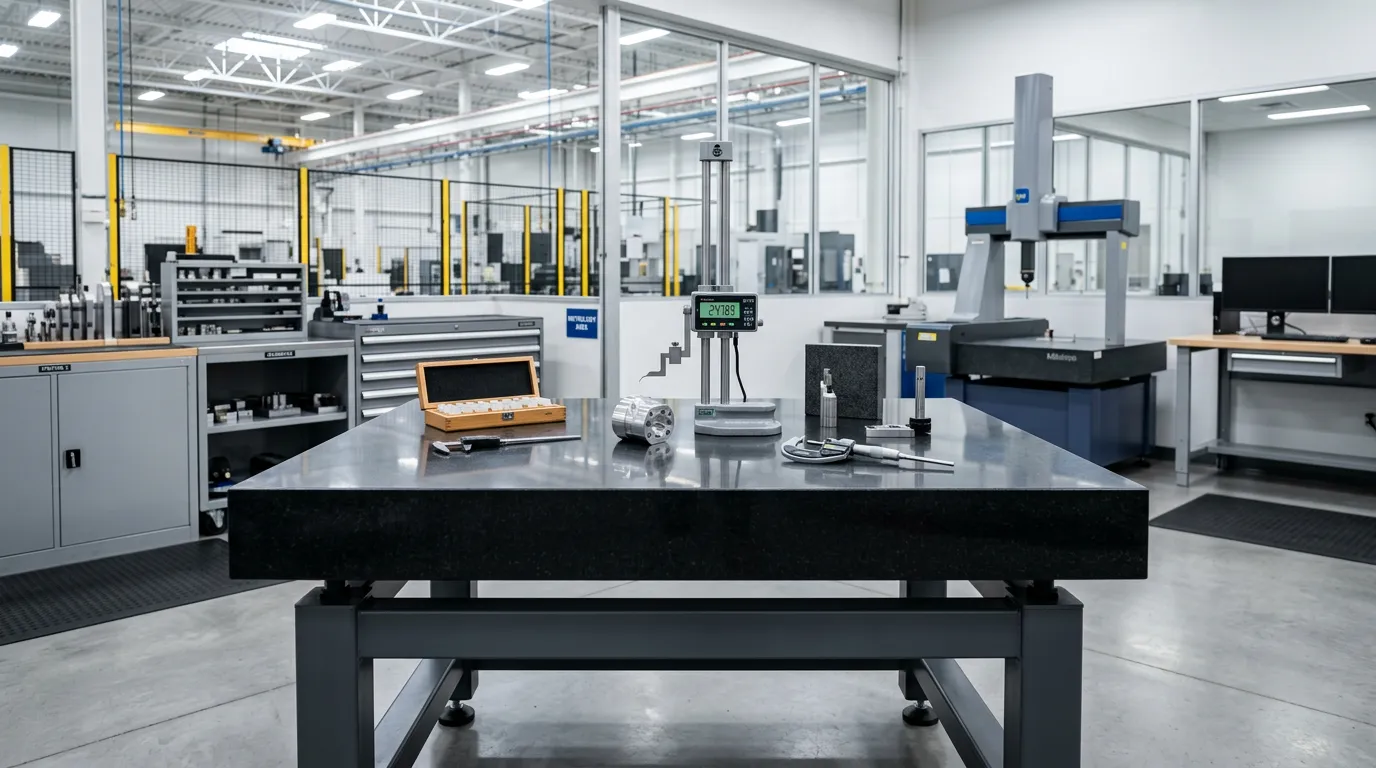
Davenport Granite Surface Plate Services
For industrial operations and manufacturing facilities throughout Davenport, Iowa, accredited [granite surface plate calibration services](/services/) are performed directly on-site. Precision flatness verification is achieved using advanced metrology equipment, including Hilger-Watts autocollimators, ensuring adherence to GGG-P-463C and ASME B89.3.7 standards. This [ISO/IEC 17025 accredited service](/about/) negates the necessity for shipping, with all critical measurements taken within the client’s facility.
Should out-of-tolerance conditions be identified, on-site [wet lap resurfacing](/services/) is performed to restore plates to Grade AA, A, or B tolerances. This method effectively minimizes airborne particulate, providing a cleaner, safer work environment. Before the technician’s departure from the site, comprehensive calibration certificates, featuring NIST traceability and detailed flatness maps, are provided for immediate recordkeeping.
The vibrant industrial landscape of [Davenport, Iowa](/iowa-surface-plate-calibration/), situated within the larger Quad Cities metropolitan area encompassing Scott County and neighboring Rock Island County, hosts a significant array of manufacturing and fabrication operations. These facilities, ranging from heavy machinery production to precision component manufacturing, depend on foundational metrology tools to ensure product quality and adherence to tight specifications. The continued economic vitality of this Mississippi River hub relies on the precision achievable within these diverse industrial settings.
Central to many of these quality control workflows are granite surface plates, serving as the essential datum plane for dimensional inspection and measurement. Despite their inherent stability, these critical tools are subject to gradual wear and localized deformation from constant use and handling. Over time, this wear can compromise the plate’s flatness, leading to inaccuracies in measurements that directly impact product conformity. Consequently, periodic verification of surface plate geometry against standards like GGG-P-463C or ASME B89.3.7 becomes indispensable for maintaining measurement integrity.
To mitigate the impact of this inevitable wear, comprehensive [calibration and resurfacing services](/services/) are provided on-site, directly within Davenport’s manufacturing facilities. This eliminates the logistical complexities and downtime associated with shipping heavy, sensitive equipment off-site. Calibrations are meticulously performed using high-precision Hilger-Watts autocollimators, applying the Moody Method for [flatness verification](/services/). A key benefit of this on-site approach is the provision of complete certification documentation, including a NIST-traceable calibration certificate and a detailed flatness map with data point measurements, before the technician departs.
Furthermore, when a surface plate is found to be out of its specified Grade AA, A, or B tolerances, on-site wet lap resurfacing is available. This process not only restores the plate’s required flatness but crucially eliminates the generation of harmful airborne silica dust, ensuring a safer work environment for personnel in the Davenport area. All measurements and resurfacing work are backed by [ISO/IEC 17025 accreditation and A2LA certification](/about/), guaranteeing the highest levels of accuracy and confidence in the measurement results for local industries.
Enhancing Quality for Davenport Businesses
Regional Reach & Quick Scheduling
For industrial operations across Davenport, Iowa, and the surrounding Quad Cities manufacturing corridor, on-site granite surface plate calibration services are routinely scheduled, minimizing disruption. This direct facility access eliminates the logistical burden and downtime associated with shipping critical metrology equipment.
Accredited Calibration, NIST Traceability
Accuracy of flatness verification for industrial operations in Davenport is supported by ISO/IEC 17025 accreditation and A2LA certification. All measurement results are directly traceable to NIST primary standards, ensuring metrological integrity.
Restoring Flatness with Wet Lapping
For granite surface plates in Davenport experiencing flatness deviations, wet lap resurfacing is performed to restore dimensional accuracy, a method inherently designed to prevent airborne silica dust. This process allows plates to be brought back into tolerance without contaminating the local facility environment.
Frequently Asked Questions
What is the primary method for maintaining NIST traceability for an autocollimator used in surface plate calibration?
Maintaining NIST traceability for an autocollimator involves its periodic calibration against higher-level primary standards, such as calibrated master polygons or angle blocks, which are themselves traceable to NIST. The calibration ensures the autocollimator’s angular measurement accuracy is within specified limits. This chain of traceability ensures the reliability of all subsequent surface plate flatness measurements.
How does the wet lap resurfacing process fundamentally restore the flatness of a granite surface plate?
Wet lap resurfacing fundamentally restores flatness by precisely abrading the plate’s surface with a slurry of abrasive particles and water, typically using a cast iron lap. This controlled removal of material corrects high spots and wear patterns, gradually bringing the entire surface into a uniform plane. The process continues until the desired flatness tolerance is achieved across the entire plate.
What is the typical composition of the abrasive slurry used in wet lap resurfacing, and why is it effective?
The abrasive slurry typically consists of silicon carbide particles suspended in water. Silicon carbide is chosen for its hardness and sharp crystalline structure, which effectively grinds away granite material. The liquid medium ensures uniform distribution of abrasive particles and dissipates heat, facilitating a precise and smooth cutting action.
Why is consistent temperature control necessary in the environment where a granite surface plate is stored?
Consistent temperature control is necessary during storage to prevent thermal expansion and contraction cycles that can induce stress and alter the plate’s flatness over time. Frequent or significant temperature fluctuations can lead to dimensional instability, compromising the plate’s ability to maintain its calibrated accuracy. A stable storage environment helps preserve its metrological integrity.
What is the benefit of using a laser interferometer instead of an autocollimator for certain surface plate calibrations?
A laser interferometer offers higher resolution and accuracy for certain surface plate calibrations, particularly for very large plates or those requiring ultra-precision flatness. It measures linear displacements directly rather than angular deviations, providing a direct measurement of height variations across the surface. This can lead to lower measurement uncertainty in highly demanding applications.