Dubuque Calibration for Granite Inspection Plates
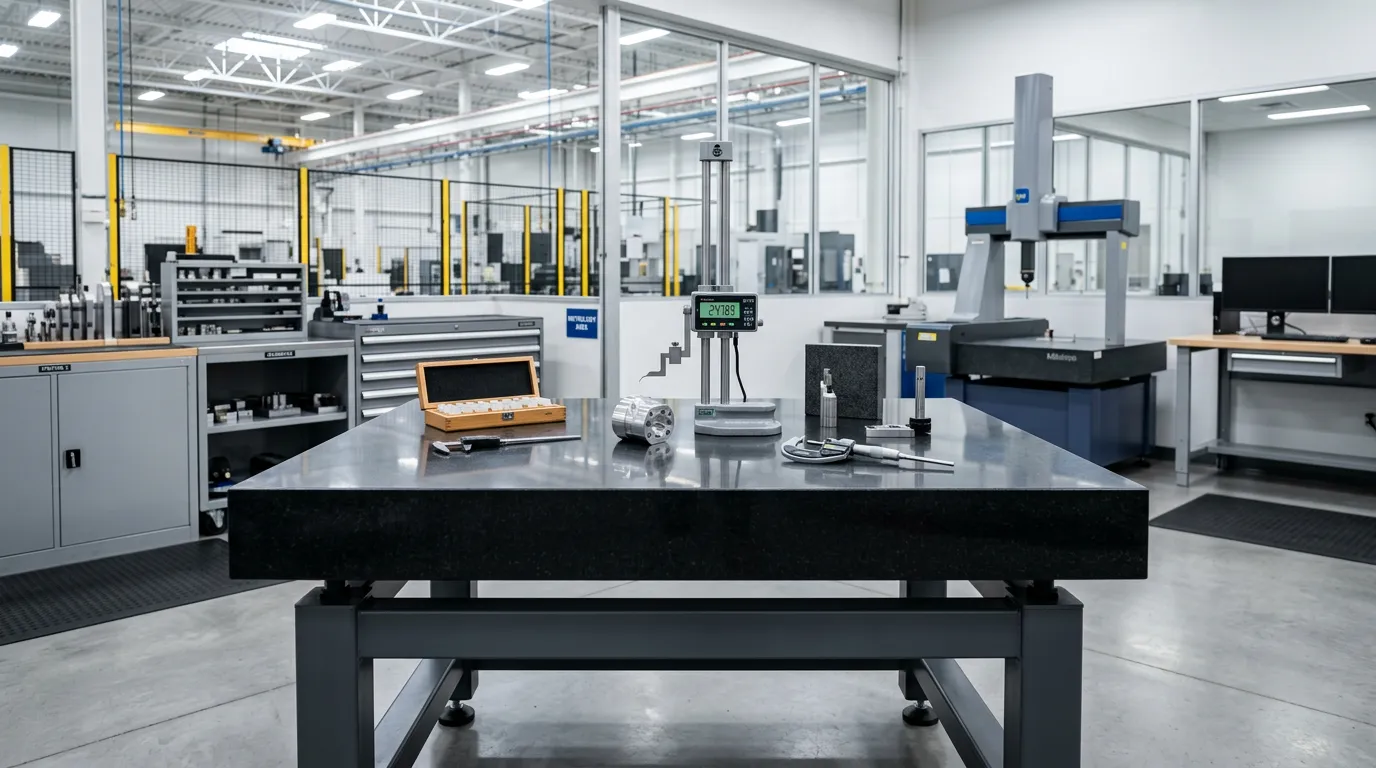
Precision granite [surface plate calibration](/services/) is performed on-site for facilities throughout Dubuque, [Iowa](/iowa-surface-plate-calibration/). This service ensures metrological integrity directly at the customer’s location, eliminating the need for equipment shipping. Measurements are conducted utilizing advanced Hilger-Watts autocollimators, supporting the maintenance of critical manufacturing and inspection platforms through precise flatness verification.
All calibration activities are executed under an A2LA-accredited ISO/IEC 17025 quality system, providing NIST-traceable results. Should a plate fall outside specified Grade AA, A, or B tolerances, wet lap resurfacing is employed to restore flatness without generating airborne silica dust. Comprehensive certification documentation is issued before the technician’s departure, confirming adherence to standards like GGG-P-463C and ASME B89.3.7.
The industrial landscape in Dubuque, Iowa, situated along the Mississippi River in the Tri-State Area, maintains a consistent need for foundational metrology equipment in its diverse manufacturing and fabrication sectors. Operations ranging from heavy machinery production to precision component manufacturing rely extensively on granite surface plates as the baseline for dimensional inspection and quality control. The daily demands placed on these critical inspection tools, through regular use and exposure to shop floor conditions, inevitably lead to wear and a gradual deviation from their original flatness specifications. Such variations necessitate regular, documented [flatness verification](/services/) to ensure sustained accuracy in production processes across Dubuque County and its surrounding economic corridors.
Maintaining the integrity of these metrology assets is paramount for facilities seeking to uphold stringent quality standards. Flatness verification, performed using advanced instrumentation such as Hilger-Watts autocollimators and applying the established Moody Method, provides a precise assessment of a surface plate’s condition. This process determines if a plate remains within the specified Grade AA, A, B, or Laboratory tolerances as defined by standards like GGG-P-463C and ASME B89.3.7. The resulting documentation, including a detailed flatness map with data point measurements, offers verifiable proof of compliance and is essential for adhering to internal quality protocols and external regulatory requirements.
For Dubuque’s busy industrial facilities, on-site [granite plate calibration](/services/) offers significant operational advantages by eliminating the complexities and downtime associated with shipping large, heavy granite plates. Technicians are dispatched to client locations, allowing calibrations and any necessary resurfacing to be completed without removing the equipment from the production environment. A crucial aspect of this service is the provision of immediate, NIST-traceable certification documentation upon completion. Furthermore, out-of-tolerance plates can be restored to their specified grade through [wet lap resurfacing](/services/), a technique that minimizes airborne silica dust, ensuring a cleaner and safer work area during the restoration process. All services are conducted under the stringent guidelines of ISO/IEC 17025, with A2LA accreditation ensuring the highest levels of measurement integrity and reliability for local manufacturers in the region, including those in nearby [Davenport](/davenport-surface-plate-calibration/) and [Cedar Rapids](/cedar-rapids-surface-plate-calibration/).
Local Industry Relies on Our Calibration
Broad Coverage, Efficient Booking
For precision manufacturing and industrial operations in Dubuque, Iowa, and its surrounding industrial corridors, on-site granite surface plate flatness verification is efficiently scheduled. This allows for prompt service deployment, eliminating the logistical requirements and downtime associated with off-site shipping.
Meeting ISO 17025, A2LA Standards
For manufacturing operations in Dubuque, Iowa, granite surface plate calibration services maintain stringent quality, with all measurements NIST-traceable. This adherence is reinforced through ISO/IEC 17025 accreditation and A2LA certification, ensuring metrological integrity.
Dust-Free Resurfacing for Accuracy
Wet lap resurfacing processes restore granite surface plate flatness while inherently eliminating the generation of silica dust. This method ensures environmental safety and prevents contamination within Dubuque’s industrial settings.
Frequently Asked Questions
What critical information is verified during the initial setup of an autocollimator for surface plate calibration?
During initial setup, critical information verified includes the autocollimator’s perpendicularity to the surface plate’s measurement path and its proper focusing. The stability of the stand and the correct alignment of the optical axis are also meticulously checked. These steps ensure that all angular deviation readings accurately reflect the surface plate’s geometry without instrument-induced errors.
How does the surface finish achieved during wet lap resurfacing affect subsequent surface plate performance?
The surface finish achieved during wet lap resurfacing directly affects the plate’s subsequent performance by determining its bearing area and friction characteristics. A very fine, smooth finish reduces wear on gauging instruments and enhances the precision of measurements by minimizing stick-slip effects. A superior finish also contributes to better long-term flatness stability.
What are the inherent risks associated with using a cast iron surface plate in a highly corrosive environment?
In highly corrosive environments, cast iron surface plates are susceptible to rust and pitting, which can severely degrade their surface integrity and flatness. Corrosion creates uneven surfaces, compromising measurement accuracy and potentially damaging precision instruments. Granite plates are typically preferred in such conditions due to their inherent resistance to corrosion.
How does an on-site surface plate calibration typically accommodate varying ambient lighting conditions?
On-site calibration procedures typically account for varying ambient lighting by utilizing specialized illumination or by conducting measurements under controlled conditions where possible. Direct sunlight or inconsistent lighting can create thermal gradients or visual distortions affecting autocollimator readings. Technicians often employ diffusers or temporary enclosures to maintain stable lighting for optimal accuracy.
What is the typical process for handling and installing a very large granite surface plate to prevent damage?
Handling and installing very large granite surface plates typically involves specialized lifting equipment, such as cranes or air-bearings, and experienced personnel to prevent cracking or warping. The plate must be uniformly supported during transport and carefully leveled onto its permanent stand to ensure its inherent flatness is not compromised. Improper handling can induce internal stresses or permanent deformation.
What actions should be taken if a granite surface plate is found to be out of tolerance during calibration?
If a granite surface plate is found to be out of tolerance, the appropriate action depends on the extent and nature of the deviation. Minor deviations might be corrected by adjusting the support points if possible, or by localized spot lapping. More significant deviations typically necessitate professional wet lap resurfacing to restore the plate to its specified tolerance grade.