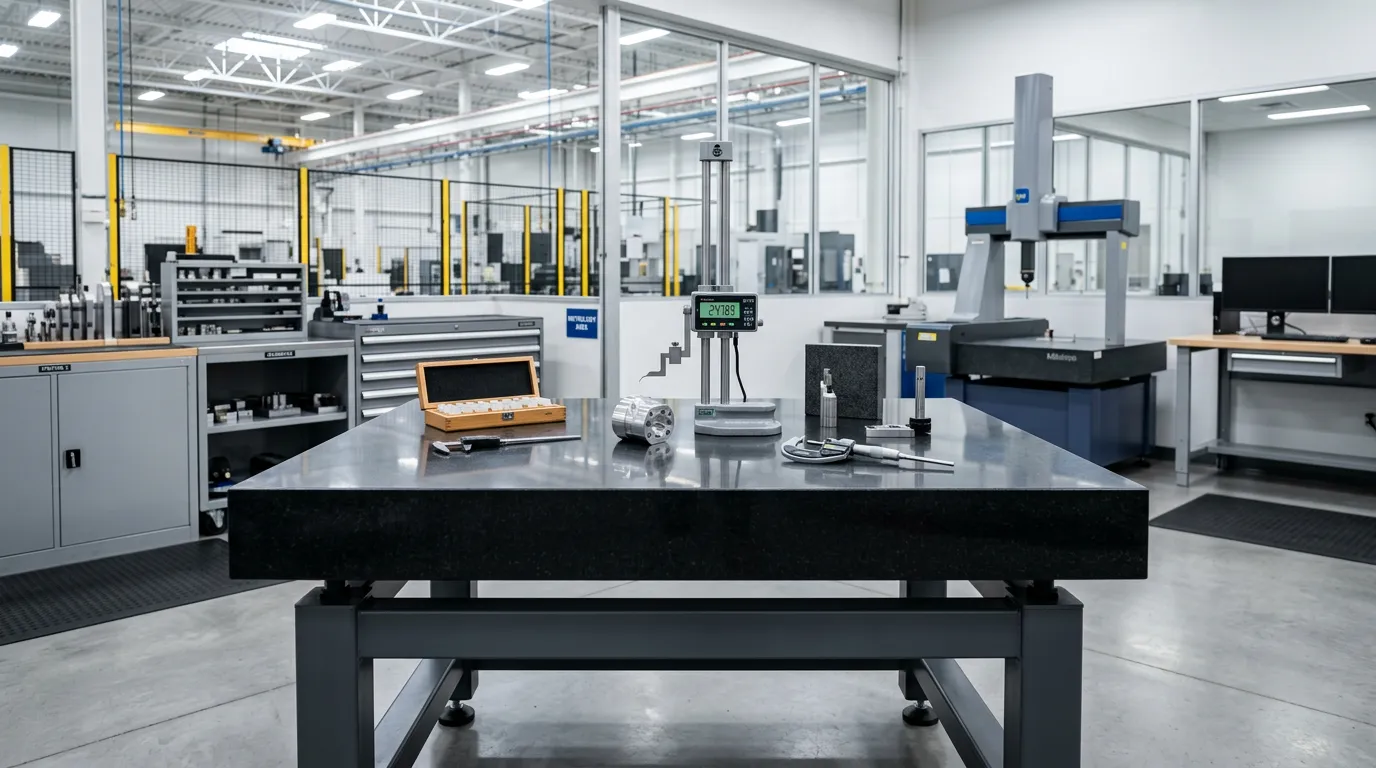
Elgin Calibration for Granite Inspection Plates
Precision [granite surface plate calibration services](/services/) are performed directly at facilities throughout the [Elgin, Illinois area](/illinois-surface-plate-calibration/). This A2LA-accredited service adheres to ISO/IEC 17025 standards, utilizing Hilger-Watts autocollimators for accurate flatness verification. Eliminating the logistics of shipping, all necessary metrology operations are completed on-site, ensuring minimal disruption to production schedules.
When out-of-tolerance conditions are detected, wet lap resurfacing is executed at the client’s location, restoring the surface plate’s integrity without generating airborne silica dust. Comprehensive certification documentation, including NIST traceability and a detailed flatness map, is provided before technicians depart, affirming compliance with specifications such as ASME B89.3.7 or GGG-P-463C.
Elgin, Illinois, situated within Kane County and along the Fox River Valley, represents a notable component of the broader [Chicago metropolitan area’s industrial landscape](/chicago-surface-plate-calibration/). The region, particularly along the I-90 corridor, supports a diverse array of manufacturing and precision engineering operations. Companies here frequently rely on exacting measurements and high-precision tooling for the production of components, assemblies, and finished goods that demand stringent quality control. The enduring presence of these facilities underscores a continuous need for foundational metrology equipment to maintain operational accuracy.
Within these precision-driven environments, granite surface plates are fundamental for dimensional inspection and layout tasks. These critical reference planes serve as the bedrock for verifying the accuracy of gages, fixtures, and machined parts. Over time, despite careful handling, surface plates experience wear from routine use, abrasive contact with workpieces, and temperature fluctuations, leading to deviations in flatness. Regular flatness verification, adhering to federal specifications such as GGG-P-463C and industry standards like ASME B89.3.7, becomes imperative to prevent measurement errors that could compromise product quality and operational efficiency.
To ensure the sustained integrity of these essential measurement tools, [on-site calibration services](/services/) are crucial for facilities throughout Elgin and [surrounding industrial parks](/elk-grove-village-surface-plate-calibration/). This approach minimizes logistical challenges and production downtime, as surface plates remain in their operational setting. Flatness verification is meticulously performed using advanced optical instruments, specifically Hilger-Watts autocollimators, employing the precise Moody Method to map the entire surface. This process yields a detailed flatness map, complete with numerous data point measurements, providing a comprehensive assessment of the plate’s geometric accuracy.
Upon completion of the calibration procedure, traceable documentation is immediately provided, including a calibration certificate detailing NIST traceability and the plate’s assigned grade classification (e.g., Grade AA, A, B). For surface plates found to be out of tolerance, restoration through [wet lap resurfacing](/services/) can be performed. This technique efficiently restores the plate’s flatness while notably avoiding the generation of airborne silica dust, a significant benefit for cleanroom environments. The entire process is underpinned by A2LA accreditation to ISO/IEC 17025, ensuring that all measurements and services meet rigorous international quality standards, a necessity for the precision manufacturing sector in the Elgin area.
Local Industry Relies on Our Calibration
Wide Service Area, Expedited Appointments
Calibration appointments for granite surface plates are conveniently scheduled for facilities across Elgin, Illinois, and the wider Chicagoland manufacturing corridor, with rapid on-site service preventing the need for off-site shipping.
Compliant with ISO/IEC 17025 & NIST
Surface plate calibrations performed for facilities in the Elgin, Illinois, manufacturing sector adhere to ISO/IEC 17025 accreditation, ensuring A2LA certified and NIST-traceable measurement results.
Safe Resurfacing: Wet Lapping Process
The restoration of a granite surface plate’s flatness is achieved through wet lap resurfacing, a method designed to prevent the creation of airborne silica dust typically associated with dry grinding. This process ensures a clean environment while bringing out-of-tolerance plates back to specification.
Frequently Asked Questions
What is the primary purpose of granite surface plate calibration?
Calibration ensures the accuracy and reliability of measurements performed on the surface plate. It verifies the plate’s flatness and overall dimensional integrity against established standards. This process provides confidence in the metrological capabilities of the plate.
How do the ASME B89.3.7 and GGG-P-463C specifications compare in their scope?
ASME B89.3.7 is a voluntary industry standard providing detailed methods and requirements for granite surface plates, including calibration procedures. GGG-P-463C is a federal specification that mandates material, construction, and performance criteria for surface plates procured by U.S. government agencies. Both address flatness and overall quality but differ in their intended application and mandate.
What specific parameters are evaluated during a surface plate calibration?
During calibration, parameters such as overall flatness, repeat reading measurements, and local area variations are evaluated. The stability of the plate’s supporting structure may also be assessed. These measurements confirm the plate’s adherence to specified tolerance grades.
What are the applications for a Grade B surface plate?
Grade B surface plates are typically suitable for general manufacturing, shop floor inspections, and layout work where extreme precision is not the primary requirement. They offer an economical solution for applications needing reasonable accuracy. This grade ensures a working surface sufficient for less stringent metrology tasks.