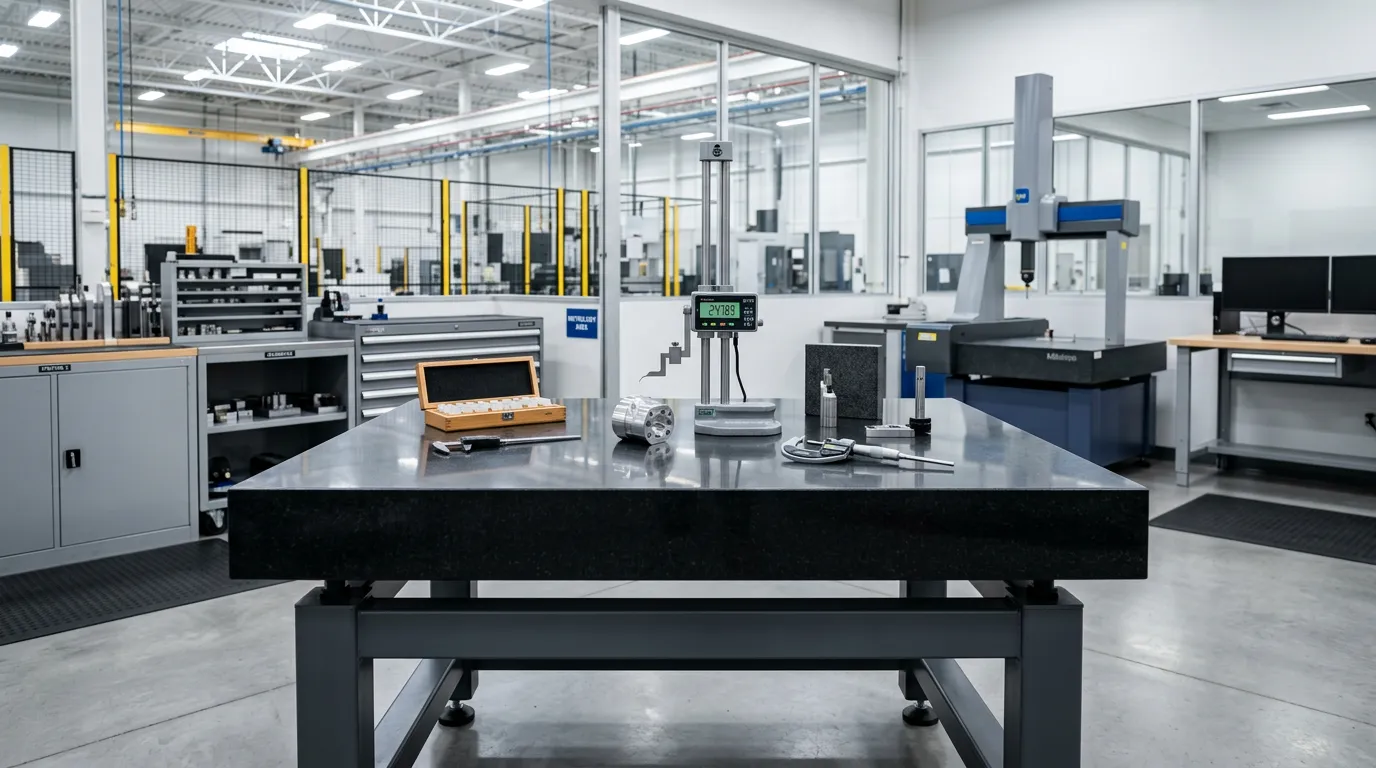
Precision Calibration for Granite Plates, Grand Rapids
Throughout the manufacturing and precision industries of Grand Rapids, Michigan, [ISO/IEC 17025 accredited granite surface plate calibration](/services/) is readily available on-site. Precision flatness verification is performed utilizing advanced Hilger-Watts autocollimators, confirming adherence to specifications such as GGG-P-463C and ASME B89.3.7 for Grade AA, A, or B tolerances.
This dedicated service prevents the need for shipping bulky metrology equipment, as all calibration and potential [wet lap resurfacing](/services/) work occurs directly at the client’s facility. Any necessary restoration to bring plates back within tolerance is completed during the on-site visit, with NIST-traceable certification documentation issued before the technician’s departure.
The manufacturing landscape within Grand Rapids, Michigan, and throughout Kent County is characterized by a robust industrial presence. This [West Michigan economic engine](/michigan-surface-plate-calibration/) supports diverse operations, from automotive suppliers and advanced machining facilities to furniture manufacturers and component fabricators. Precision is paramount in these environments, where the integrity of dimensional measurements directly impacts product quality and operational efficiency. The sustained accuracy of metrology equipment, particularly granite surface plates, is therefore a critical concern for facilities operating across the region.
Granite surface plates serve as foundational reference planes for inspection and assembly processes in countless Grand Rapids-area workshops and quality control departments. Over time, these critical instruments experience wear from regular use, accumulating abrasions and localized high spots that compromise their specified flatness. Such degradation necessitates periodic [flatness verification and calibration](/services/) to maintain adherence to industry standards like GGG-P-463C and ASME B89.3.7. Without routine inspection, plates can drift out of Grade AA, A, or B tolerances, leading to inaccurate measurements and potential production issues.
For busy Grand Rapids manufacturers, [on-site surface plate calibration](/services/) provides a streamlined solution, eliminating the logistical challenges and downtime associated with shipping large, heavy metrology equipment. Calibrations are performed at the client’s facility using high-precision instruments such as autocollimators, often employing the Moody Method to meticulously map the plate’s flatness. Same-day certification documentation is typically provided, ensuring immediate access to verifiable results. This approach minimizes disruption to production schedules and maintains the continuous workflow essential for facilities in industrial corridors extending through cities like Wyoming and [Kentwood](/michigan-surface-plate-calibration/).
The calibration process culminates in the provision of comprehensive service deliverables. These include a detailed calibration certificate demonstrating [NIST traceability](/services/), a precise flatness map outlining data point measurements across the plate’s surface, and an official grade classification (AA, A, B, or Laboratory) based on current specifications. When a plate is found to be out of tolerance, on-site wet lap resurfacing is an available option to restore its accuracy. This method safely eliminates silica dust generation, providing an environmentally cleaner and safer solution than traditional dry sanding techniques, ensuring the plate’s dimensional integrity is fully recovered to meet required standards, supported by ISO/IEC 17025 accreditation and A2LA certification.
Why Grand Rapids Manufacturers Choose Our Service
Statewide Service, Prompt Calibration
On-site granite surface plate calibration services are routinely scheduled with efficiency for operations within Grand Rapids and across Michigan, precluding the necessity of equipment transport.
A2LA Certified, NIST Traceable Calibration
Calibration services for industrial operations in Grand Rapids are executed under ISO/IEC 17025 accreditation, with A2LA certified results consistently achieved. Verifiable NIST traceability is maintained for all flatness verification measurements, upholding stringent quality system compliance.
Silica-Free Wet Lap Resurfacing
Flatness restoration for granite surface plates in Grand Rapids is performed using wet lap resurfacing. This methodology is critical for achieving specified tolerances while actively preventing the creation of airborne silica dust during the resurfacing process.
Frequently Asked Questions
What is the significance of the reported measurement uncertainty on a calibration certificate?
The measurement uncertainty quantifies the doubt associated with the calibration result, providing a range within which the true value is expected to lie. It is critical for assessing the reliability of the measurement and ensuring that the plate’s tolerance grade is confidently met.
How does plate size influence the density of the measurement grid used during calibration?
Larger surface plates typically require a denser measurement grid to adequately map their entire surface and detect localized deviations. This ensures comprehensive flatness verification, as overall flatness can mask significant local imperfections on expansive surfaces.
What preventative measures can be taken to minimize localized wear on a granite surface plate?
Implementing rotation of workpieces, using sacrificial wear plates in high-usage areas, and regularly cleaning the surface help prevent localized wear. Distributing loads evenly and avoiding dragging heavy objects across the surface are also effective measures.
What specific criteria typically trigger a decision for resurfacing rather than just calibration?
Resurfacing is typically warranted when the plate’s overall flatness or local area flatness exceeds the specified tolerance limits significantly, making it impossible to bring back into tolerance through minor adjustments. Visible, deep wear, scratches, or damage also often necessitate resurfacing.
How does NIST traceability extend to the personnel involved in surface plate calibration?
NIST traceability influences personnel by requiring them to be proficient in using traceable equipment and following documented procedures that ensure the integrity of the measurement chain. This involves training, competency assessments, and adherence to quality system requirements.
How does ISO/IEC 17025 accreditation ensure impartiality in surface plate calibration services?
ISO/IEC 17025 requires accredited laboratories to demonstrate impartiality, ensuring that calibration decisions are based solely on objective evidence. This involves structuring the organization to minimize conflicts of interest and implementing policies to safeguard the integrity of calibration results.