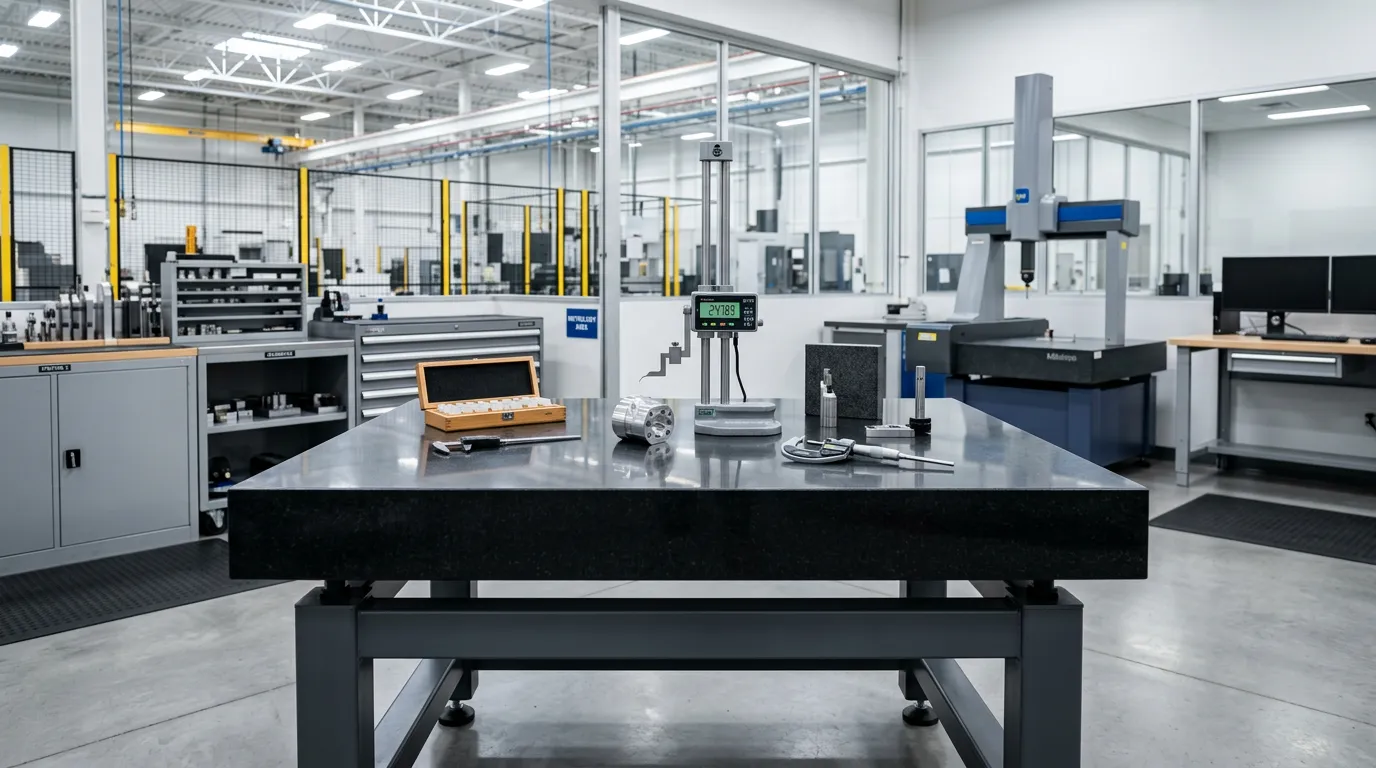
Holland Granite Surface Plate Services
Granite surface plate [calibration and flatness verification services](/services/) are provided on-site across Holland, Michigan, ensuring metrological integrity for local manufacturing and industrial operations. All calibration procedures adhere to stringent ISO/IEC 17025 standards, with measurements performed using high-precision Hilger-Watts autocollimators to achieve accurate Grade AA, A, or B tolerances.
The entire calibration process is conducted at the client’s facility, eliminating the need for shipping and minimizing operational downtime. Out-of-tolerance plates are restored through wet lap resurfacing, a dust-free method. Comprehensive certification documentation, including flatness maps and NIST traceability, is provided before the technician departs the site, ensuring immediate compliance.
Holland, Michigan, situated along the shores of Lake Macatawa and Lake Michigan, forms a vital part of [West Michigan’s robust industrial landscape](/michigan-surface-plate-calibration/). The region, encompassing Ottawa County and extending towards [Grand Rapids](/grand-rapids-surface-plate-calibration/), supports a diverse array of manufacturing operations, from advanced automotive components to specialized machinery and precision tooling. The consistent demand for dimensional accuracy in these sectors necessitates a strong foundation in metrology. Within these facilities, granite surface plates serve as fundamental reference planes for inspection and measurement, directly impacting the quality control processes inherent to precision manufacturing.
The rigorous daily use of granite surface plates in industrial environments inevitably leads to wear and localized degradation of the working surface. Abrasive materials, repetitive part placement, and the weight of measurement equipment can gradually alter a plate’s flatness, diminishing its ability to provide accurate readings. Regular flatness verification is therefore indispensable for maintaining the integrity of these critical measurement tools. Without periodic [calibration](/services/) to standards such as GGG-P-463C or ASME B89.3.7, the reliability of quality assurance processes can be compromised, leading to potential manufacturing defects or costly rework. Calibration procedures typically involve the use of high-precision instruments like Hilger-Watts autocollimators to map the surface topography.
For busy manufacturing facilities throughout Holland and the surrounding areas, the logistical challenges and downtime associated with shipping large, heavy granite surface plates for off-site calibration can be significant. On-site calibration services circumvent these disruptions, allowing for the comprehensive assessment and reconditioning of surface plates directly at the facility. This approach minimizes workflow interruptions, with technicians performing flatness verification using methods such as the Moody Method. Upon completion, a comprehensive calibration certificate is provided, detailing NIST traceability and including a flatness map with data point measurements. This documentation, delivered on the same day the service is performed, confirms adherence to ISO/IEC 17025 and [A2LA accreditation standards](/about/), ensuring metrological integrity.
Beyond routine verification, surface plates found to be out of tolerance can be restored through precision [wet lap resurfacing](/services/). This process is engineered to remove minimal material while re-establishing the plate’s original flatness specification, often bringing it back to Grade AA, A, or B tolerances as required. Critically, wet lap resurfacing generates no airborne silica dust, ensuring a clean and safe environment within the manufacturing facility during the reconditioning process. This capability ensures that aging or worn plates do not require replacement, but can be economically returned to service, complete with a new grade classification, thereby sustaining the West Michigan region’s manufacturing excellence.
Enhancing Quality for Holland Businesses
Broad Coverage, Efficient Booking
On-site granite surface plate calibration services are routinely provided to manufacturing operations throughout Holland, Michigan, and the surrounding industrial corridors. Service appointments, including NIST-traceable flatness verification and GGG-P-463C compliant resurfacing, are typically scheduled with efficiency to minimize operational disruptions.
Meeting ISO 17025, A2LA Standards
Throughout Holland, Michigan’s industrial landscape, precise surface plate calibration relies on an ISO/IEC 17025 A2LA-accredited quality system. This ensures all flatness measurements and grade classifications are fully NIST-traceable, meeting rigorous metrology requirements.
Dust-Free Resurfacing for Accuracy
To restore out-of-tolerance granite surface plates, a wet lap resurfacing technique is utilized. This process precisely re-establishes required flatness for facilities in the Holland, Michigan area, while simultaneously preventing the release of hazardous silica dust into the workspace.
Frequently Asked Questions
Can a surface plate be recalibrated to a less stringent tolerance grade if it no longer meets its original specification?
Yes, a granite surface plate can be re-certified to a lower tolerance grade if it no longer meets its original, higher specification. This typically occurs when wear or damage has accumulated to an extent that prevents meeting Grade AA or A, but still falls within Grade B limits. Re-certification to a lower grade allows the plate to remain in service for less critical applications.
What data points from previous calibration reports are valuable when determining the optimal recalibration interval for a granite surface plate?
Historical data from past calibration reports, including initial flatness readings, deviation trends, and wear patterns, are invaluable for assessing a plate’s stability. Analyzing the rate at which a plate drifts out of tolerance helps in predicting future performance and establishing a pragmatic recalibration schedule. This data-driven approach ensures that calibration frequency is optimized for both accuracy and operational efficiency.
How does the presence of localized pitting or chipping on a surface plate affect the wet lap resurfacing process?
Localized pitting or chipping can complicate the wet lap resurfacing process, requiring more extensive material removal to achieve a uniformly flat surface. These imperfections typically necessitate longer resurfacing times and potentially multiple passes to eliminate. While most surface damage can be corrected, very deep damage may reduce the plate’s overall thickness more significantly during resurfacing.
What are the limitations of using mechanical abrading techniques compared to wet lap resurfacing for achieving high-precision flatness?
Mechanical abrading techniques, such as dry grinding, often introduce localized heat and stress, which can lead to subsurface micro-cracking or uneven material removal. This method typically struggles to achieve the ultra-precise, uniform flatness and mirror-like surface finish characteristic of wet lap resurfacing. The superior control over material removal and heat dissipation in wet lapping is crucial for maintaining high tolerance grades.
What specific preparations should be made regarding facility lighting to ensure optimal conditions for on-site surface plate calibration?
Adequate, uniform lighting free from direct glare is essential to ensure clear visibility for accurate autocollimator readings and visual inspections during on-site calibration. Harsh shadows or inconsistent illumination can obscure surface details and make precise alignment challenging. Adjustments to ambient lighting or the use of supplemental, diffused lighting may be necessary.