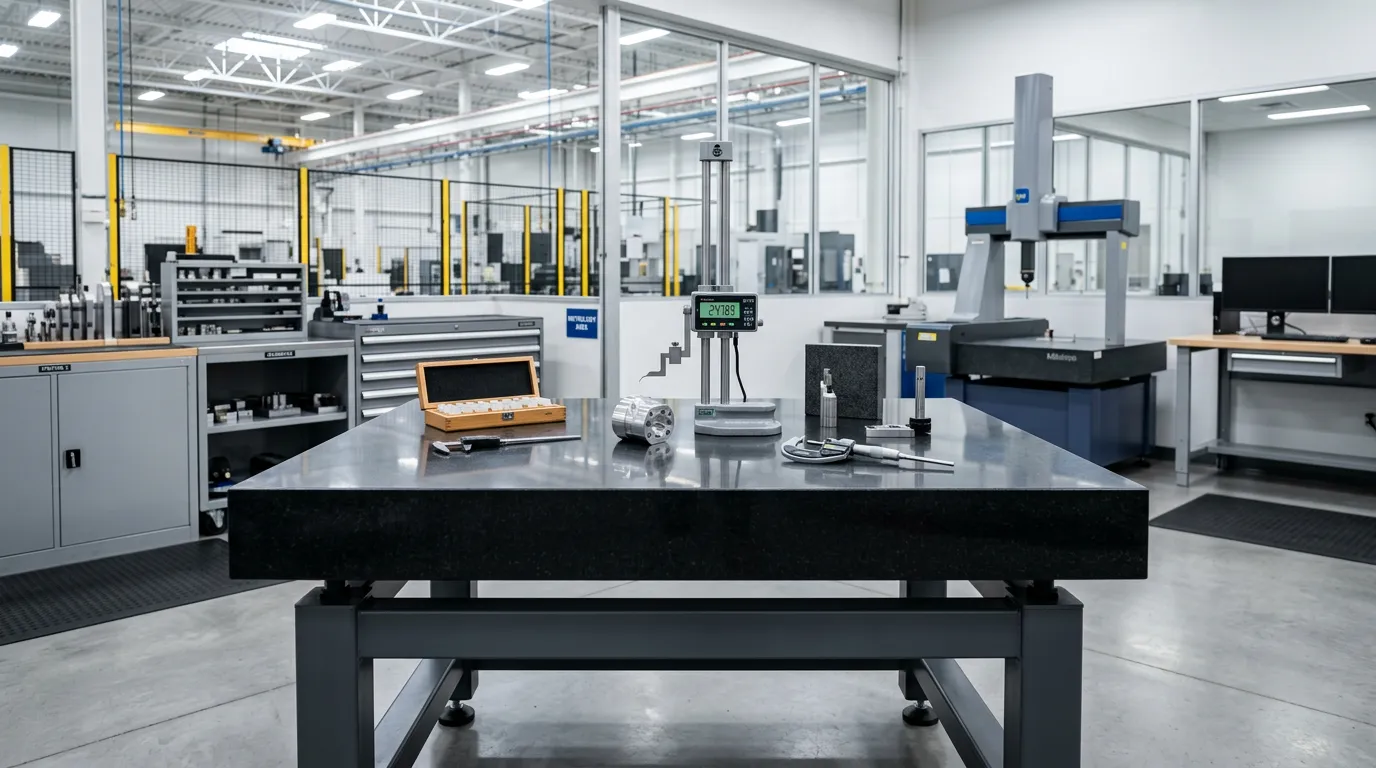
Granite Surface Plate Calibration in Lansing
Accredited [granite surface plate calibration](/services/), compliant with ISO/IEC 17025 standards, is delivered directly on-site throughout [Lansing, Michigan](/michigan-surface-plate-calibration/). Precision flatness verification is conducted utilizing Hilger-Watts autocollimators, ensuring accurate metrological assessment of critical measuring surfaces. This eliminates the necessity for shipping heavy granite plates, as all procedures occur within the client’s facility.
Plates found to be outside specified Grade AA, A, or B tolerances are eligible for on-site restoration through [wet lap resurfacing](/services/). This method not only restores dimensional integrity but also prevents the generation of silica dust. Complete certification documentation, featuring NIST traceability and a detailed flatness map, is issued on the same day as the service completion.
Lansing, situated in central Michigan within Ingham County, forms a significant hub for [industrial activity](/grand-rapids-surface-plate-calibration/) and manufacturing operations. The region, encompassing areas like East Lansing, Delta Township, and Grand Ledge, features numerous production facilities, research centers, and fabrication shops where dimensional accuracy is paramount. Maintaining the integrity of measurement standards is critical for the quality control departments and engineering teams supporting these diverse enterprises. The sustained operational excellence of machinery, tooling, and finished goods relies directly on the precision achieved at every stage of the manufacturing process.
Granite surface plates serve as fundamental reference planes for dimensional inspection throughout the Lansing metropolitan area’s industrial landscape. These precision instruments, essential for verifying components against stringent specifications, are subject to cumulative wear from regular use, abrasive debris, and the constant movement of parts and gages. Over time, this wear can compromise the plate’s inherent flatness, leading to inaccuracies in measurements if not regularly assessed. Adherence to federal specifications like GGG-P-463C and industry standards such as ASME B89.3.7 mandates periodic [flatness verification](/services/) to ensure continued reliability and maintain the required Grade AA, A, or B tolerances.
For the busy manufacturing facilities scattered across Ingham County and its surrounding industrial corridors, on-site calibration services provide a practical solution, eliminating the logistical complexities and downtime associated with shipping large, heavy surface plates. Calibrations are performed utilizing advanced metrology equipment, such as Hilger-Watts autocollimators, often employing the Moody Method for comprehensive data collection. Upon completion, a traceable calibration certificate is provided, detailing NIST traceability, along with a flatness map indicating data point measurements and the plate’s classified grade. Additionally, out-of-tolerance plates can be restored through on-site wet lap resurfacing, a dust-free process that restores the plate’s flatness to within specified limits, all under the umbrella of [ISO/IEC 17025 accreditation](/about/).
Improving Precision for Lansing Industry
Servicing Your Area, Fast Turnaround
On-site granite surface plate calibration is readily available for industrial facilities throughout Lansing and across Michigan, negating the requirement for equipment transport. Scheduling for these precision metrology services is typically expedited to minimize operational downtime.
NIST Traceable Accuracy Assurance
For manufacturers in the Lansing area, surface plate calibrations are delivered with A2LA certification under the rigorous framework of ISO/IEC 17025 accreditation. This process guarantees NIST-traceable measurement results, essential for maintaining precision in quality control.
Precision Wet Lap Method Used
Precision flatness restoration of granite surface plates is achieved in Lansing facilities using the wet lap resurfacing process. This advanced methodology entirely prevents the creation of harmful airborne silica dust, ensuring a cleaner environment during calibration.
Frequently Asked Questions
What is the typical flow of activities from arrival to departure during an on-site granite surface plate calibration visit?
Upon arrival, calibration equipment is carefully unloaded and acclimated to the site’s environmental conditions. The surface plate is then thoroughly cleaned and inspected, followed by the meticulous setup of the autocollimator and measurement instruments. Data collection, often utilizing the Moody Method, is performed across the plate’s surface, after which the equipment is carefully packed, and preliminary findings may be discussed.
How are potential sources of floor vibration isolated or mitigated during the calibration of a high-precision granite surface plate?
Floor vibration is typically mitigated by utilizing specialized vibration-damping pads or tables beneath the surface plate or calibration equipment. Identifying and isolating the source of vibration, such as heavy machinery or foot traffic, is a primary step. The calibration process may also be timed to occur during periods of minimal facility activity to reduce environmental interference.
What is the primary function of the master straightedge when performing flatness measurements using an autocollimator and the Moody Method?
The master straightedge serves as a highly accurate, NIST-traceable reference line or datum against which the surface plate’s flatness deviations are measured. It is positioned along specific grid lines on the plate, providing a consistent path for the autocollimator to traverse. Angular deviations relative to this known straightedge are captured to build a comprehensive flatness profile.
How does the Moody Method compensate for small errors in the placement or leveling of the autocollimator during a measurement sequence?
The Moody Method is inherently designed to compensate for minor autocollimator setup errors through its structured grid measurement and mathematical reduction process. By taking overlapping measurements along multiple intersecting lines and using a least-squares adjustment, the method effectively averages out local setup inconsistencies. This comprehensive data array allows for an accurate global flatness calculation independent of perfect initial instrument alignment.
Why is it standard practice to record multiple angular readings at each grid point during an autocollimator-based flatness verification?
Recording multiple angular readings at each grid point enhances the precision and reliability of the flatness verification by minimizing the impact of random measurement errors. Averaging these readings reduces the influence of localized air currents, subtle vibrations, or minor operator variability. This practice contributes to a lower measurement uncertainty for the overall calibration.
What inherent thermal properties of granite contribute to its superior performance over steel for dimensional stability in metrology?
Granite exhibits a significantly lower coefficient of thermal expansion compared to steel, meaning its dimensions change less dramatically with temperature fluctuations. Additionally, granite has a higher thermal inertia, allowing it to acclimatize more slowly and maintain a stable temperature longer than metallic alternatives. These properties minimize thermal distortion, preserving flatness accuracy.