Select Your Local Service Area:
Precision Calibration for Granite Plates, Michigan
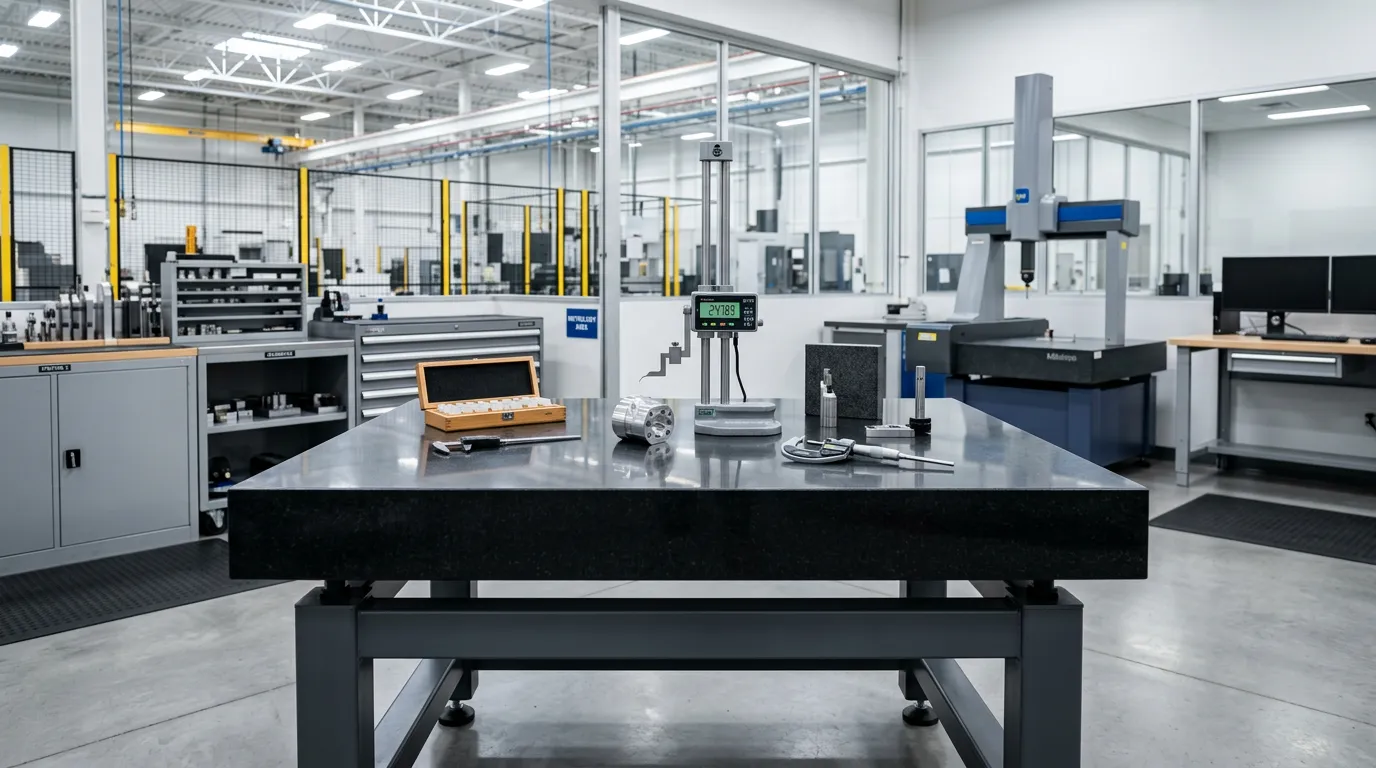
[Granite surface plate calibration services](/services/) are readily available across Michigan’s diverse industrial and manufacturing landscape. On-site procedures eliminate the need for equipment shipping, with all flatness verification and necessary adjustments performed directly at the client’s facility. ISO/IEC 17025 accredited measurements are conducted using precision Hilger-Watts autocollimators.
This meticulous approach ensures compliance with rigorous standards such as ASME B89.3.7. For surface plates found to be outside specified Grade AA, A, or B tolerances, [wet lap resurfacing](/services/) accurately restores geometry without generating harmful silica dust. Traceable documentation, including comprehensive flatness maps and grade classifications, is furnished before the technician departs the facility.
Michigan’s expansive industrial base, stretching from the automotive heartland of Southeast Michigan across the manufacturing corridors of I-94 and I-75, and into the [precision machining hubs around Grand Rapids](/grand-rapi d s – s u r f a c e – p l a t e – c a l i b r a t i o n /) and the Saginaw Valley, relies heavily on foundational metrology. Across countless facilities in counties like Oakland, Macomb, Wayne, Kent, and Genesee, robust manufacturing operations necessitate consistent accuracy. This widespread reliance on precise measurement underpins the state’s economic output, where components ranging from complex aerospace parts to intricate medical devices and automotive tooling are regularly produced, demanding the highest levels of dimensional integrity.
Within these diverse manufacturing environments, granite surface plates serve as critical reference planes for inspection, layout, and calibration tasks. Over time, these plates inevitably experience localized wear from constant use, impacting their flatness and overall accuracy. Adherence to stringent federal specifications like GGG-P-463C and industry standards such as ASME B89.3.7 is paramount for maintaining product quality and interchangeability. Therefore, periodic [flatness verification and recertification](/services/) are indispensable to ensure that these metrology tools continue to provide a true and stable reference for precision work, preventing costly errors and maintaining compliance with quality management systems like ISO/IEC 17025.
The logistical challenges associated with transporting heavy and delicate granite surface plates for off-site calibration can severely disrupt production schedules in Michigan’s busy facilities. [On-site calibration services](/services/) circumvent this issue, allowing plates to be verified and, if necessary, resurfaced directly within their operational environment. Using specialized equipment, such as Hilger-Watts autocollimators and the Moody Method, flatness measurements are meticulously taken, and a detailed flatness map with data point measurements is generated. This on-site approach minimizes downtime, ensuring that critical inspection stations remain operational, with comprehensive, [NIST-traceable certification documentation](/services/) provided immediately upon service completion.
Beyond initial verification, out-of-tolerance surface plates can often be restored to specified accuracy grades (AA, A, or B) through a process of wet lap resurfacing. This method effectively removes minute layers of granite, restoring the plate’s flatness while eliminating airborne silica dust, which is a common concern with traditional dry grinding methods. Such comprehensive on-site service, backed by [A2LA accreditation](/about/), provides Michigan manufacturers with a reliable means to maintain their metrology infrastructure, ensuring sustained precision and compliance without the logistical burden of shipping critical equipment.
Benefits for Michigan Manufacturing Facilities
Areawide Coverage with Fast Scheduling
On-site granite surface plate calibration services are efficiently scheduled for facilities throughout Michigan’s manufacturing regions. Rapid deployment of precision metrology equipment directly to the work site eliminates the logistical complexities and downtime associated with off-site shipments.
ISO/IEC 17025 Accredited & NIST Traceable
Throughout Michigan, granite surface plate calibrations are conducted within an ISO/IEC 17025 accredited framework, guaranteeing A2LA certified and NIST-traceable measurement results. This commitment to metrological integrity ensures verifiable accuracy across industrial applications.
Wet Lap Resurfacing for Flatness
Wet lap resurfacing procedures are conducted on granite surface plates in Michigan to restore precise flatness. This method specifically eliminates airborne silica dust generation, promoting a cleaner and safer calibration environment.
Frequently Asked Questions
What are the risks of extending a calibration interval beyond the recommended period?
Extending calibration intervals increases the risk of undetected wear or deformation, leading to unreliable measurements and potential quality control failures. This can result in the production of non-conforming parts or inaccurate inspection data, impacting overall product integrity.
How does wet lap resurfacing compare to plate replacement in terms of long-term cost-effectiveness?
Wet lap resurfacing is generally more cost-effective than replacing a granite surface plate, especially for larger or specialty plates. It extends the life of existing assets, preserving the investment in the original plate and its supporting structure.
Why is it important to stabilize the room temperature before an on-site surface plate calibration?
Stabilizing room temperature allows the granite surface plate to thermally acclimate to its environment, minimizing thermal expansion or contraction that could temporarily alter its flatness. Calibrating a plate that is not thermally stable introduces significant measurement uncertainty.
How is measurement uncertainty minimized when using an autocollimator for flatness verification?
Measurement uncertainty is minimized through careful instrument setup, proper thermal acclimatization of the plate, and adherence to established calibration procedures like the Moody Method. The use of high-quality optical components and stable stands also contributes to reduced uncertainty.
How does granite’s vibration dampening property compare to cast iron for precision metrology?
Granite possesses superior vibration dampening characteristics compared to cast iron, absorbing mechanical vibrations more effectively. This inherent property helps create a more stable measurement platform, reducing the transmission of external disturbances to sensitive metrology equipment.