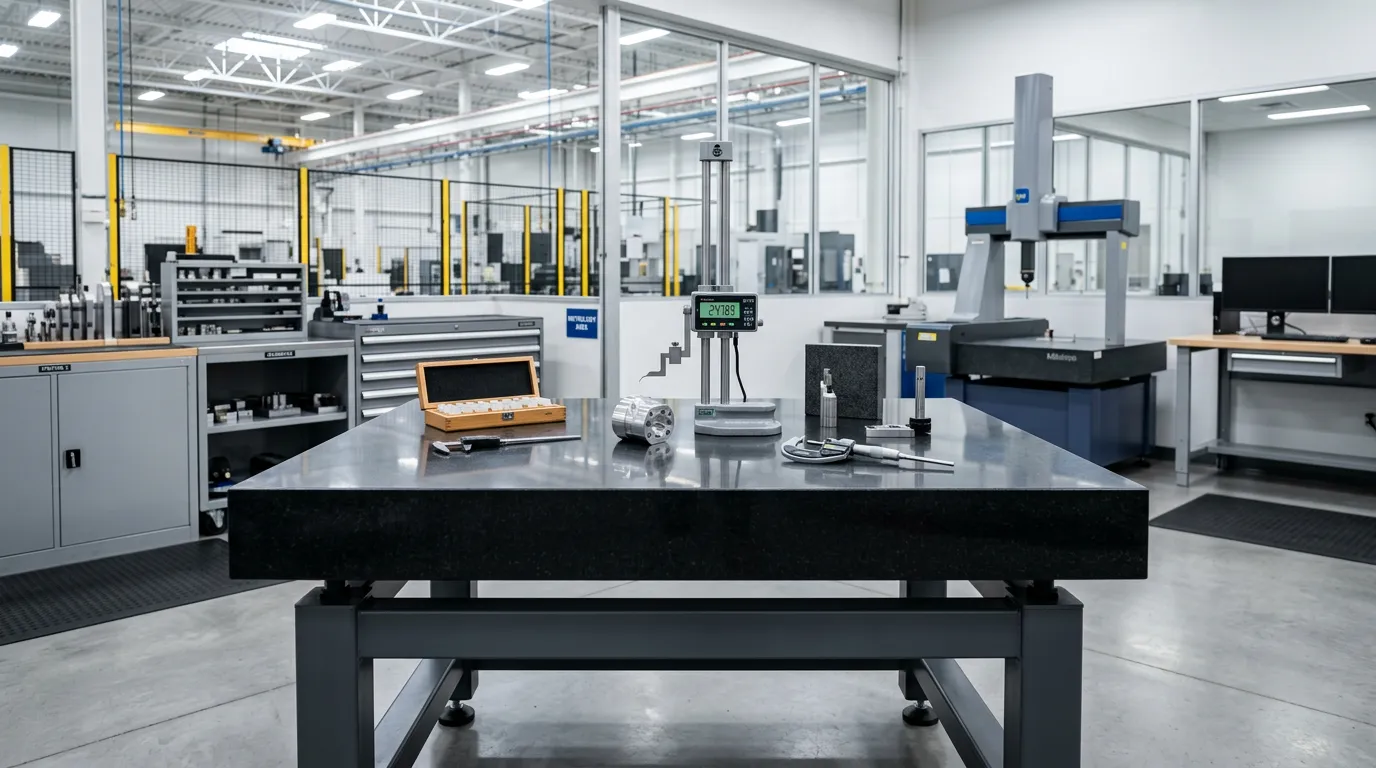
Maintain Flatness: Racine Calibration
Precision [granite surface plate calibration](/services/) is performed on-site throughout Racine, Wisconsin, maintaining essential accuracy for local industrial operations. This specialized service carries ISO/IEC 17025 accreditation, providing assurance of technical competence and consistent results. Flatness verification procedures utilize advanced Hilger-Watts autocollimators, ensuring meticulous measurement against standards like GGG-P-463C and ASME B89.3.7.
The on-site model means no plate shipping is necessary, as all calibration work occurs directly at the facility. Out-of-tolerance plates can be restored through wet lap resurfacing, which minimizes airborne silica dust, while immediately following service, full NIST-traceable certification documentation is supplied. Grade classifications, including AA, A, or B tolerances, are determined and reported on the same day.
Situated along the western shore of Lake Michigan, Racine, [Wisconsin](/wisconsin-surface-plate-calibration/), has a deep-rooted industrial heritage, serving as a vital component of the broader [Milwaukee](/milwaukee-surface-plate-calibration/)-Racine-[Waukesha](/waukesha-surface-plate-calibration/) metropolitan area’s manufacturing footprint. The city and its surrounding Racine County are home to diverse industrial operations, ranging from heavy equipment fabrication to advanced components production. Throughout this southeastern Wisconsin corridor, precise dimensional metrology forms the foundation of quality control and product integrity. The sustained accuracy of measurement tools, particularly granite surface plates, is therefore critical for maintaining the high standards expected by these varied manufacturing and assembly facilities.
Surface plates function as the primary reference plane for dimensional inspection, enabling the accurate gauging of parts and tooling. In busy production environments across Racine, these essential metrology tools are subjected to daily wear and tear from part handling, instrument drag, and environmental factors. Over time, this consistent use can degrade the plate’s critical flatness, leading to measurement uncertainty and potential quality issues. Regular flatness verification is indispensable for ensuring that inspection processes remain reliable, preventing costly errors, and upholding product specifications within the demanding tolerances common in local industries.
Precision [granite plate calibration](/services/) involves the use of specialized instrumentation, such as autocollimators, to precisely map the plate’s topography. This process determines whether the surface plate conforms to federal specification GGG-P-463C or ASME B89.3.7 standards and verifies its assigned Grade AA, A, or B classification. A comprehensive flatness map with data point measurements is generated, alongside an accredited calibration certificate featuring NIST traceability. This critical documentation provides a clear, verifiable record of the plate’s condition, assuring compliance and operational integrity for facilities throughout the region.
On-site service minimizes disruption to operations in Racine-area facilities, eliminating the need to ship critical equipment off-site. Calibrations are performed at the client’s location, allowing surface plates to be returned to service quickly. If a plate is found to be out of tolerance, [plate calibration and resurfacing](/services/) using a wet lap process can restore its precision and extend its service life, all without creating silica dust. This efficient approach ensures that essential measurement capabilities are maintained with minimal downtime, providing immediate documentation upon completion, thereby supporting continuous quality assurance for southeastern Wisconsin’s industrial sector.
Improving Precision for Racine Industry
Wide Service Area, Expedited Appointments
On-site granite surface plate calibration, including flatness verification, is regularly dispatched across Wisconsin, servicing industrial operations in Racine and surrounding areas. Scheduling is typically managed to facilitate prompt service delivery, removing the need for plate shipment.
Compliant with ISO/IEC 17025 & NIST
Calibration services provided in the Racine area deliver results with NIST traceability, supported by ISO/IEC 17025 accreditation and A2LA certification.
Safe Resurfacing: Wet Lapping Process
For out-of-tolerance granite surface plates in the Racine area, flatness restoration is accomplished through wet lap resurfacing. This specialized process ensures that hazardous silica dust generation is fully eliminated during the work.
Frequently Asked Questions
How does the ‘local area flatness’ specification relate to the ‘overall flatness’ requirement for a surface plate?
Overall flatness specifies the maximum deviation across the entire surface of the plate, encompassing the highest and lowest points. Local area flatness, conversely, limits the deviation within a smaller, defined area, typically a 24-inch diameter circle, ensuring consistent accuracy for localized measurements. Both are critical for comprehensive evaluation.
What aspects of the manufacturing process can influence a granite surface plate’s ability to maintain its flatness over time?
Factors such as the quality of the granite material, proper stress relief during manufacturing, the precision of the initial lapping process, and the design of the support points all influence a plate’s long-term flatness stability. Inadequate attention to these details can lead to premature degradation of accuracy.
How does the systematic grid pattern of the Moody Method aid in comprehensive surface plate flatness assessment?
The systematic grid pattern defined by the Moody Method ensures that all critical areas of the surface plate are measured. This methodical approach allows for thorough data collection, enabling accurate calculation of overall and local area flatness deviations across the entire surface. It helps ensure no areas are overlooked during flatness verification.
What unique properties of black granite make it a preferred material for high-precision surface plates compared to other granite types?
Black granite typically exhibits superior density, lower water absorption, and often a finer grain structure compared to other granite types, such as pink or gray. These properties contribute to its enhanced rigidity, wear resistance, and thermal stability, making it ideal for the most demanding metrology applications.
What constitutes a sufficient thermal acclimatization period for a surface plate prior to calibration?
A sufficient thermal acclimatization period allows the surface plate to reach a stable, uniform temperature equilibrium with the calibration environment. This period can range from several hours to 24-48 hours, depending on the plate’s size and the temperature difference, ensuring dimensional stability during measurement.