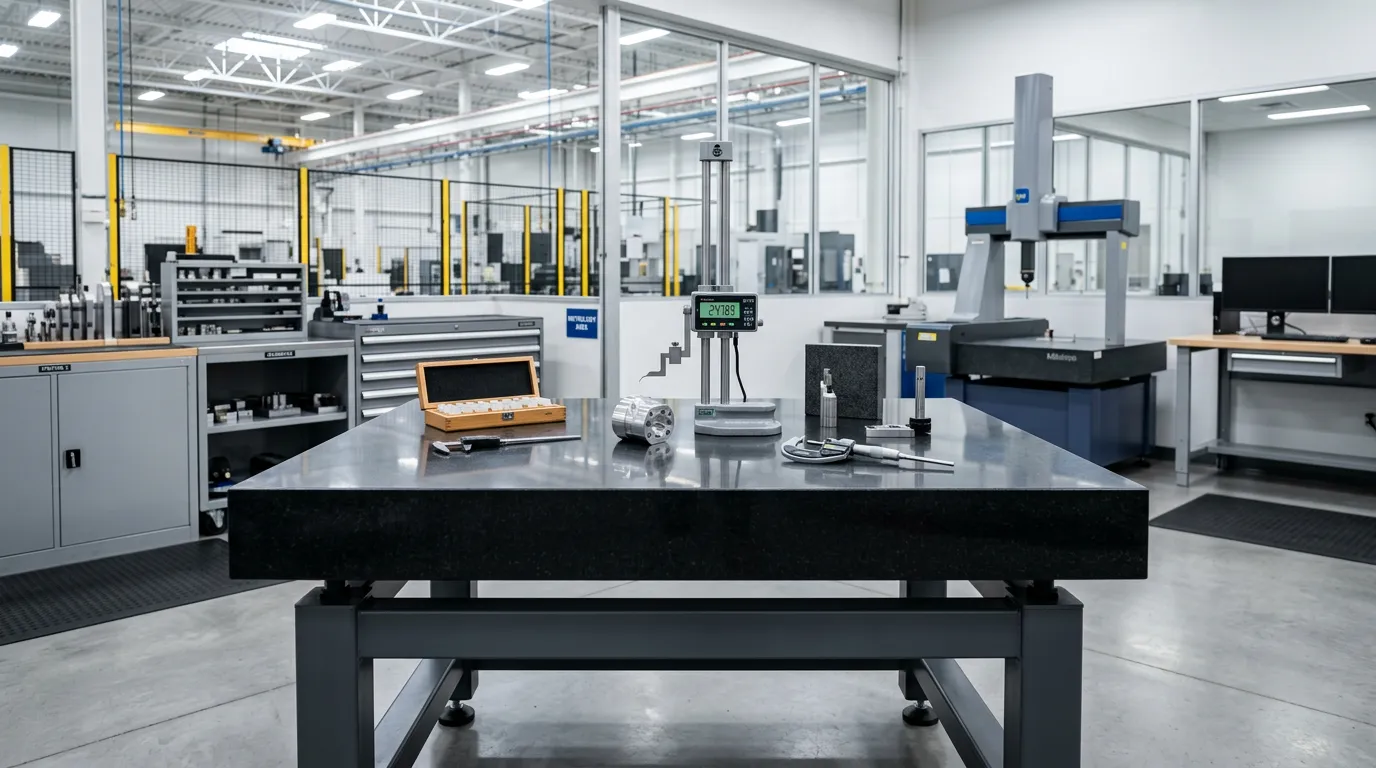
Precision Calibration for Granite Plates, Rockford
In Rockford, Illinois, on-site [granite surface plate calibration](/services/) is readily performed at client facilities. Services are backed by ISO/IEC 17025 accreditation, ensuring rigorous quality standards for flatness verification. Precision measurements are executed using advanced Hilger-Watts autocollimators, providing highly accurate data points across the plate surface.
The entire calibration process, including any necessary resurfacing, takes place at the customer’s location, removing the complexities of shipping. Contamination concerns are minimized through wet lap resurfacing techniques. Comprehensive, NIST-traceable certification documentation is supplied before the technician concludes the service.
The Rockford metropolitan area, situated in [Northern Illinois](/illinois-surface-plate-calibration/) within Winnebago County, has long been recognized for its robust manufacturing and industrial heritage. Its strategic location along major transportation corridors, including the I-90 corridor, connects it closely with the broader Midwest industrial landscape and the [Chicago metropolitan area](/chicago-surface-plate-calibration/). Facilities across this region, ranging from precision machining operations to heavy equipment fabrication, rely on highly accurate metrology to maintain product quality and operational efficiency. The continuous demand for precision in components and assemblies necessitates an unwavering commitment to the accuracy of foundational measurement equipment within these diverse industrial settings.
Central to many of these manufacturing processes are granite surface plates, serving as the primary reference plane for dimensional inspection and layout tasks. While exceptionally durable, these critical metrology tools are subjected to constant wear from repeated use, abrasive contact with workpieces, and the movement of gauging equipment. Over time, this wear causes minute deviations in a surface plate’s flatness, potentially compromising the integrity of measurements performed upon it. Periodic flatness verification, conducted to standards such as GGG-P-463C and ASME B89.3.7, is therefore indispensable to ensure ongoing compliance with specified Grade AA, A, or B tolerances and to uphold measurement confidence.
Maintaining the requisite accuracy of these measurement platforms involves [precision calibration and, when necessary, resurfacing](/services/). Calibration procedures are typically performed using advanced optical instruments like Hilger-Watts autocollimators, often employing techniques such as the Moody Method to generate a comprehensive flatness map detailing any deviations. Documentation provided following this service typically includes a calibration certificate confirming NIST traceability, along with a detailed flatness map displaying multiple data point measurements and a precise grade classification. For plates found to be out of tolerance, [wet lap resurfacing](/services/) is an available option that effectively restores flatness without generating airborne silica dust, mitigating environmental and health concerns.
For the busy industrial facilities operating in and around Rockford, [on-site calibration service](/services/) is a practical necessity. The logistical challenges and potential for damage associated with transporting large, heavy granite surface plates off-site are considerable. By bringing fully accredited services directly to the facility floor, downtime is minimized, and the continuity of critical inspection processes is maintained. Furthermore, the provision of same-day certification documentation ensures that a fully traceable record of calibration compliance is immediately available, supporting the efficient workflow and quality assurance protocols vital to the region’s manufacturing base.
Advantages for Rockford Metrology Teams
Broad Coverage, Efficient Booking
For industrial facilities within Rockford, Illinois, and the surrounding northern Illinois region, on-site granite surface plate calibration is available. Scheduling for these critical flatness verification procedures is typically arranged with expediency to support continuous operations.
Meeting ISO 17025, A2LA Standards
For industrial operations throughout Rockford, Illinois, granite surface plate calibrations are delivered under full ISO/IEC 17025 accreditation and A2LA certification, establishing direct traceability to NIST standards for all measurements.
Dust-Free Resurfacing for Accuracy
Out-of-tolerance granite surface plates are restored to their required flatness through wet lap resurfacing, a process that inherently eliminates the production of harmful airborne silica dust within Rockford manufacturing environments.
Frequently Asked Questions
What is the Moody Method, and how does it relate to surface plate calibration?
The Moody Method is a specific measurement grid pattern and calculation technique used in conjunction with an autocollimator for surface plate flatness verification. It involves taking angular measurements along diagonals and perimeter lines, allowing for the comprehensive assessment of the entire surface. This systematic approach ensures accurate flatness verification across the plate.
Is the Hilger-Watts autocollimator still used for surface plate measurements?
Yes, Hilger-Watts autocollimators remain a respected and effective instrument for surface plate measurements, despite the advent of newer technologies. Their robust design and optical precision continue to make them suitable for accurate angular deviation measurements. Modern digital autocollimators are also widely employed for convenience and data logging.
What are the advantages of granite over cast iron for surface plates?
Granite surface plates offer several advantages over cast iron, including greater dimensional stability due to a lower coefficient of thermal expansion and higher resistance to corrosion. Granite is non-magnetic, does not burr when damaged, and provides superior vibration dampening. These properties contribute to longer life and consistent accuracy.
Are steel surface plates ever used in precision metrology?
Steel surface plates are generally not preferred for high-precision metrology applications due to their susceptibility to rust, magnetic properties, and higher thermal expansion coefficient compared to granite. While they might be used for less critical layout work or as weldment tables, they do not offer the stability or accuracy required for precision calibration. Granite or cast iron is typically used for metrology-grade reference surfaces.