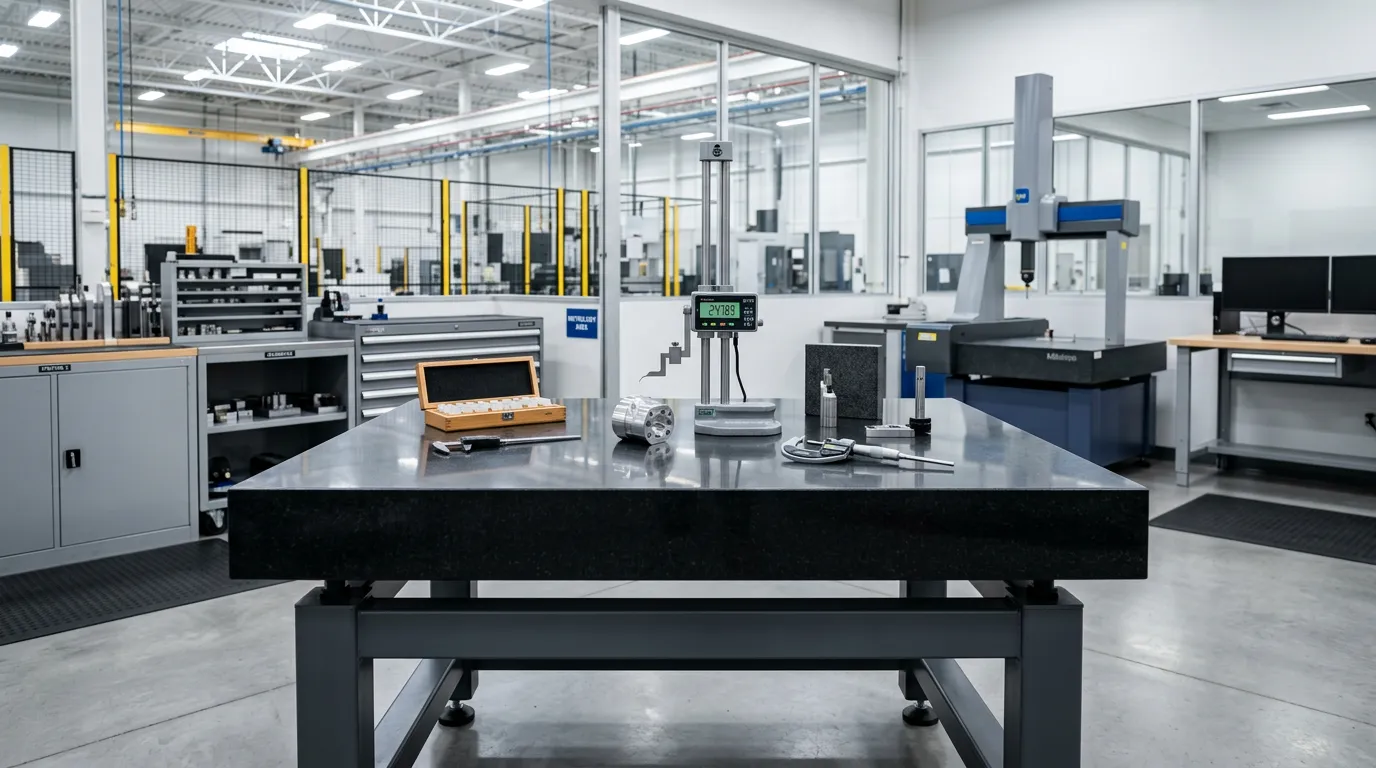
Schaumburg Calibration for Granite Inspection Plates
Granite surface plate calibration, accredited to ISO/IEC 17025 standards, is provided directly on-site throughout Schaumburg, [Illinois](/illinois-surface-plate-calibration/). This specialized service eliminates the logistical demands of shipping precision instruments, ensuring that critical measurement tools remain within the facility during the entire [calibration process](/services/). Flatness verification is meticulously performed using high-precision Hilger-Watts autocollimators, ensuring superior measurement accuracy.
For surface plates found outside acceptable Grade AA, A, or B tolerances, restoration is achieved through [wet lap resurfacing](/services/). This method not only restores compliance with specifications like GGG-P-463C and ASME B89.3.7 but also significantly reduces airborne silica dust. Comprehensive documentation, including a NIST-traceable calibration certificate and a detailed flatness map with data point measurements, is furnished before the technician’s departure, providing immediate verification.
Schaumburg, Illinois, nestled within Cook County and serving as a vital component of the broader [Chicago metropolitan industrial landscape](/chicago-surface-plate-calibration/), hosts a significant concentration of manufacturing and precision-oriented facilities. The region’s robust economic framework supports operations where dimensional accuracy and stringent quality control are not merely advantageous but fundamental. Sustaining the integrity of critical measurement infrastructure is therefore a perpetual necessity for the varied industrial enterprises situated throughout Schaumburg and its adjacent commercial areas, including facilities in nearby [Elk Grove Village](/elk-grove-village-surface-plate-calibration/).
At the heart of many of these exacting processes are granite surface plates, which serve as the foundational reference datum for verifying component dimensions and assembling precision parts. Consistent use, however, inevitably leads to localized wear, diminishing the plate’s intrinsic flatness over time. To uphold the uncompromising accuracy required for metrological confidence, regular flatness verification and calibration are indispensable. Adherence to recognized federal specifications such as GGG-P-463C and industry standards like ASME B89.3.7 is crucial for ensuring that these reference surfaces continue to meet specified Grade AA, A, or B tolerances.
For the busy industrial facilities operating across Schaumburg, the provision of on-site [surface plate calibration services](/services/) offers a distinct operational advantage. The logistical challenges and potential for damage associated with shipping heavy granite plates off-site are circumvented entirely. During these on-location procedures, flatness measurements are meticulously captured using precision instruments like Hilger-Watts autocollimators, often applying the rigorous Moody Method to ensure comprehensive data collection. Should a surface plate be found out of tolerance, wet lap resurfacing can be performed to restore its required accuracy, critically mitigating the generation of airborne silica dust, which is a significant health and cleanliness consideration for manufacturing environments.
Upon the conclusion of [calibration and any necessary resurfacing](/services/), comprehensive documentation is immediately furnished to the facility. This includes an official calibration certificate detailing NIST traceability, a thorough flatness map illustrating all measured data points, and the determined grade classification. The prompt issuance of these documents facilitates immediate compliance and operational continuity, reflecting the rigorous standards maintained through ISO/IEC 17025 accreditation and A2LA certification.
Why Schaumburg Manufacturers Choose Our Service
Servicing Your Area, Fast Turnaround
On-site granite surface plate calibration is scheduled efficiently for operations throughout Schaumburg and the Illinois industrial corridor, eliminating the need for plate transport and ensuring timely adherence to metrology standards.
NIST Traceable Accuracy Assurance
Granite surface plate calibrations for facilities within the Schaumburg area are executed to stringent ISO/IEC 17025 requirements. This ensures all documentation reflects A2LA accreditation and NIST traceability, affirming measurement integrity.
Precision Wet Lap Method Used
Precision wet lap resurfacing is employed for granite surface plates requiring flatness restoration within Schaumburg-area industrial settings. This technique effectively removes material to meet GGG-P-463C or ASME B89.3.7 specifications, critically avoiding the generation of hazardous silica dust during the process.
Frequently Asked Questions
How do temperature variations impact surface plate accuracy during calibration?
Temperature variations can significantly impact surface plate accuracy because granite expands and contracts with temperature changes. A non-uniform temperature across the plate can cause distortion, leading to inaccurate flatness measurements. Calibrations are typically performed within a controlled temperature range, often 68°F (20°C) ±1°F, to minimize thermal effects.
Why is vibration a concern during surface plate calibration?
Vibration is a significant concern during surface plate calibration because it can introduce inaccuracies into optical measurements taken with an autocollimator. Even slight vibrations can cause the reflected light beam to oscillate, making precise angular readings difficult or impossible. Stable, vibration-free environments are crucial for accurate results.
What role does humidity play in maintaining surface plate integrity?
Humidity plays a role in maintaining the integrity of surface plates primarily by preventing the formation of rust on precision tools and instruments used on the plate, which could then transfer contaminants. While granite itself is largely unaffected by humidity, high moisture levels can encourage mold growth or affect sensitive electronic measurement equipment. Maintaining stable humidity contributes to overall laboratory control.
What kind of documentation is provided after a surface plate calibration?
Following a surface plate calibration, a comprehensive calibration certificate is provided. This document details the measurement results, states conformance to relevant standards, and identifies the calibrated plate. It serves as official proof of the plate’s current accuracy status and includes references to NIST traceability.
What information is typically included on a calibration certificate?
A calibration certificate typically includes the plate’s identification (serial number, size), the environmental conditions during calibration, the specified tolerance grade, and the actual measured total flatness deviation. It also details the measurement method used (e.g., Moody Method with autocollimator), the calibration date, and the next due date. References to NIST traceability and ISO/IEC 17025 accreditation are also present.