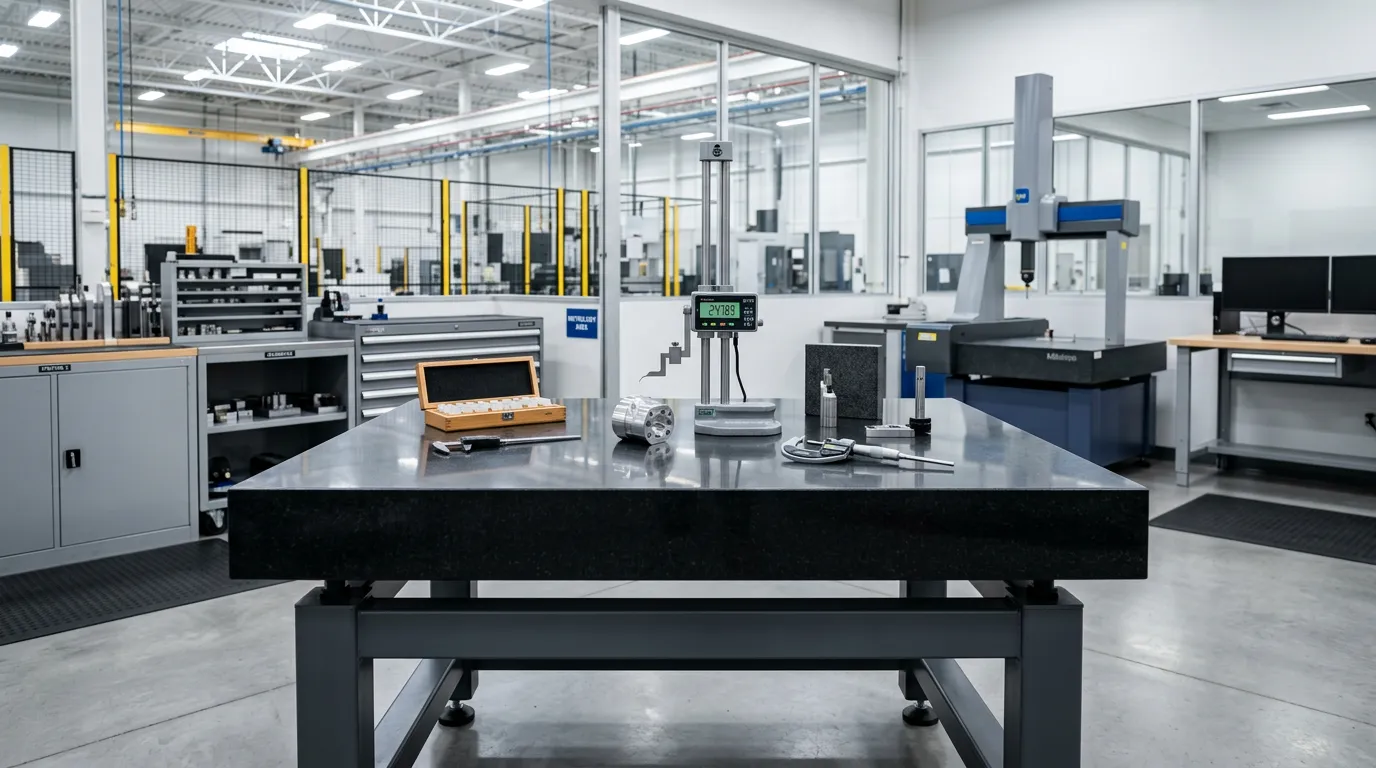
Granite Surface Plate Calibration in South Bend
Granite surface plate calibration services are performed directly at facilities throughout the South Bend, Indiana region. This on-site precision metrology work adheres to stringent ISO/IEC 17025 accreditation standards, ensuring the highest level of accuracy for critical measurement surfaces. Flatness verification is executed using advanced Hilger-Watts autocollimators, with results demonstrating compliance with federal specification GGG-P-463C and ASME B89.3.7.
Surface plates found to be outside established Grade AA, A, or B tolerances are restored through on-site wet lap resurfacing, a dust-free process that eliminates the need for shipping valuable metrology equipment. Comprehensive NIST-traceable documentation, including detailed flatness maps with data point measurements and an accredited calibration certificate, is issued directly on the day of service completion, providing immediate verification of compliance.
South Bend, situated in St. Joseph County, Indiana, maintains a notable industrial and manufacturing footprint, forming a critical part of the wider Michiana region’s economic landscape. Facilities throughout South Bend, Mishawaka, and extending towards Elkhart rely on precision measurement tools for quality control and operational integrity. The demanding nature of contemporary manufacturing processes within this corridor necessitates adherence to exacting metrological standards, where even minute deviations can compromise product quality and operational efficiency.
Central to many of these operations are granite surface plates, serving as the foundational reference plane for dimensional inspection and layout tasks. Through consistent daily use, surface plates are subject to wear, particularly around frequently utilized areas, which can lead to a gradual degradation of their critical flatness. This inevitable wear necessitates periodic flatness verification and plate calibration to ensure sustained accuracy. Without routine assessment, out-of-tolerance plates can introduce cumulative errors into downstream manufacturing and inspection processes, undermining the precision vital for conformance to specifications such as ASME B89.3.7 or GGG-P-463C.
To address this crucial need, on-site calibration services are deployed directly to manufacturing sites across the South Bend area, eliminating the logistical complexities and downtime associated with shipping large, heavy granite equipment. Calibrations are meticulously performed using high-precision autocollimators, often Hilger-Watts models, employing established techniques like the Moody Method to achieve highly accurate flatness measurements. During the service, a comprehensive calibration certificate is generated with NIST traceability, along with a detailed flatness map outlining data point measurements across the plate’s surface. Plates found to be outside specified Grade AA, A, B, or Laboratory tolerances can undergo wet lap resurfacing, a dust-free process that restores the plate to its required accuracy without generating airborne silica. This approach ensures A2LA accreditation to ISO/IEC 17025 standards, validating the integrity of every measurement and providing immediate, verifiable documentation for quality systems before the technician departs the facility.
Why South Bend Manufacturers Choose Our Service
Servicing Your Area, Fast Turnaround
On-site granite surface plate calibration services are promptly scheduled for facilities in South Bend and throughout Indiana’s manufacturing corridors, ensuring minimal operational disruption for precise flatness verification and grade classification.
NIST Traceable Accuracy Assurance
For facilities in South Bend, Indiana, surface plate calibration results are supported by ISO/IEC 17025 accreditation and A2LA certification. All flatness verification and grade classifications are established with NIST traceability, ensuring metrological integrity.
Precision Wet Lap Method Used
For South Bend’s precision manufacturing sector, granite surface plate flatness is precisely restored through the wet lap resurfacing process. This advanced technique completely eliminates the release of airborne silica dust, a significant advantage over conventional dry methods.
Frequently Asked Questions
What is the primary method for verifying the accuracy of a master straightedge used in surface plate calibration?
The accuracy of a master straightedge is typically verified through calibration against an even higher-level standard, such as a laser interferometer or a reference flat. This involves measuring its deviations from true straightness along its length. The straightedge’s flatness is confirmed in an environmentally controlled setting, ensuring its suitability as a reference for surface plate measurements.
How do concentrated loads and improper loading techniques contribute to localized wear and flatness deviations?
Concentrated loads, such as placing heavy instruments repeatedly in the same spot, cause accelerated wear in those specific areas. Improper loading techniques, like dragging heavy workpieces, can also create grooves or depressions. These actions lead to localized flatness deviations, which can significantly compromise the accuracy of measurements taken on those affected plate regions.
When performing on-site calibration, what measures are taken to ensure the security and protection of proprietary client information?
All calibration personnel are trained to maintain strict confidentiality regarding client operations and proprietary information encountered during on-site visits. Documentation and data are handled securely, ensuring that sensitive details are protected from unauthorized access or disclosure. Ethical guidelines and non-disclosure agreements are adhered to as standard practice.
What are the implications of choosing a calibration laboratory that lacks A2LA accreditation for surface plate services?
Choosing a non-accredited laboratory introduces a higher risk of inaccurate or unreliable calibration results. Without A2LA accreditation, there is no independent third-party verification of the laboratory’s technical competence, quality management system, or NIST traceability. This can lead to questions regarding the validity of measurement results, potentially impacting quality assurance, regulatory compliance, and product quality.
What is the practical impact of the differing overall flatness tolerances between a Grade A and a Grade B surface plate on typical measurements?
The practical impact lies in the level of measurement uncertainty achievable. A Grade A plate, with tighter overall flatness tolerances, supports more precise measurements and reduces potential errors when gauging critical dimensions. A Grade B plate, having larger tolerances, is suitable for less stringent applications where minor flatness deviations will not critically affect product quality.