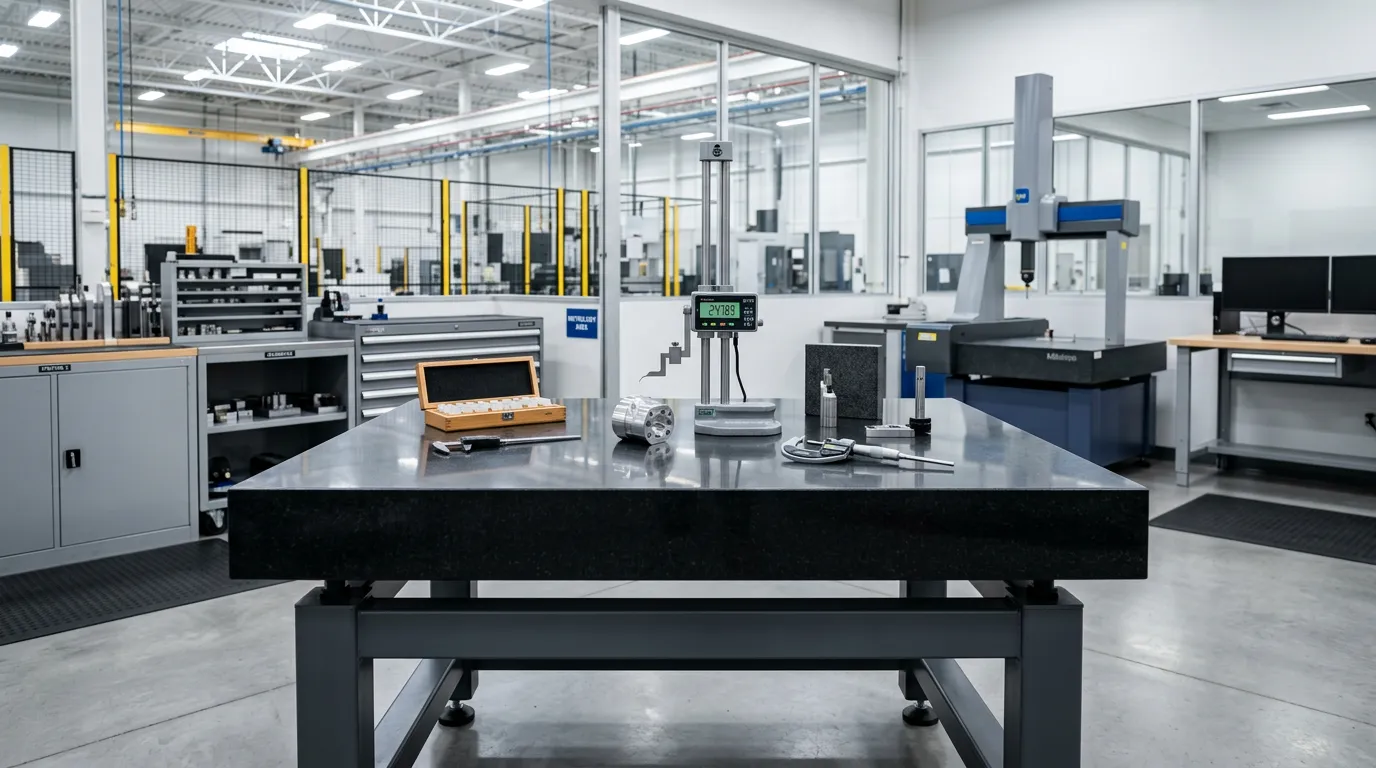
Maintain Flatness: St. Louis Calibration
Throughout St. Louis, Missouri, on-site [granite surface plate calibration](/services/) is performed with ISO/IEC 17025 accredited methods. Precision flatness verification is achieved using Hilger-Watts autocollimators, ensuring accurate measurements directly within the facility. This approach eliminates the logistical challenges and risks associated with shipping large, sensitive metrology equipment.
Service is conducted entirely at the client’s site, negating the need for off-site transportation. Should a plate fall outside specified Grade AA, A, or B tolerances, [wet lap resurfacing](/services/) is employed to restore its precision, effectively removing material without generating silica dust. Comprehensive certification documentation, including NIST traceability, is issued immediately upon completion of the calibration or resurfacing process.
The [St. Louis metropolitan area](/missouri-surface-plate-calibration/), encompassing communities throughout St. Louis County and extending into St. Charles County, hosts a significant and diverse industrial footprint. Manufacturing facilities within this strategic Midwest hub rely heavily on foundational metrology equipment for quality assurance and precision production. Within these operations, granite surface plates serve as critical reference planes for dimensional inspection and layout tasks. The consistent accuracy of these plates is paramount for maintaining product integrity across various sectors, necessitating rigorous adherence to established [surface plate calibration protocols](/services/).
Over time, the constant use of surface plates leads to wear and localized deflections, compromising their inherent flatness and subsequently affecting measurement reliability. Such degradation necessitates periodic [flatness verification and calibration](/services/) to standards like GGG-P-463C or ASME B89.3.7. For St. Louis-based operations, on-site calibration services circumvent the logistical challenges and downtime associated with shipping large, heavy metrology equipment. This approach allows for minimal disruption to workflow, ensuring that critical production schedules across the region’s industrial corridors remain uninterrupted while upholding metrological integrity.
Precision [granite plate calibration](/missouri-surface-plate-calibration/) in facilities throughout the St. Louis area is performed utilizing advanced instrumentation, including Hilger-Watts autocollimators, following methodologies such as the Moody Method. This process yields a comprehensive flatness map, documenting data point measurements and providing a precise grade classification—whether Grade AA, A, B, or Laboratory—indicating compliance with specified tolerances. Where surface plates are found to be out of tolerance, on-site wet lap resurfacing is available. This technique restores the plate’s critical flatness without generating airborne silica dust, a significant advantage for maintaining facility air quality and operator safety.
Upon completion of calibration and any necessary resurfacing, comprehensive documentation is provided. This includes an [ISO/IEC 17025 accredited calibration certificate](/services/), complete with NIST traceability, ensuring all measurements meet national standards. This immediate provision of verifiable results is crucial for St. Louis facilities requiring prompt evidence of metrological compliance for audits or quality system maintenance. Such services collectively support the region’s manufacturing excellence by ensuring the foundational accuracy of its metrology infrastructure.
Improving Precision for St. Louis Industry
Fast Scheduling Across St. Louis, Missouri
For manufacturing and quality control operations in St. Louis and throughout Missouri, on-site granite surface plate calibration is promptly arranged, negating the requirement for equipment shipping and reducing operational interruption.
Certified to A2LA, Traceable to NIST
Granite surface plate calibration in St. Louis is conducted under strict adherence to ISO/IEC 17025 accreditation requirements. This practice ensures all flatness verification procedures yield A2LA certified and NIST traceable measurements.
Wet Lap: Optimal Flatness Restoration
Wet lap resurfacing is performed on-site for St. Louis area industrial clients to restore granite surface plates to their specified Grade AA, A, or B tolerances. This precision process completely prevents the generation of silica dust, maintaining facility air quality during flatness restoration.
Frequently Asked Questions
How can warping or deflection be minimized during long-term storage of a granite surface plate?
The plate should be stored on its designated support system or a stable, level surface, avoiding cantilevered edges or uneven support. Covering it with a non-abrasive, breathable material also helps protect against dust and temperature fluctuations without trapping moisture.
What aspects of granite composition does GGG-P-463C specify for surface plates?
GGG-P-463C outlines requirements for specific properties of the granite material itself, such as density, modulus of elasticity, and water absorption. These characteristics ensure the plate possesses the necessary hardness, stability, and resistance to wear for metrological applications.
How does ASME B89.3.7 address local area flatness in addition to overall flatness?
ASME B89.3.7 specifies a separate tolerance for local area flatness, often referred to as “repeat reading” or “gauge block flatness.” This ensures that small, critical working areas on the plate maintain a high degree of precision, preventing localized deviations that could affect specific measurements.
What is the relationship between a surface plate’s tolerance grade and its acceptable repeat reading deviation?
The specified tolerance grade (e.g., AA, A, B) directly dictates the permissible repeat reading deviation. Higher grades, such as Grade AA, have significantly tighter tolerances for repeat reading, reflecting their requirement for extreme precision in localized measurements.