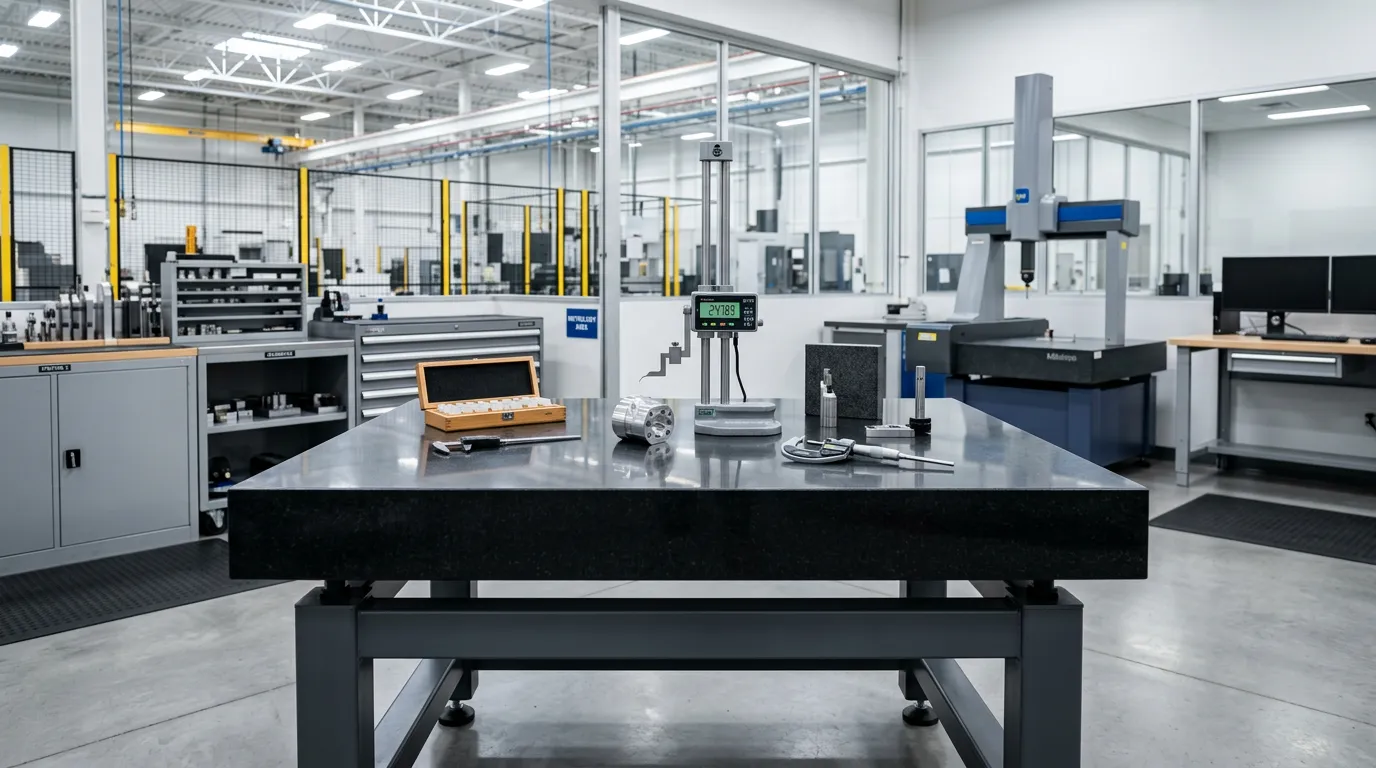
Precision Calibration for Granite Plates, St. Paul
For manufacturing and metrology operations throughout St. Paul, [Minnesota](/minnesota-surface-plate-calibration/), ISO/IEC 17025 accredited [surface plate calibration services](/services/) are delivered directly on-site. This methodology ensures that critical granite surface plates, vital for precision measurement, remain within their operational environment, thereby eliminating the logistical complexities and potential risks associated with off-site shipping.
Flatness verification is achieved through the meticulous application of Hilger-Watts autocollimators, producing NIST-traceable results compliant with standards like GGG-P-463C and ASME B89.3.7. Should a plate fall outside its designated Grade AA, A, or B tolerances, [wet lap resurfacing](/services/) is performed at the facility. Comprehensive certification documentation is issued immediately upon completion of services.
The robust manufacturing and industrial sectors across St. Paul, situated within Ramsey County and the broader [Twin Cities metropolitan area](/minneapolis-surface-plate-calibration/), frequently rely on foundational metrology tools for precision fabrication and quality control. Throughout the industrial corridors adjacent to the Mississippi River and along key transportation routes such as I-94, operations depend on equipment that delivers unwavering accuracy. Granite surface plates serve as critical reference planes in these environments, providing a stable, precise base for measurement and inspection tasks. Sustaining the integrity of these essential instruments is paramount, ensuring that the dimensional measurements taken reflect true values and uphold stringent production standards.
Daily operational demands in St. Paul’s diverse facilities subject granite surface plates to continuous wear, gradually compromising their flatness and parallelism. Over time, this cumulative use can lead to deviations from specified tolerances, directly impacting the accuracy of subsequent measurements. Regular flatness verification is therefore indispensable for maintaining the operational reliability of these precision tools. Utilizing advanced techniques, such as the Moody Method with Hilger-Watts autocollimators, enables precise assessment of surface plate condition. Adherence to industry standards like GGG-P-463C and ASME B89.3.7 is maintained, ensuring that any detected irregularities are accurately quantified and addressed.
For organizations located in St. Paul and the surrounding regional hubs, [on-site calibration services](/services/) offer significant logistical advantages. This approach eliminates the complexities and risks associated with shipping large, delicate granite plates off-site, thereby minimizing downtime and preserving critical operational continuity. Technicians performing the service directly at the client’s facility allows for seamless integration into existing workflows, reducing disruption to production schedules. Upon completion of the calibration or resurfacing process, comprehensive documentation is provided on the same day, including a detailed calibration certificate with NIST traceability and an exhaustive flatness map outlining data point measurements.
Accredited [calibration services](/services/) deliver verifiable assurance of metrological accuracy. Each calibrated surface plate receives an A2LA-accredited, ISO/IEC 17025 compliant certificate, clearly indicating its new grade classification—whether Grade AA, A, or B—following the flatness verification. Should a surface plate be found out of tolerance, [resurfacing](/services/) is performed to restore its original precision, ensuring it meets required specifications. This resurfacing procedure employs a wet lap technique, effectively eliminating silica dust commonly associated with traditional dry grinding methods, thereby maintaining a cleaner and safer work environment within the client’s facility.
Advantages for St. Paul Metrology Teams
Statewide Service, Prompt Calibration
On-site granite surface plate calibration services are routinely dispatched across Minnesota, including the St. Paul metropolitan area, facilitating prompt scheduling and removing the necessity for plate shipment.
A2LA Certified, NIST Traceable Calibration
Calibrations performed throughout St. Paul, Minnesota, demonstrate A2LA certification to ISO/IEC 17025, validating the technical competence and impartiality of measurement results. All reported flatness verifications and grade classifications are established with direct NIST traceability, providing an unbroken chain of comparison to national standards.
Silica-Free Wet Lap Resurfacing
Precision flatness restoration for granite surface plates in St. Paul, Minnesota, is accomplished via wet lap resurfacing. This technique inherently prevents the generation of airborne silica dust, safeguarding air quality within industrial workspaces.
Frequently Asked Questions
What is the role of the master straightedge in ensuring NIST traceability for surface plate flatness verification?
The master straightedge serves as a primary transfer standard for flatness measurements, being itself calibrated to NIST-traceable standards. Its precisely known straightness is used as a reference during the autocollimator measurements to establish the flatness of the surface plate. This ensures the accuracy of the overall flatness verification.
How does A2LA accreditation benefit clients seeking surface plate calibration services?
A2LA accreditation provides assurance to clients that the calibration laboratory operates under a rigorous quality system and possesses demonstrated technical competence. This reduces client risk by confirming that the calibration results are reliable, impartial, and globally recognized. It signifies adherence to international standards like ISO/IEC 17025.
Should a granite surface plate be completely unloaded before calibration commences?
Yes, a granite surface plate should be completely unloaded before calibration to prevent any deflection or localized stresses caused by measurement equipment or workpieces. The surface should be free of all items to ensure an accurate assessment of its inherent flatness. Any load can introduce temporary or permanent distortions.
What are the consequences of storing a granite surface plate in an unstable temperature environment?
Storing a granite surface plate in an unstable temperature environment can lead to thermal stress and potential distortions. Repeated expansion and contraction cycles can negatively impact the plate’s long-term flatness retention and calibration stability. This can necessitate more frequent recalibrations or resurfacing.
What role does a grid pattern play in the Moody Method of surface plate calibration?
A precisely established grid pattern on the surface plate guides the placement of the autocollimator and mirror during Moody Method calibration. This grid ensures systematic coverage of the plate’s entire surface, allowing for accurate integration of localized slope measurements to derive the overall flatness profile. Each point on the grid is a critical data acquisition location.
How does the criticality of parts being measured influence the required calibration interval for a surface plate?
The criticality of parts being measured directly dictates the stringency of the surface plate’s calibration interval. If the plate is used for highly critical components with tight tolerances, a shorter calibration frequency is typically mandated to minimize measurement risk. This ensures the plate’s accuracy remains verified for demanding applications.