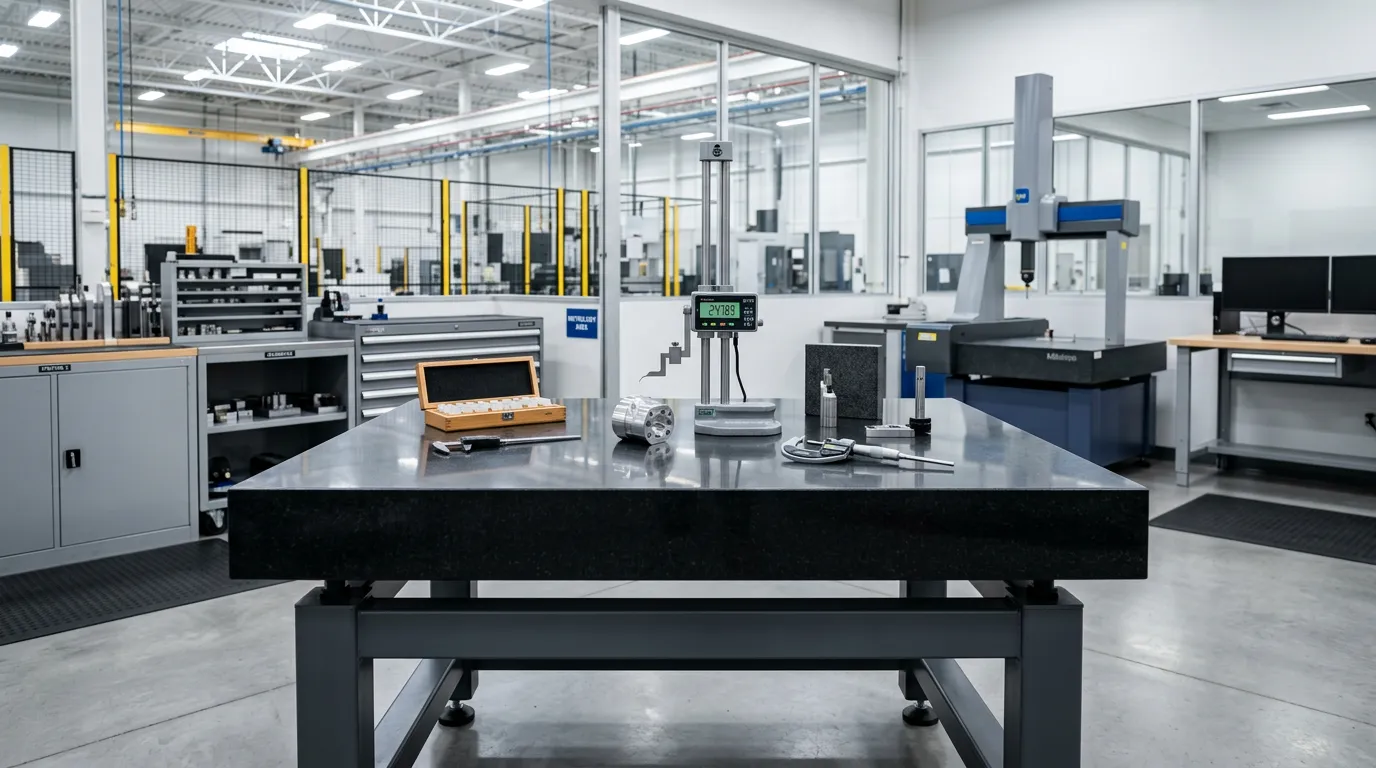
Expert Surface Plate Calibration, Waukesha
[Granite surface plate calibration](/services/), including flatness verification and resurfacing, is performed on-site throughout the Waukesha, [Wisconsin area](/wisconsin-surface-plate-calibration/). This ISO/IEC 17025 accredited service ensures precise metrology standards are maintained directly at the client’s facility, eliminating the logistical burden and downtime associated with shipping large plates.
Utilizing advanced Hilger-Watts autocollimators and the Moody Method, accurate measurements are obtained for NIST traceability. Furthermore, out-of-tolerance plates benefit from [wet lap resurfacing](/services/), which effectively restores critical flatness without generating airborne silica dust. All necessary certification documentation is provided before the technician departs the site on the same day.
Waukesha County, a key component of the greater [Milwaukee metropolitan area](/milwaukee-surface-plate-calibration/), sustains a robust manufacturing and industrial landscape. Along the I-94 corridor and throughout cities such as Brookfield, New Berlin, and Pewaukee, numerous facilities are engaged in producing components and assemblies where precision is paramount. The regional economy has long relied on its diversified industrial base, necessitating stringent quality control and accurate measurement capabilities in daily operations.
Within these demanding environments, granite surface plates serve as fundamental reference planes for dimensional inspection and layout tasks. Constant use and the placement of heavy workpieces inevitably lead to localized wear, diminishing a plate’s flatness over time. To ensure continued adherence to specifications like GGG-P-463C and ASME B89.3.7, [periodic flatness verification](/services/) becomes essential. Without precise calibration, the accuracy of critical measurements can be compromised, potentially impacting product quality and operational efficiency across various manufacturing processes.
The logistical challenges associated with shipping heavy, delicate surface plates off-site for calibration can disrupt production schedules significantly. Therefore, [on-site calibration services](/services/) are crucial for Waukesha’s industrial entities. Such services allow facilities to maintain operational continuity, as the work is performed directly within the metrology department. Verification procedures, often utilizing high-precision autocollimators and the Moody Method, are conducted with minimal interruption, with detailed certification documentation provided before the technician departs. This includes a flatness map and an updated Grade classification, such as AA, A, or B, ensuring NIST traceability and compliance with ISO/IEC 17025 accreditation standards. Wet lap resurfacing, when required to restore out-of-tolerance plates, can also be performed on-site, effectively eliminating airborne silica dust and maintaining a clean working environment.
Improving Precision for Waukesha Industry
Extensive Coverage, Rapid Scheduling
On-site calibration for surface plates serving Waukesha, Wisconsin, and surrounding industrial corridors is scheduled with efficiency, eliminating the need for equipment transport and associated logistical delays.
A2LA Certification for Precision
Calibration services provided for facilities across Waukesha and the surrounding Wisconsin region strictly adhere to ISO/IEC 17025 accreditation standards. All measurement results are A2LA certified and directly traceable to NIST, ensuring robust metrological integrity for all flatness verifications.
Enhanced Flatness, No Silica Dust
Out-of-tolerance granite surface plates in Waukesha are restored using wet lap resurfacing, a precision method that re-establishes required flatness grades without generating airborne silica dust.
Frequently Asked Questions
What is the underlying principle by which NIST traceability assures the accuracy of surface plate measurements?
NIST traceability ensures accuracy by establishing an unbroken chain of comparisons to national measurement standards, each comparison having a stated uncertainty. For surface plates, this means the instruments used for calibration, such as autocollimators and master straightedges, have themselves been calibrated against higher-level standards ultimately traceable to NIST. This chain provides confidence in the accuracy of the flatness verification.
What specific requirements does ISO/IEC 17025 accreditation impose on a calibration laboratory’s quality management system?
ISO/IEC 17025 mandates stringent requirements for a laboratory’s quality management system, including documentation of procedures, personnel competence, proper environmental conditions, valid calibration methods, and control of non-conforming work. Adherence to these standards, often demonstrated through A2LA accreditation, provides assurance of the technical competence and reliability of calibration results for clients.
Why is the use of non-abrasive, residue-free cleaning agents critical for granite surface plates?
Non-abrasive, residue-free cleaning agents are crucial to prevent damage to the finely lapped surface of the granite plate. Abrasives can create micro-scratches, while residues can alter the surface properties and compromise subsequent precision measurements. Proper cleaning maintains the plate’s integrity and accuracy.
What types of materials are unsuitable for covering a granite surface plate during storage?
Materials that are abrasive, shed lint, or trap moisture are unsuitable for covering a granite surface plate. These can either scratch the surface, leave particles that compromise cleanliness, or create a corrosive environment, all of which can degrade the plate’s precision over time.